
Thymic Stromal Lymphopoietin (TSLP) was originally identified as an activity from the conditioned medium of a mouse thymic stromal cell line that promoted the development of B cells. The activities of mouse TSLP overlap with, but are distinct from, those of mouse IL-7. Both mouse TSLP and IL-7 can co-stimulate growth of thymocytes and mature T cells, and support B lymphopoiesis in long-term cultures of fetal liver cells and bone-marrow cells. Whereas mouse IL-7 facilitates the development of B220+/IgM- pre-B cells, mouse TSLP promotes the development B220+/IgM+ B cells. Human TSLP was reported to preferentially stimulate myeloid cells; inducing the release of T cell-attracting chemokines from monocytes and enhancing the maturation of CD11c+ dendritic cells. Mouse TSLP cDNA encodes a 140 amino acid (aa) residue precursor protein with a 19 aa signal sequence. Within the mature region, there are three potential N-glycosylation sites and 7 cysteine residues. Mouse TSLP shares approximately 43% aa sequence identity with human TSLP. The gene for mouse TSLP has been localized to chromosome 18. By Northern and RT-PCR analysis, mouse TSLP expression has been detected in spleen, thymus, kidney, lung and bone marrow. TSLP is proposed to signal through a heterodimeric receptor complex that consists of IL-7 R alpha and the TSLP R, a new member of the hemopoietin receptor family most closely related to R gamma c.


Key Product Details
- R&D Systems NS0-derived Recombinant Mouse TSLP Protein (555-TS)
- Quality control testing to verify active proteins with lot specific assays by in-house scientists
- All R&D Systems proteins are covered with a 100% guarantee
Source
Accession Number
Applications
Product Specifications
Source
Tyr20-Glu140, with a C-terminal 10-His tag
Purity
Endotoxin Level
N-terminal Sequence Analysis
Predicted Molecular Mass
SDS-PAGE
Activity
The ED50 for this effect is 0.5-2.5 ng/mL.
Reviewed Applications
Read 6 reviews rated 3.8 using 555-TS in the following applications:
Formulation, Preparation, and Storage
Carrier Free
What does CF mean?CF stands for Carrier Free (CF). We typically add Bovine Serum Albumin (BSA) as a carrier protein to our recombinant proteins. Adding a carrier protein enhances protein stability, increases shelf-life, and allows the recombinant protein to be stored at a more dilute concentration. The carrier free version does not contain BSA.
What formulation is right for me?In general, we advise purchasing the recombinant protein with BSA for use in cell or tissue culture, or as an ELISA standard. In contrast, the carrier free protein is recommended for applications, in which the presence of BSA could interfere.
Carrier: 555-TS
| Formulation | Lyophilized from a 0.2 μm filtered solution in PBS with BSA as a carrier protein. |
| Reconstitution | Reconstitute at 100 μg/mL in sterile PBS containing at least 0.1% human or bovine serum albumin. |
| Shipping | The product is shipped at ambient temperature. Upon receipt, store it immediately at the temperature recommended below. |
| Stability & Storage | Use a manual defrost freezer and avoid repeated freeze-thaw cycles.
|
Carrier Free: 555-TS/CF
| Formulation | Lyophilized from a 0.2 μm filtered solution in PBS. |
| Reconstitution | Reconstitute at 100 μg/mL in sterile PBS. |
| Shipping | The product is shipped at ambient temperature. Upon receipt, store it immediately at the temperature recommended below. |
| Stability & Storage | Use a manual defrost freezer and avoid repeated freeze-thaw cycles.
|
Calculators
Background: TSLP
References
- Sims, J.E. et al. (2000) J. Exp. Med. 192:671.
- Park, L.S. et al. (2000) J. Exp. Med. 192:659.
- Pandey, A. et al. (2000) Nature Immunol. 1:59.
- Reche, P.A. et al. (2001) J. Immunol. 167:336.
Long Name
Alternate Names
Gene Symbol
UniProt
Additional TSLP Products
Product Documents for Recombinant Mouse TSLP Protein
Certificate of Analysis
To download a Certificate of Analysis, please enter a lot or batch number in the search box below.
Note: Certificate of Analysis not available for kit components.
Product Specific Notices for Recombinant Mouse TSLP Protein
For research use only
Citations for Recombinant Mouse TSLP Protein
 Powered by Bioz
Customer Reviews for Recombinant Mouse TSLP Protein (6)
Have you used Recombinant Mouse TSLP Protein?
Submit a review and receive an Amazon gift card!
$25/€18/£15/$25CAN/¥2500 for a review with an image
$10/€7/£6/$10CAN/¥1110 for a review without an image
Submit a review
Customer Images

-
Application: In vivo studyVerified Customer | Posted 07/23/2022
-
Application: In vivo studyVerified Customer | Posted 11/13/2019
-
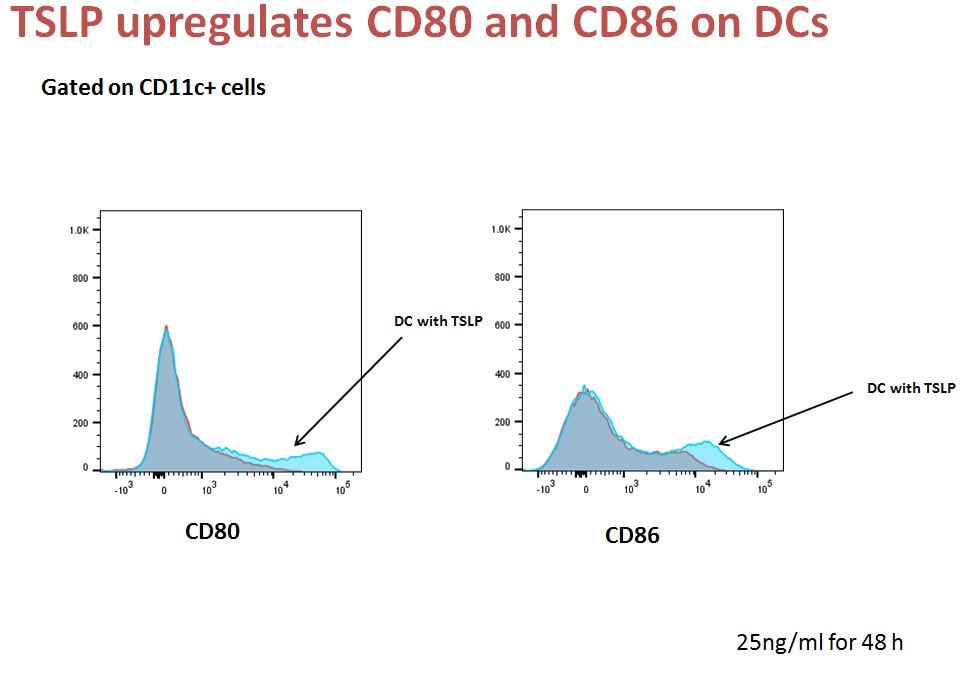
Application: In vitro bioactivity in cell cultureVerified Customer | Posted 12/07/2018TSLP upregulates CD80 and CD86 expression in BM-derived DCs

-
Application: In vivo studyVerified Customer | Posted 01/05/2018
-
Application: MassSpecVerified Customer | Posted 12/18/2017
-
Application: In vitro bioactivity in cell cultureVerified Customer | Posted 12/06/2017
There are no reviews that match your criteria.
FAQs for Recombinant Mouse TSLP Protein
-
Q: Is Recombinant Mouse TSLP Protein (Catalog # 555-TS) the short or long isoform?
A: Mouse TSLP is considered to be an ortholog of human long TSLP (Fornasa et al., 2015). However, TSLP variants in mice are currently uncertain as a murine short TSLP variant has not been described or annotated in Reference Sequence so far (Bjerkan et al., 2016).
Associated Pathways
