
Recombinant S. marcescens NucA nuclease Protein, CF
R&D Systems | Catalog # 10038-NA

Key Product Details
- Recombinant NucA Protein supports enzymatic and antibacterial therapeutic research applications.
- R&D Systems E. coli-derived Recombinant S. marcescens NucA nuclease Protein (10038-NA)
- Quality control testing to verify active proteins with lot specific assays by in-house scientists
- All R&D Systems proteins are covered with a 100% guarantee
Source
Accession Number
Applications
Product Specifications
Source
Met1-Asn266
Purity
Predicted Molecular Mass
SDS-PAGE
Activity
The specific activity is >130,000 pmol/min/ug, as measured under the described conditions.
Reviewed Applications
Read 2 reviews rated 4.5 using 10038-NA in the following applications:
Scientific Data Images for Recombinant S. marcescens NucA nuclease Protein, CF
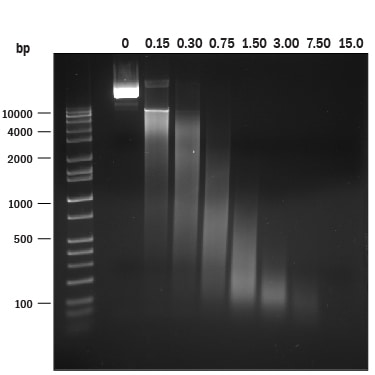
NucA nuclease Digestion of DNA.
2 μg plasmid DNA was incubated with increasing amounts (ng/mL) of RecombinantS. marcescensNucA nuclease (Catalog # 10038-NA) in 50 mM Tris (pH 8.0) and 1 mM MgCl2 for 30 minutes at room temperature. Samples were analyzed by agarose gel electrophoresis and DNA was visualized by ethidium bromide staining.Formulation, Preparation, and Storage
10038-NA
| Formulation | Supplied as a 0.2 μm filtered solution in Tris and NaCl. |
| Shipping | The product is shipped with dry ice or equivalent. Upon receipt, store it immediately at the temperature recommended below. |
| Stability & Storage | Use a manual defrost freezer and avoid repeated freeze-thaw cycles.
|
Background: NucA nuclease
References
- Benedik, MJ and Strych, U. (1998) FEMS Microbiol Lett. 165:1.
- Nestle, M, et al. (1999) J. Biol. Chem. 274:825.
- Ball, T.K. et al. (1992) Nucleic Acids Res. 20:4971.
- Wu, Z.L. et al. (2011) Glycobiology 21:727.
- Van Veldhoven, P.P. and G.P. Mannaerts (1987) Anal. Biochem. 161:45.
Long Name
Alternate Names
Entrez Gene IDs
Gene Symbol
UniProt
Additional NucA nuclease Products
Product Documents for Recombinant S. marcescens NucA nuclease Protein, CF
Certificate of Analysis
To download a Certificate of Analysis, please enter a lot or batch number in the search box below.
Note: Certificate of Analysis not available for kit components.
Product Specific Notices for Recombinant S. marcescens NucA nuclease Protein, CF
Benzonase® is a registered trademark of Merck KGaA Corporation. Bio-Techne Corporation and its affiliates, and their respective products and services, are not sponsored, endorsed, or approved by Merck KGaA.
For research use only
Customer Reviews for Recombinant S. marcescens NucA nuclease Protein, CF (2)
Have you used Recombinant S. marcescens NucA nuclease Protein, CF?
Submit a review and receive an Amazon gift card!
$25/€18/£15/$25CAN/¥2500 for a review with an image
$10/€7/£6/$10CAN/¥1110 for a review without an image
Submit a review
Customer Images
-
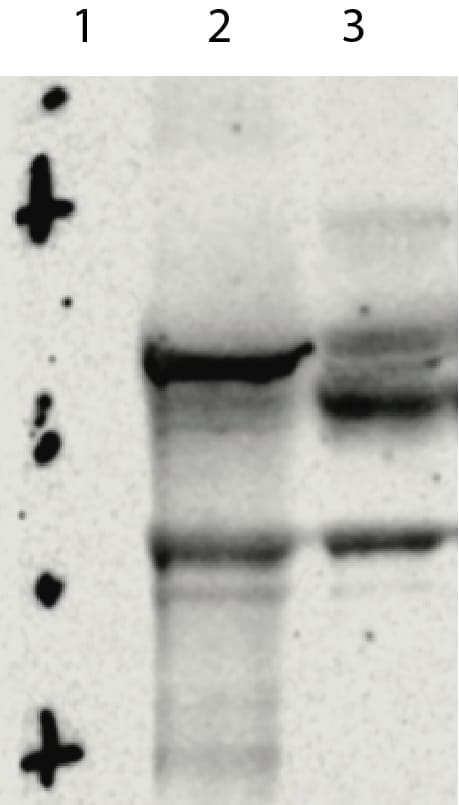
Application: SDS-PAGE ControlVerified Customer | Posted 08/25/20221. Ladder 2. Sample without NucA 3. Sample with NucA

-
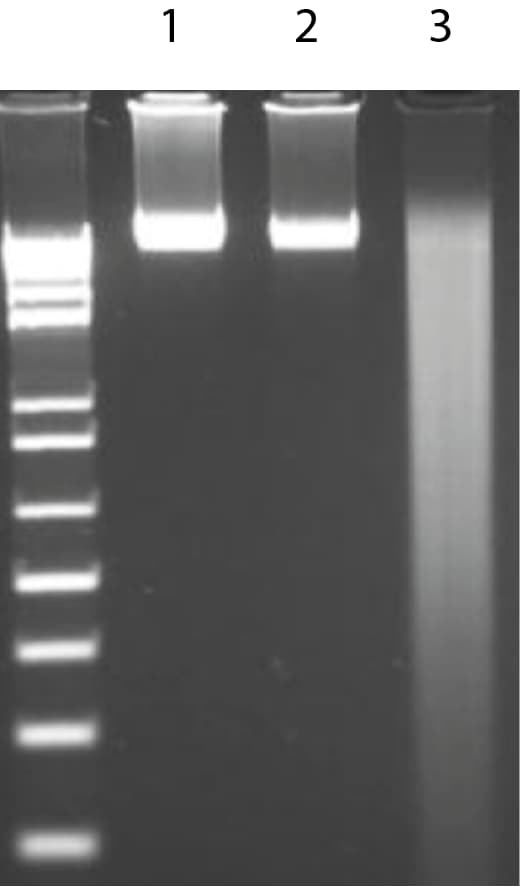
Application: Agarose gelVerified Customer | Posted 08/25/20221. Plasmid control 2. Plasmid control in buffer 3. Plasmid with nuclease in buffer
There are no reviews that match your criteria.
Protocols
View specific protocols for Recombinant S. marcescens NucA nuclease Protein, CF (10038-NA):
- Assay Buffer: 100 mM Tris, 1 mM MgCl2, pH 8.5
- rS.marcescens NucA (Catalog # 10038-NA)
- Deoxyribonucleic acid (DNA) sodium salt from salmon testes (Millipore Sigma, Catalog # D1626), 5 mg/mL stock in deionized water
- Coupling Enzyme: Recombinant Mouse Alkaline Phosphatase/ALPL (rmALPL) (Catalog # 2910-AP)
- Malachite Green Phosphate Detection Kit (Catalog # DY996)
- 96-well Clear Plate (Catalog # DY990)
- Plate Reader (Model: SpectraMax Plus by Molecular Devices) or equivalent
- Dilute 1 M Phosphate Standard by adding 10 µL of the 1 M Phosphate Standard to 990 µL of Assay Buffer for a 10 mM stock. Continue by adding 10 µL of the 10 mM Phosphate stock to 990 µL of Assay Buffer for a 100 µM stock. This is the first point of the standard curve.
- Complete the standard curve by performing six one-half serial dilutions of the 100 µM Phosphate stock in Assay Buffer. The standard curve has a range of 0.078 to 5 nmol per well.
- Prepare a reaction mixture containing 0.16 mg/mL DNA and 4 µg/mL rmALPL in Assay Buffer.
- Dilute rS. marcescens NucA to 4 ng/mL in Assay Buffer.
- Load 50 µL of each dilution of the standard curve into a plate. Include a curve blank containing 50 μL of Assay Buffer.
- Load 25 µL of 4 ng/mL rS. marcescens NucA into empty wells of the same plate as the curve. Include a Control containing 25 µL of Assay Buffer.
- Add 25 µL of reaction mixture to the wells, excluding the standard curve.
- Seal plate and incubate at room temperature for 20 minutes.
- Add 30 µL of the Malachite Green Reagent A to all wells. Mix briefly.
- Add 100 µL of deionized water to all wells. Mix briefly.
- Add 30 µL of the Malachite Green Reagent B to all wells. Mix and incubate for 20 minutes at room temperature.
- Read plate at 620 nm (absorbance) in endpoint mode.
- Calculate specific activity:
Specific Activity (pmol/min/µg) = | Phosphate released* (nmol) x (1000 pmol/nmol) |
| Incubation time (min) x amount of enzyme (µg) |
*Derived from the phosphate standard curve using linear or 4-parameter fitting and adjusted for Control.
Per Reaction:
- rS. marcescens NucA: 0.1 ng (0.0001 µg)
- rmALPL: 0.1 µg
- DNA: 4 µg