
Simple Plex AAV2 Cartridge
R&D Systems | Catalog # SPCKB-OT-005905

Key Product Details
Assay Length
Sample Type & Volume Required Per Well*
Sensitivity
Assay Range
Simple Plex AAV2 Cartridge Summary
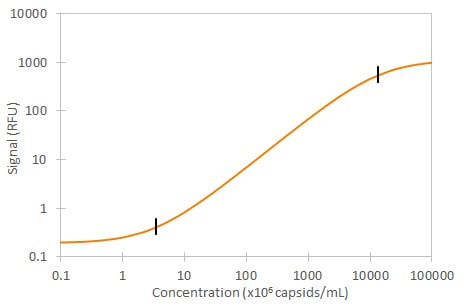
- Sensitivity: 0.9 x 10⁶ capsids/mL
- Range: 3.41 x 10⁶ - 1.3 x 10¹⁰ capsids/mL
*The Sample Volume represented is based on the amount of sample incorporated into the reaction after taking into account the assay's minimum required dilution for a given matrix. Serial dilution may be necessary to achieve some of the final sample volumes represented.
Compatible Instruments
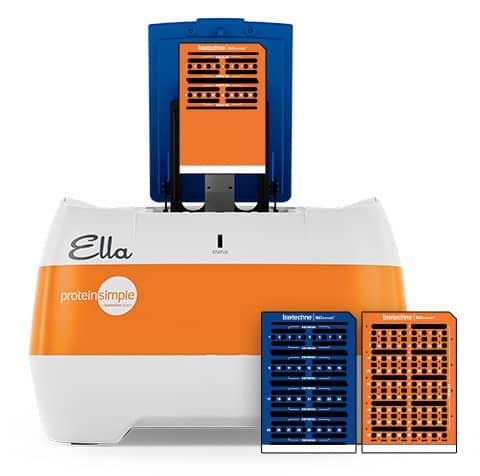
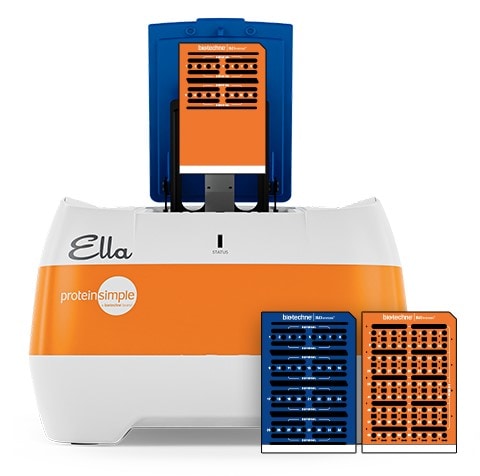
Ella Automated Immunoassay System
Product Specifications
Assay Type
Format
Species
Specificity
Cross-reactivity
Interference
Precision
Intra-Assay Precision (Precision within an assay) Each control was tested 16 times in one assay.
Inter-Assay Precision (Precision between assays) Replicates of each control were tested in multiple assays performed by at least three technicians using two lots of reagents.
Bioprocess Samples
| Intra-Assay Precision | Inter-Assay Precision | |||
|---|---|---|---|---|
| Sample | 1 | 2 | 1 | 2 |
| n | 16 | 16 | 58 | 56 |
| Mean (10<sup>6</sup> capsids/mL) | 40 | 2103 | 42.2 | 2045 |
| Standard Deviation | 3.5 | 55.3 | 4.7 | 158 |
| CV% | 8.8 | 2.6 | 11.2 | 7.7 |
Recovery for Simple Plex AAV2 Cartridge
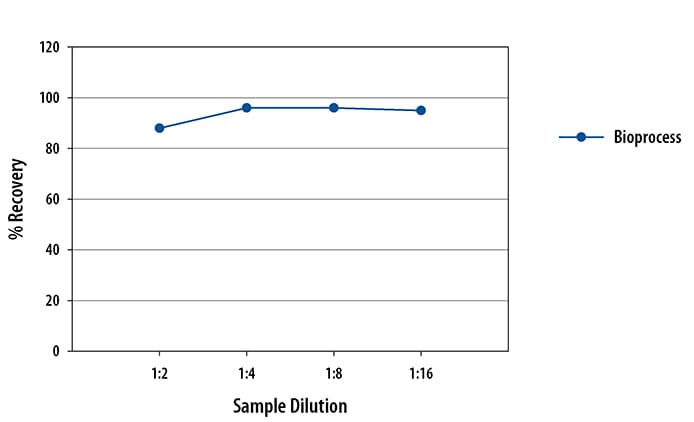
Recovery was not necessary as AAV2 shows natural linearity data from a neat sample to a 1:16 dilution.
Linearity
Samples containing and/or spiked with high concentrations of AAV2 were serially diluted with Sample Diluent to produce samples within the dynamic range of the assay.
Scientific Data Images for Simple Plex AAV2 Cartridge
AAV2 Simple Plex Assay
Preparation and Storage
Shipping
Background: AAV2
References
1. Zengel J, Carette JE. Structural and cellular biology of adeno-associated virus attachment and entry. Adv Virus Res. 2020;106:39-84. https://doi.org/10.1016/bs.aivir.2020.01.002
2. Wu Z, Asokan A, Samulski RJ. Adeno-associated virus serotypes: vector toolkit for human gene therapy. Mol Ther. 2006;14(3):316-327. https://doi.org/10.1016/j.ymthe.2006.05.009
3. Drouin LM, Agbandje-McKenna M. Adeno-associated virus structural biology as a tool in vector development. Future Virol. 2013;8(12):1183-1199. https://doi.org/10.2217/fvl.13.112
4. Santiago-Ortiz JL, Schaffer DV. Adeno-associated virus (AAV) vectors in cancer gene therapy. J Control Release. 2016;240:287-301. https://doi.org/10.1016/j.jconrel.2016.01.001
Long Name
Alternate Names
Additional AAV2 Products
Product Documents for Simple Plex AAV2 Cartridge
Certificate of Analysis
To download a Certificate of Analysis, please enter your Simple Plex catalog number and lot number in the search boxes below.
Product Specific Notices for Simple Plex AAV2 Cartridge
For research use only
Citations for Simple Plex AAV2 Cartridge
View all citations for the Simple Plex platform.
Please visit our Instrument Citation Database to search our collection of scientific articles that feature our instruments.
 Powered by Bioz
Customer Reviews for Simple Plex AAV2 Cartridge
There are currently no reviews for this product. Be the first to review Simple Plex AAV2 Cartridge and earn rewards!
Have you used Simple Plex AAV2 Cartridge?
Submit a review and receive an Amazon gift card!
$25/€18/£15/$25CAN/¥2500 for a review with an image
$10/€7/£6/$10CAN/¥1110 for a review without an image
Submit a review
FAQs for Simple Plex AAV2 Cartridge
-
Q: Do the AAV assays recognize both natural and recombinant AAV?
A: Yes, the AAV assays detect both natural and recombinant AAV.
-
Q: Do the AAV assays recognize fully-assembled capsids?
A: Yes, these assays detect fully-assembled capsids. Non-assembled protein or partially assembled capsids will not be detected.
-
Q: Do the Simple Plex AAV assays distinguish between full and empty capsids?
A: No, the AAV assays do not distinguish between full and empty capsids. Complementary methods are required to distinguish full and empty capsids.
-
Q: Does the AAV2 assay recognize other AAV serotypes?
A: This assay recognizes intact AAV2 capsids. The AAV2 antibody (A20R) used in this assay cross-reacts with AAV3.
-
Q: What diluent is provided with the AAV assays?
A: The AAV assays are supplied with SD19 concentrate. The concentrate should be diluted 1:5 in deionized or dilstilled water prior to use.
-
Q: What is the minimum required dilution (MRD) for bio-process samples?
A: All samples require a minimum 2-fold dilution for use in Simple Plex assays, but further dilution may be needed for optimal performace. An appropriate dilution factor for each process matrix should be determined experimentally by assessment of sample linearity and spike recovery.
-
Q: Do the AAV assays recognize both natural and recombinant AAV?
A: Yes, the AAV assays detect both natural and recombinant AAV.
-
Q: Do the AAV assays recognize fully-assembled capsids?
A: Yes, these assays detect fully-assembled capsids. Non-assembled protein or partially assembled capsids will not be detected.
-
Q: Do the Simple Plex AAV assays distinguish between full and empty capsids?
A: No, the AAV assays do not distinguish between full and empty capsids. Complementary methods are required to distinguish full and empty capsids.
-
Q: Does the AAV2 assay recognize other AAV serotypes?
A: This assay recognizes intact AAV2 capsids. The AAV2 antibody (A20R) used in this assay cross-reacts with AAV3.
-
Q: What diluent is provided with the AAV assays?
A: The AAV assays are supplied with SD19 concentrate. The concentrate should be diluted 1:5 in deionized or dilstilled water prior to use.
-
Q: What is the minimum required dilution (MRD) for bio-process samples?
A: All samples require a minimum 2-fold dilution for use in Simple Plex assays, but further dilution may be needed for optimal performace. An appropriate dilution factor for each process matrix should be determined experimentally by assessment of sample linearity and spike recovery.
-
Q: Do the AAV assays recognize both natural and recombinant AAV?
A: Yes, the AAV assays detect both natural and recombinant AAV.
-
Q: Do the AAV assays recognize fully-assembled capsids?
A: Yes, these assays detect fully-assembled capsids. Non-assembled protein or partially assembled capsids will not be detected.
-
Q: Do the Simple Plex AAV assays distinguish between full and empty capsids?
A: No, the AAV assays do not distinguish between full and empty capsids. Complementary methods are required to distinguish full and empty capsids.
-
Q: Does the AAV2 assay recognize other AAV serotypes?
A: This assay recognizes intact AAV2 capsids. The AAV2 antibody (A20R) used in this assay cross-reacts with AAV3.
-
Q: What diluent is provided with the AAV assays?
A: The AAV assays are supplied with SD19 concentrate. The concentrate should be diluted 1:5 in deionized or dilstilled water prior to use.
-
Q: What is the minimum required dilution (MRD) for bio-process samples?
A: All samples require a minimum 2-fold dilution for use in Simple Plex assays, but further dilution may be needed for optimal performace. An appropriate dilution factor for each process matrix should be determined experimentally by assessment of sample linearity and spike recovery.
-
Q: Do the AAV assays recognize both natural and recombinant AAV?
A: Yes, the AAV assays detect both natural and recombinant AAV.
-
Q: Do the AAV assays recognize fully-assembled capsids?
A: Yes, these assays detect fully-assembled capsids. Non-assembled protein or partially assembled capsids will not be detected.
-
Q: Do the Simple Plex AAV assays distinguish between full and empty capsids?
A: No, the AAV assays do not distinguish between full and empty capsids. Complementary methods are required to distinguish full and empty capsids.
-
Q: Does the AAV2 assay recognize other AAV serotypes?
A: This assay recognizes intact AAV2 capsids. The AAV2 antibody (A20R) used in this assay cross-reacts with AAV3.
-
Q: What diluent is provided with the AAV assays?
A: The AAV assays are supplied with SD19 concentrate. The concentrate should be diluted 1:5 in deionized or dilstilled water prior to use.
-
Q: What is the minimum required dilution (MRD) for bio-process samples?
A: All samples require a minimum 2-fold dilution for use in Simple Plex assays, but further dilution may be needed for optimal performace. An appropriate dilution factor for each process matrix should be determined experimentally by assessment of sample linearity and spike recovery.
-
Q: Do the AAV assays recognize both natural and recombinant AAV?
A: Yes, the AAV assays detect both natural and recombinant AAV.
-
Q: Do the AAV assays recognize fully-assembled capsids?
A: Yes, these assays detect fully-assembled capsids. Non-assembled protein or partially assembled capsids will not be detected.
-
Q: Do the Simple Plex AAV assays distinguish between full and empty capsids?
A: No, the AAV assays do not distinguish between full and empty capsids. Complementary methods are required to distinguish full and empty capsids.
-
Q: Does the AAV2 assay recognize other AAV serotypes?
A: This assay recognizes intact AAV2 capsids. The AAV2 antibody (A20R) used in this assay cross-reacts with AAV3.
-
Q: What diluent is provided with the AAV assays?
A: The AAV assays are supplied with SD19 concentrate. The concentrate should be diluted 1:5 in deionized or dilstilled water prior to use.
-
Q: What is the minimum required dilution (MRD) for bio-process samples?
A: All samples require a minimum 2-fold dilution for use in Simple Plex assays, but further dilution may be needed for optimal performace. An appropriate dilution factor for each process matrix should be determined experimentally by assessment of sample linearity and spike recovery.
-
Q: Do the AAV assays recognize both natural and recombinant AAV?
A: Yes, the AAV assays detect both natural and recombinant AAV.
-
Q: Do the AAV assays recognize fully-assembled capsids?
A: Yes, these assays detect fully-assembled capsids. Non-assembled protein or partially assembled capsids will not be detected.
-
Q: Do the Simple Plex AAV assays distinguish between full and empty capsids?
A: No, the AAV assays do not distinguish between full and empty capsids. Complementary methods are required to distinguish full and empty capsids.
-
Q: Does the AAV2 assay recognize other AAV serotypes?
A: This assay recognizes intact AAV2 capsids. The AAV2 antibody (A20R) used in this assay cross-reacts with AAV3.
-
Q: What diluent is provided with the AAV assays?
A: The AAV assays are supplied with SD19 concentrate. The concentrate should be diluted 1:5 in deionized or dilstilled water prior to use.
-
Q: What is the minimum required dilution (MRD) for bio-process samples?
A: All samples require a minimum 2-fold dilution for use in Simple Plex assays, but further dilution may be needed for optimal performace. An appropriate dilution factor for each process matrix should be determined experimentally by assessment of sample linearity and spike recovery.