
ULBPs activate multiple signaling pathways in primary NK cells, resulting in the production of cytokines and chemokines. Binding of ULBPs ligands to NKG2D induces calcium mobilization and activation of the JAK2, STAT5, ERK and PI3K kinase/Akt signal transduction pathway. The name ULBP derives from the original identification of three proteins, ULBP-1, -2, and -3, as ligands for the human cytomegalovirus glycoprotein UL16; they were designated UL16 binding proteins (ULBP). The genes for ULBPs reside in a cluster of ten related genes, six of which encode potentially functional glycoproteins. ULBP-2 has also been described under the names RaeT1H (retinoic acid early transcript), NKG2DL2, and ALCAN-alpha. ULBP-5 is also known as RaeT1G and ULBP-6 is also known as RaeT1L. These proteins are distantly related to MHC class I proteins, but they possess only the alpha 1 and alpha 2 Ig-like domains, and they have no capacity to bind peptide or interact with beta 2-Microglobulin. Some family members, including ULBP-2, are anchored to the membrane via a GPI-linkage, whereas others have transmembrane domains. Engagement of NKG2D results in the activation of cytolytic activity and/or cytokine production by these effector cells. The ULBPs are expressed on some tumor cells and have been implicated in tumor surveillance. Over aa 26-217, ULBP-2 shares 92% and 95% aa sequence identity with the human ULBP-5 and ULBP-6, respectively.
ULBP-2/5/6 Antibody (165903) [DyLight 350]
Novus Biologicals | Catalog # FAB1298D

Key Product Details
Species Reactivity
Applications
Label
Antibody Source
Product Specifications
Immunogen
Accession # Q9BZM5
Specificity
Clonality
Host
Isotype
Description
For specialized conjugation needs, like large quantities, specific concentrations, and defined F/P ratios, bulk and custom antibody conjugation services are available.
Applications for ULBP-2/5/6 Antibody (165903) [DyLight 350]
Blockade of Receptor-ligand Interaction
CyTOF-ready
Flow Cytometry
Spectra Viewer
Plan Your Experiments
Use our spectra viewer to interactively plan your experiments, assessing multiplexing options. View the excitation and emission spectra for our fluorescent dye range and other commonly used dyes.
Spectra Viewer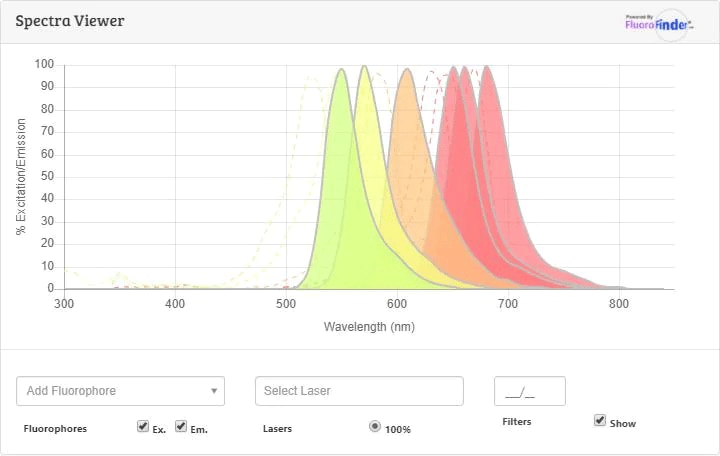
Flow Cytometry Panel Builder
Bio-Techne Knows Flow Cytometry
Save time and reduce costly mistakes by quickly finding compatible reagents using the Panel Builder Tool.
Advanced Features
- Spectra Viewer - Custom analysis of spectra from multiple fluorochromes
- Spillover Popups - Visualize the spectra of individual fluorochromes
- Antigen Density Selector - Match fluorochrome brightness with antigen density

Formulation, Preparation, and Storage
Purification
Formulation
Preservative
Concentration
Shipping
Stability & Storage
Background: ULBP-2/5/6
Long Name
Alternate Names
Additional ULBP-2/5/6 Products
Product Documents for ULBP-2/5/6 Antibody (165903) [DyLight 350]
Certificate of Analysis
To download a Certificate of Analysis, please enter a lot or batch number in the search box below.
Product Specific Notices for ULBP-2/5/6 Antibody (165903) [DyLight 350]
DyLight (R) is a trademark of Thermo Fisher Scientific Inc. and its subsidiaries.
This product is for research use only and is not approved for use in humans or in clinical diagnosis. Primary Antibodies are guaranteed for 1 year from date of receipt.
Related Research Areas
Customer Reviews for ULBP-2/5/6 Antibody (165903) [DyLight 350]
There are currently no reviews for this product. Be the first to review ULBP-2/5/6 Antibody (165903) [DyLight 350] and earn rewards!
Have you used ULBP-2/5/6 Antibody (165903) [DyLight 350]?
Submit a review and receive an Amazon gift card!
$25/€18/£15/$25CAN/¥2500 for a review with an image
$10/€7/£6/$10CAN/¥1110 for a review without an image
Submit a review
Protocols
Find general support by application which include: protocols, troubleshooting, illustrated assays, videos and webinars.
- 7-Amino Actinomycin D (7-AAD) Cell Viability Flow Cytometry Protocol
- Extracellular Membrane Flow Cytometry Protocol
- Flow Cytometry Protocol for Cell Surface Markers
- Flow Cytometry Protocol for Staining Membrane Associated Proteins
- Flow Cytometry Staining Protocols
- Flow Cytometry Troubleshooting Guide
- Intracellular Flow Cytometry Protocol Using Alcohol (Methanol)
- Intracellular Flow Cytometry Protocol Using Detergents
- Intracellular Nuclear Staining Flow Cytometry Protocol Using Detergents
- Intracellular Staining Flow Cytometry Protocol Using Alcohol Permeabilization
- Intracellular Staining Flow Cytometry Protocol Using Detergents to Permeabilize Cells
- Propidium Iodide Cell Viability Flow Cytometry Protocol
- Protocol for Liperfluo
- Protocol for the Characterization of Human Th22 Cells
- Protocol for the Characterization of Human Th9 Cells
- Protocol: Annexin V and PI Staining by Flow Cytometry
- Protocol: Annexin V and PI Staining for Apoptosis by Flow Cytometry
- Troubleshooting Guide: Fluorokine Flow Cytometry Kits
- View all Protocols, Troubleshooting, Illustrated assays and Webinars