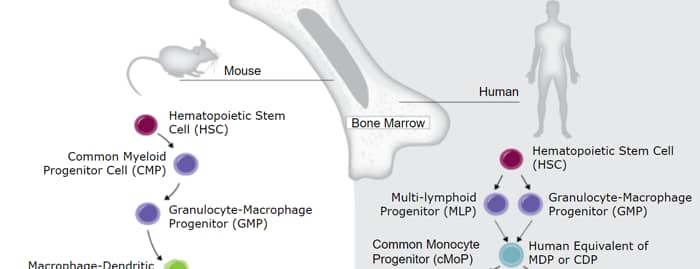
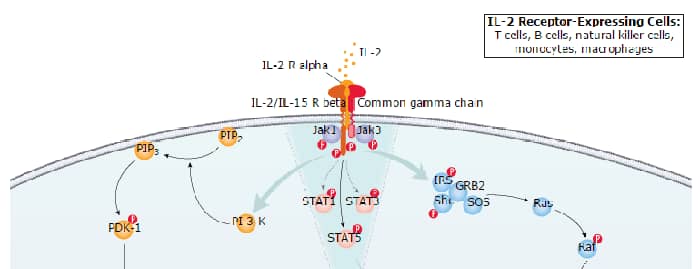
Bovine Interleukin-2 (IL-2) is a 15 kDa, alpha -helical, single chain, potentially glycosylated polypeptide that has potent stimulatory activity for antigen-activated T cells (1‑5). The molecule is synthesized as a 155 amino acid (aa) precursor that contains a 20 aa signal peptide plus a 135 aa mature segment that is possibly O‑glycosylated (4, 5). The mature region has multiple alpha -helices and one intrachain disulfide bond. Mature bovine IL-2 is 64%, 60%, 49%, 50%, 72%, 63% and 67% to mature human, canine, mouse, rat, porcine, equine, and feline IL-2, respectively. Mammalian cells known to express IL-2 include CD4+ and CD8+ T cells, visceral smooth muscle cells, eosinophils, gamma delta T cells, B cells and dendritic cells. The receptor for IL-2 is complex and consists of three distinct subunits in varying combinations (6, 7). Two of these are ligand-binding and are termed IL-2 R alpha and IL-2 R beta. IL-2 R alpha is 55 kDa and binds IL-2 with low affinity. IL-2 R beta is 75 kDa and binds IL-2 with intermediate affinity. Signal transduction is performed by both IL-2 R beta and a 64 kDa common gamma chain ( gamma c). This signal transducing common gamma chain does not bind IL-2, but does heterodimerize with IL-2 R beta to form a functional IL-2 receptor. The complex heterotrimeric alpha -beta -gamma c receptor may arise from IL-2 binding to preformed R alpha -R beta complexes (8). Functionally, IL-2 is best known for its autocrine and paracrine activity on T cells. It drives resting T cells into active G1, inducing IL-2 and IL-2 R alpha synthesis and cell proliferation (7). It also promotes Fas-induced death of naïve CD4+ T cells, while having minimal effect on activated CD4+ memory lymphocytes. Finally, IL-2 seems to play a central role in the expansion and maintenance of CD4+ CD25+ regulatory T cells. Thus, IL-2 may be a key cytokine in the natural suppression of autoimmunity (9, 10).
Bovine IL-2 Antibody [Alexa Fluor™ Plus 594]
R&D Systems | Catalog # AF2465AFP594

![Bovine IL-2 Antibody [Alexa Fluor™ Plus 594]](https://resources.rndsystems.com/images/icons/RnD-Default-Product-Image_Antibodies-Icon.svg "Bovine IL-2 Antibody [Alexa Fluor™ Plus 594]")
Key Product Details
Species Reactivity
Applications
Label
Antibody Source
Product Specifications
Specificity
Clonality
Host
Isotype
Applications for Bovine IL-2 Antibody [Alexa Fluor™ Plus 594]
ELISA Capture (Matched Antibody Pair)
Immunocytochemistry
Western Blot
Background: IL-2
References
- Smith, K.A. (1992) Curr. Opin. Immunol. 4:271.
- Smith, K.A. (1988) Science 240:1169.
- Waldmann, T.A. et al. (2001) Immunity 14:105.
- Cerretti, D.P. et al. (1986) Proc. Natl. Acad. Sci. USA 83:3223.
- Reeves, R. et al. (1986) Proc. Natl. Acad. Sci. USA 83:3228.
- Ellery, J.M. and P.J. Nicholls (2002) Cytokine Growth Factor Rev. 13:27.
- Nelson, B.H. and D.M. Willerford (1998) Adv. Immunol. 70:1.
- Liparoto, S.F. et al. (2002) Biochemistry 41:2543.
- Jaleco, S. et al. (2003) J. Immunol. 171:61.
- Malek, T.R. (2003) J. Leukoc. Biol. 74:961.
Long Name
Alternate Names
Entrez Gene IDs
Gene Symbol
UniProt
Additional IL-2 Products
Product Documents for Bovine IL-2 Antibody [Alexa Fluor™ Plus 594]
Certificate of Analysis
To download a Certificate of Analysis, please enter a lot or batch number in the search box below.
Note: Certificate of Analysis not available for kit components.
Product Specific Notices for Bovine IL-2 Antibody [Alexa Fluor™ Plus 594]
This product is provided under an intellectual property license from Life Technologies Corporation. The transfer of this product is conditioned on the buyer using the purchased product solely in research conducted by the buyer, excluding contract research or any fee for service research, and the buyer must not (1) use this product or its components for (a) diagnostic, therapeutic or prophylactic purposes; (b) testing, analysis or screening services, or information in return for compensation on a per-test basis; or (c) manufacturing or quality assurance or quality control, and/or (2) sell or transfer this product or its components for resale, whether or not resold for use in research. For information on purchasing a license to this product for purposes other than as described above, contact Life Technologies Corporation, 5781 Van Allen Way, Carlsbad, CA 92008 USA or outlicensing@thermofisher.com.
For research use only
Related Research Areas
Customer Reviews for Bovine IL-2 Antibody [Alexa Fluor™ Plus 594]
There are currently no reviews for this product. Be the first to review Bovine IL-2 Antibody [Alexa Fluor™ Plus 594] and earn rewards!
Have you used Bovine IL-2 Antibody [Alexa Fluor™ Plus 594]?
Submit a review and receive an Amazon gift card!
$25/€18/£15/$25CAN/¥2500 for a review with an image
$10/€7/£6/$10CAN/¥1110 for a review without an image
Submit a review
Protocols
Find general support by application which include: protocols, troubleshooting, illustrated assays, videos and webinars.
- Appropriate Fixation of IHC/ICC Samples
- Cellular Response to Hypoxia Protocols
- ClariTSA™ Fluorophore Kits
- Detection & Visualization of Antibody Binding
- ICC Cell Smear Protocol for Suspension Cells
- ICC Immunocytochemistry Protocol Videos
- ICC for Adherent Cells
- Immunocytochemistry (ICC) Protocol
- Immunocytochemistry Troubleshooting
- Immunofluorescence of Organoids Embedded in Cultrex Basement Membrane Extract
- Immunohistochemistry (IHC) and Immunocytochemistry (ICC) Protocols
- Preparing Samples for IHC/ICC Experiments
- Preventing Non-Specific Staining (Non-Specific Binding)
- Primary Antibody Selection & Optimization
- Protocol for VisUCyte™ HRP Polymer Detection Reagent
- Protocol for the Fluorescent ICC Staining of Cell Smears - Graphic
- Protocol for the Fluorescent ICC Staining of Cultured Cells on Coverslips - Graphic
- Protocol for the Preparation and Fluorescent ICC Staining of Cells on Coverslips
- Protocol for the Preparation and Fluorescent ICC Staining of Non-adherent Cells
- Protocol for the Preparation and Fluorescent ICC Staining of Stem Cells on Coverslips
- Protocol for the Preparation of a Cell Smear for Non-adherent Cell ICC - Graphic
- R&D Systems Quality Control Western Blot Protocol
- TUNEL and Active Caspase-3 Detection by IHC/ICC Protocol
- The Importance of IHC/ICC Controls
- Troubleshooting Guide: Western Blot Figures
- Western Blot Conditions
- Western Blot Protocol
- Western Blot Protocol for Cell Lysates
- Western Blot Troubleshooting
- Western Blot Troubleshooting Guide
- View all Protocols, Troubleshooting, Illustrated assays and Webinars
Associated Pathways