
Human HAND1 Antibody
R&D Systems | Catalog # AF3168

Scientific images may be resized, cropped, or adjusted for brightness or contrast for presentation purposes. These updates are limited to presentation and do not affect the underlying scientific interpretation of the data. Where available, additional source data may be provided upon request.
Key Product Details
Species Reactivity
Validated:
Cited:
Applications
Validated:
Cited:
Label
Antibody Source
Product Specifications
Immunogen
Met1-Gln215
Accession # O96004
Specificity
Clonality
Host
Isotype
Scientific Data Images for Human HAND1 Antibody
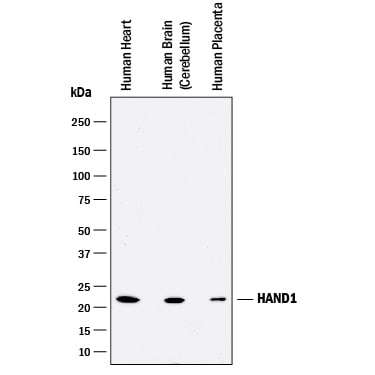
Detection of Human HAND1 by Western Blot.
Western blot shows lysates of human heart tissue, human brain (cerebellum) tissue, and human placenta tissue. PVDF membrane was probed with 1 µg/mL of Goat Anti-Human HAND1 Antigen Affinity-purified Polyclonal Antibody (Catalog # AF3168) followed by HRP-conjugated Anti-Goat IgG Secondary Antibody (Catalog # HAF017). A specific band was detected for HAND1 at approximately 22 kDa (as indicated). This experiment was conducted under reducing conditions and using Immunoblot Buffer Group 1.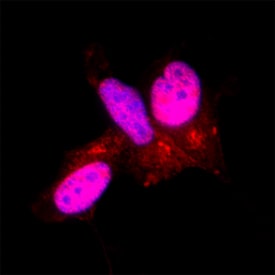
HAND1 in SH‑SY5Y Human Cell Line.
HAND1 was detected in immersion fixed SH‑SY5Y human neuroblastoma cell line using Goat Anti-Human HAND1 Antigen Affinity-purified Polyclonal Antibody (Catalog # AF3168) at 5 µg/mL for 3 hours at room temperature. Cells were stained using the NorthernLights™ 557-conjugated Anti-Goat IgG Secondary Antibody (red; NL001) and counterstained with DAPI (blue). Specific staining was localized to nuclei. Staining was performed using our protocol for Fluorescent ICC Staining of Non-adherent Cells.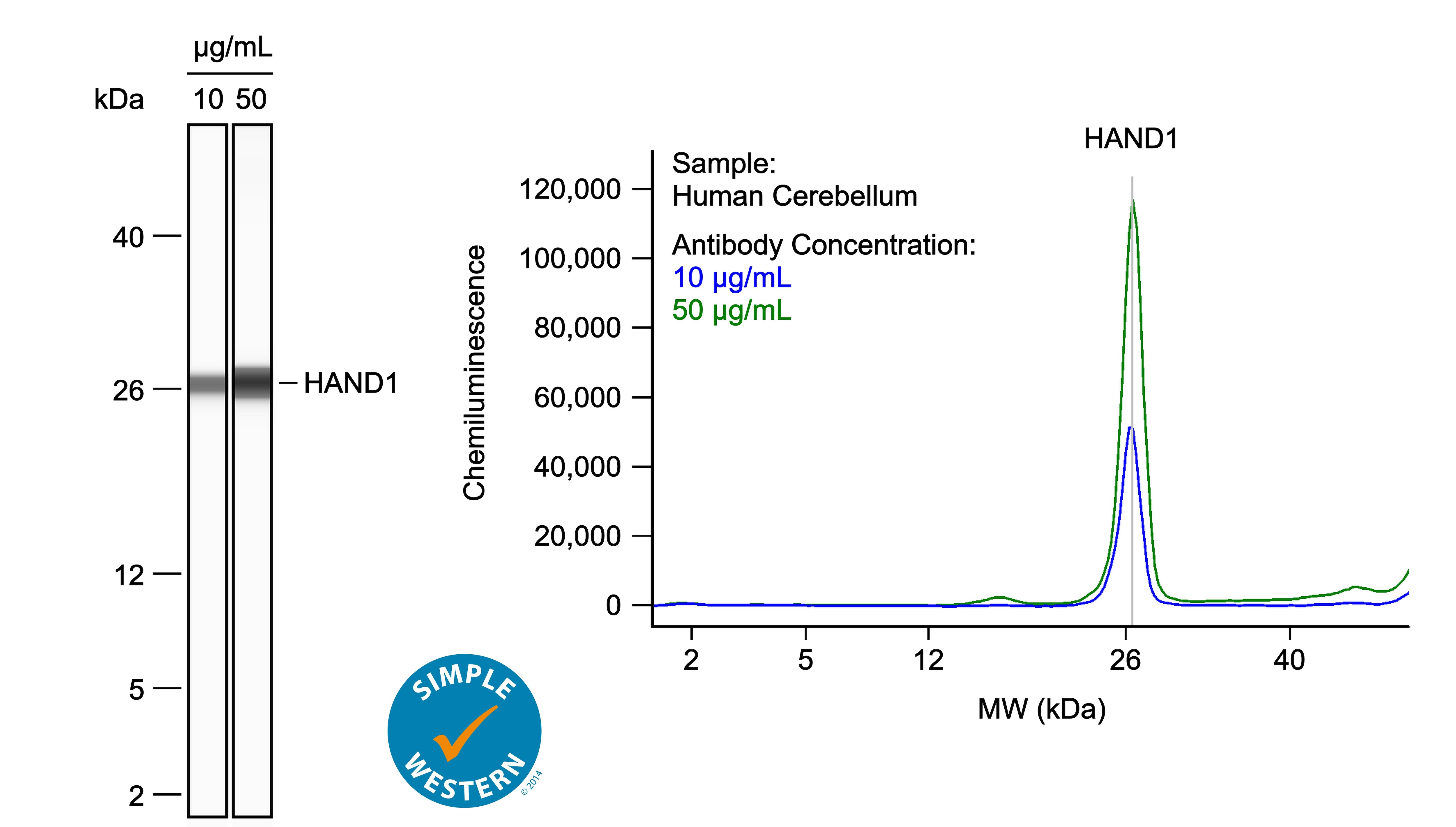
Detection of Human HAND1 by Simple WesternTM.
Left: Simple Western lane view shows lysates of human cerebellum, loaded at 1 mg/ml. A specific band was detected for HAND1 at approximately 26 kDa (as indicated) using both 10 µg/ml and 50 µg/ml of Goat Anti-Human HAND1 Antigen Affinity-purified Polyclonal Antibody (Catalog # AF3168) followed by HRP-conjugated Donkey Anti-Goat Secondary Antibody (Catalog # 043-522-2). This experiment was conducted under reducing conditions and using the 2-40kDa separation system. Right: Simple Western electropherogram showing the same Goat Anti-Human HAND1 Antigen Affinity-purified Polyclonal Antibody (Catalog # AF3168) tested at 10 µg/ml (blue line) and 50 µg/ml (green line) in the human cerebellum.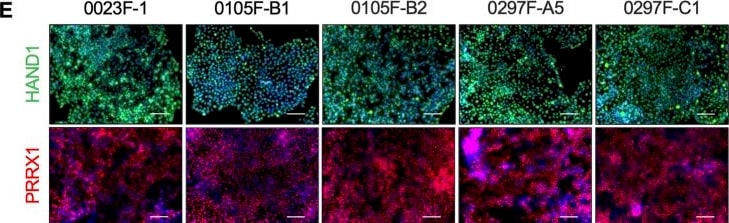
Detection of HAND1 by Immunohistochemistry
Directed differentiation of small ape iPSCs. (A) Schematic overview of direct neurosphere formation and the subsequent neuronal differentiation cultures. (B) Phase-contrast images of representative neurospheres (day 7) and neurons (day 21) derived from small ape iPSCs. (C) Immunofluorescence images of beta III tubulin in day 21 neurons. Nuclei were counterstained with DAPI. Scale bar: 100 μm. (D) Schematic design of limb bud mesoderm differentiation culture. (E) Immunofluorescence images of HAND1 in day 2 lateral plate mesoderm cells and PRRX1 in day 4 limb bud mesoderm cells. Nuclei were counterstained with DAPI. Scale bar: 100 μm. (F) Heatmap showing the expression of genes associated with pluripotency (POU5F1, NANOG), lateral plate mesoderm (HAND1, FOXF1, NKX2.5, ISL1), and limb bud mesoderm (PRRX1, MSX1, PITX1) in iPSCs, day 2 lateral plate mesoderm cells, and day 4 limb bud mesoderm cells determined by quantitative RT-PCR analysis. beta -ACTIN was used as an internal control. (G) Immunofluorescence images of SOX17 in day 2 definitive endoderm cells. Nuclei were counterstained with DAPI. Scale bar: 100 μm. (H) Heatmap showing the expression of genes associated with pluripotency (POU5F1, NANOG) and definitive endoderm (SOX17, FOXA2, GSC, CER1, HHEX, GATA6) in iPSCs and day 2 definitive endoderm cells determined by quantitative RT-PCR analysis. Image collected and cropped by CiteAb from the following open publication (https://www.frontiersin.org/articles/10.3389/fcell.2025.1536947/full), licensed under a CC-BY license. Not internally tested by R&D Systems.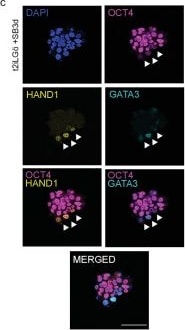
Detection of HAND1 by Immunocytochemistry/ Immunofluorescence
Pseudotime trajectories of TGF beta -inhibited naïve hPSCs recapitulates early trophectoderm specification in human embryos.(a) Diffusion maps of naïve hPSC 10X scRNA-seq data during the SB time-course, reporting diffusion pseudotime scores. (b) Diffusion map visualisation of naïve cells during the SB time-course reporting the relative expression of additional pluripotency markers KLF4 and DPPA5, TGF beta effector NODAL, and trophoblast markers CDX1, MARCKS, and GATA2. (c) Immunofluorescence microscopy for OCT4 (magenta), HAND1 (yellow), GATA3 (cyan) and DAPI (blue) in H9 NK2 naïve cells following 3 days of SB supplementation to t2iLGö medium. White arrowheads indicate cells that co-express low levels of OCT4 and HAND1 or GATA3. Scale bars: 50 µm. (d) Correlation heatmap between the pseudobulked datasets from all Louvain clusters (A/B/C/D/E) and the identified cell lineages from the cultured human pre-gastrulation embryos (Xiang et al., 2020). CTB: Cytotrophoblast; EVT: Extravillous trophoblast; STB: Syncytiotrophoblast; EPI: Epiblast; ICM: Inner Cell Mass; PrE: Primitive Endoderm, TE: Trophectoderm. (e) Heatmap reporting the expression in the Louvain clusters A, D, and E of the top 20 differentially expressed genes between EPI, ICM, and CTB cell lineages (based on data published by Xiang et al., 2020). Image collected and cropped by CiteAb from the following open publication (https://pubmed.ncbi.nlm.nih.gov/34463252), licensed under a CC-BY license. Not internally tested by R&D Systems.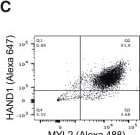
Detection of HAND1 by Flow Cytometry
Generation of hPSC-LV-CMs using a two-step approach(A) Depiction of the standard WNT-ON/WNT-OFF protocol; modifications to this protocol (±) and critical feeding steps are indicated. CHIR, CHIR99021; BMP, BMP4; A, activin A; FGF, FGF2; LAA, L-ascorbic acid; IWR1, WNT pathway inhibitor; AGN, AGN193109, a pan-retinoic acid (RA) inhibitor; VitA, vitamin A.(B) Immunostaining micrographs of day 20 hPSC-CMs generated from mesoderm cells exposed to activin A, FGF2, and varying amounts of BMP4 and CHIR, demonstrating the cardiac corridor for making LV-like cardiomyocytes (red box). Scale bar: 100 μm.(C) Flow cytometry plot of day 20 hPSC-LV-CM cultures.(D and E) Day 20 hPSC-CMs generated in the presence or absence of RA signaling (±AGN, ±vitamin A, ±RA).(D) Immunostaining micrographs; scale bar: 100 μm.(E) qRT-PCR analysis.(F and G) Cardiomyocyte quantification in day 20 hPSC-CM cultures differentiated using the standard (Std) or LV protocols. Cells were co-stained with ACTN2, MYL2, and HAND1. DAPI was used to normalize the data.See also Figure S2. Image collected and cropped by CiteAb from the following open publication (https://pubmed.ncbi.nlm.nih.gov/37159667), licensed under a CC-BY license. Not internally tested by R&D Systems.Applications for Human HAND1 Antibody
Immunocytochemistry
Sample: Immersion fixed SH‑SY5Y human neuroblastoma cell line
Simple Western
Sample: Human cerebellum tissue
Western Blot
Sample: Human heart tissue, human brain (cerebellum) tissue, and human placenta tissue
Formulation, Preparation, and Storage
Purification
Reconstitution
Reconstitute at 0.2 mg/mL in sterile PBS. For liquid material, refer to CoA for concentration.
Formulation
Shipping
Stability & Storage
- 12 months from date of receipt, -20 to -70 °C as supplied.
- 1 month, 2 to 8 °C under sterile conditions after reconstitution.
- 6 months, -20 to -70 °C under sterile conditions after reconstitution.
Calculators
Background: HAND1
Long Name
Alternate Names
Gene Symbol
UniProt
Additional HAND1 Products
Product Documents for Human HAND1 Antibody
Certificate of Analysis
To download a Certificate of Analysis, please enter a lot or batch number in the search box below.
Note: Certificate of Analysis not available for kit components.
Product Specific Notices for Human HAND1 Antibody
For research use only
Citations for Human HAND1 Antibody
 Powered by Bioz
Customer Reviews for Human HAND1 Antibody
There are currently no reviews for this product. Be the first to review Human HAND1 Antibody and earn rewards!
Have you used Human HAND1 Antibody?
Submit a review and receive an Amazon gift card!
$25/€18/£15/$25CAN/¥2500 for a review with an image
$10/€7/£6/$10CAN/¥1110 for a review without an image
Submit a review
Protocols
Find general support by application which include: protocols, troubleshooting, illustrated assays, videos and webinars.
- Appropriate Fixation of IHC/ICC Samples
- Cellular Response to Hypoxia Protocols
- ClariTSA™ Fluorophore Kits
- Detection & Visualization of Antibody Binding
- ICC Cell Smear Protocol for Suspension Cells
- ICC Immunocytochemistry Protocol Videos
- ICC for Adherent Cells
- Immunocytochemistry (ICC) Protocol
- Immunocytochemistry Troubleshooting
- Immunofluorescence of Organoids Embedded in Cultrex Basement Membrane Extract
- Immunohistochemistry (IHC) and Immunocytochemistry (ICC) Protocols
- Preparing Samples for IHC/ICC Experiments
- Preventing Non-Specific Staining (Non-Specific Binding)
- Primary Antibody Selection & Optimization
- Protocol for VisUCyte™ HRP Polymer Detection Reagent
- Protocol for the Fluorescent ICC Staining of Cell Smears - Graphic
- Protocol for the Fluorescent ICC Staining of Cultured Cells on Coverslips - Graphic
- Protocol for the Preparation and Fluorescent ICC Staining of Cells on Coverslips
- Protocol for the Preparation and Fluorescent ICC Staining of Non-adherent Cells
- Protocol for the Preparation and Fluorescent ICC Staining of Stem Cells on Coverslips
- Protocol for the Preparation of a Cell Smear for Non-adherent Cell ICC - Graphic
- R&D Systems Quality Control Western Blot Protocol
- TUNEL and Active Caspase-3 Detection by IHC/ICC Protocol
- The Importance of IHC/ICC Controls
- Troubleshooting Guide: Western Blot Figures
- Western Blot Conditions
- Western Blot Protocol
- Western Blot Protocol for Cell Lysates
- Western Blot Troubleshooting
- Western Blot Troubleshooting Guide
- View all Protocols, Troubleshooting, Illustrated assays and Webinars