
Intercellular Adhesion Molecule-2 (ICAM-2, CD102), a member of the immunoglobulin superfamily, binds the leukocyte integrins LFA-1 (CD11a/CD18) and Mac-1 (CD11b/CD18). ICAM-2 is constitutively expressed at high levels on vascular endothelial cells and lymphohematopoietic cells. ICAM-2 mediated adhesion has been shown to provide a co-stimulatory signal for T cell aggregation, NK cytotoxicity and NK cell migration.
Human ICAM-2/CD102 Antibody
R&D Systems | Catalog # AF244

Scientific images may be resized, cropped, or adjusted for brightness or contrast for presentation purposes. These updates are limited to presentation and do not affect the underlying scientific interpretation of the data. Where available, additional source data may be provided upon request.
Key Product Details
Species Reactivity
Validated:
Human
Cited:
Human
Applications
Validated:
Western Blot, Adhesion Blockade, Flow Cytometry, CyTOF-ready
Cited:
Neutralization, Immunofluorescence, Immunoprecipitation
Label
Unconjugated
Antibody Source
Polyclonal Goat IgG
Loading...
Product Specifications
Immunogen
S. frugiperda insect ovarian cell line Sf 21-derived recombinant human ICAM‑2/CD102
Lys25-Gln223
Accession # CAA33630
Lys25-Gln223
Accession # CAA33630
Specificity
Detects human ICAM‑2/CD102 in direct ELISAs and Western blots. In direct ELISAs, less than 1% cross-reactivity with recombinant human (rh) ICAM-1 and rhICAM-3 is observed.
Clonality
Polyclonal
Host
Goat
Isotype
IgG
Endotoxin Level
<0.10 EU per 1 μg of the antibody by the LAL method.
Scientific Data Images for Human ICAM-2/CD102 Antibody
Detection of Human ICAM-2/CD102 by Western Blot
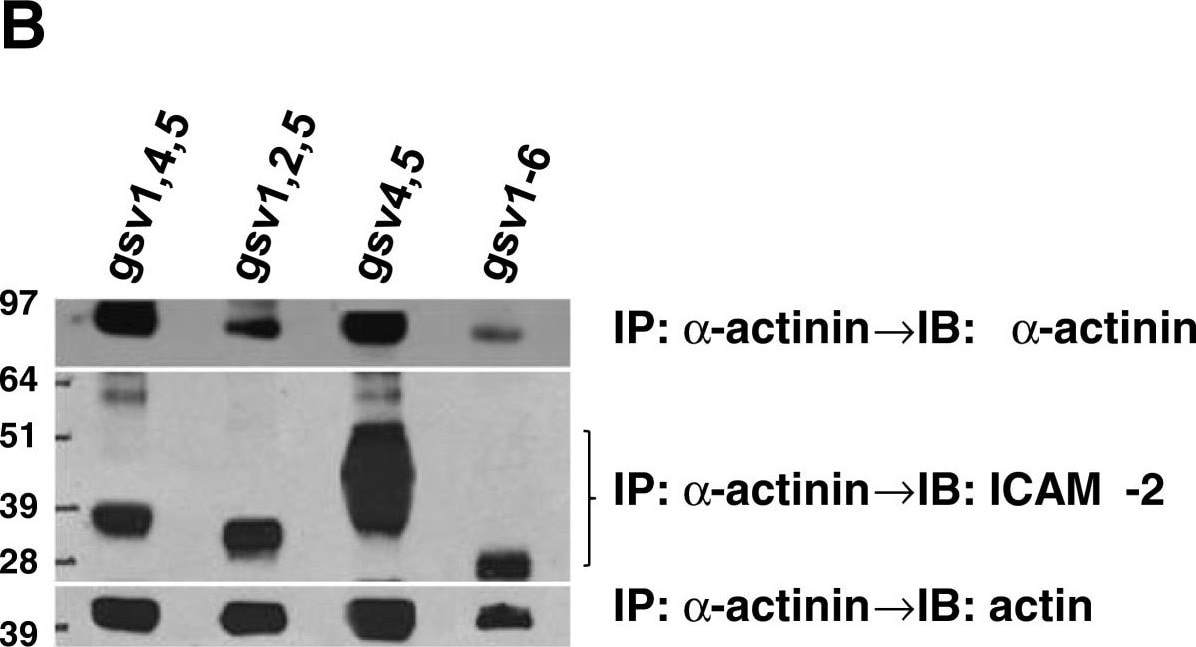
ICAM-2 WT and variants co-precipitated with alpha -actinin. A) IP/IB experiments with control cell lines demonstrate the expected association of ICAM-2, alpha -actinin and actin in lysates from SK-N-ASpIRES.ICAM-2 cells (labeled as WT), but not SK-N-ASpIRESneo cells (neo). Results for these control cell lines were published previously [13]. B) ICAM-2 glycosylation site variants associated simultaneously with alpha -actinin and actin. Immunoprecipitations (IP) were performed using whole cell lysates and a mouse monoclonal antibody to alpha -actinin (MAB1682, Millipore). Following protein separation by electrophoresis, immunoblots (IB) were performed with antibodies to alpha -actinin (sc-7454, Santa Cruz Biotech), ICAM-2 (AF244, R&D Systems), or actin (4968, Cell Signaling). The presence of ICAM-2 WT and variants in each preparation was confirmed by immunoblot analysis of input preparations (a representative blot is shown in Figure 2C) and also by immunoblot analysis of the proteins remaining in the supernatant following precipitation (not shown), to confirm the presence of sufficient/excess ICAM-2 protein or variant in each preparation used for immunoprecipitation experiments. Image collected and cropped by CiteAb from the following open publication (https://pubmed.ncbi.nlm.nih.gov/23714211), licensed under a CC-BY license. Not internally tested by R&D Systems.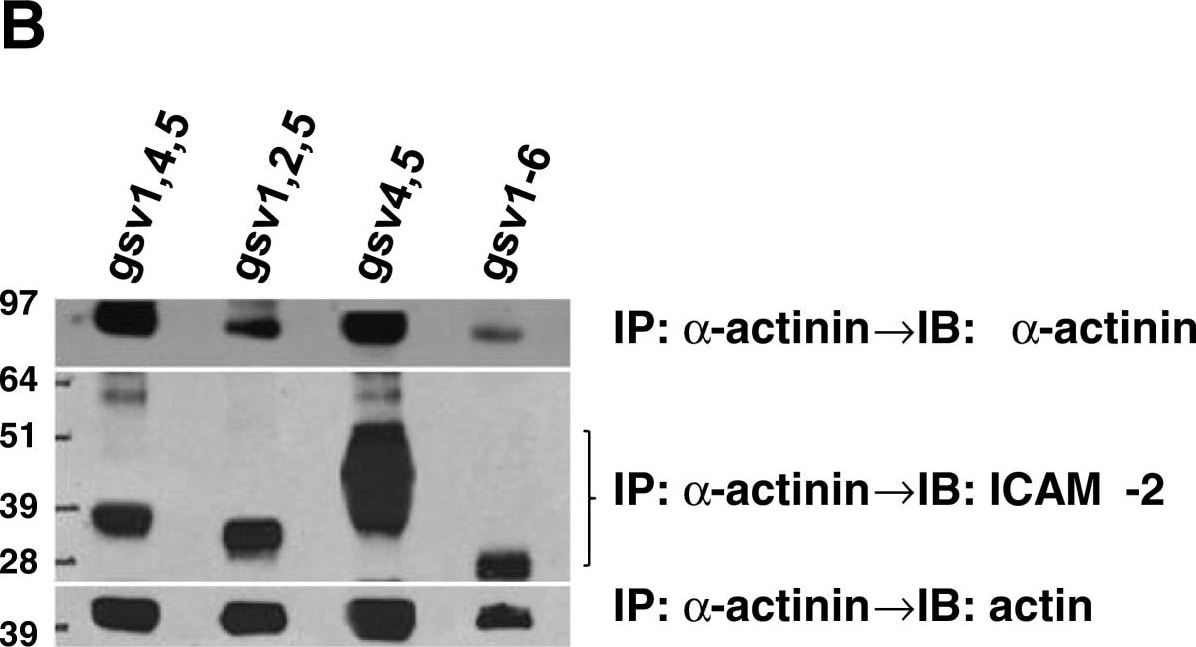
Detection of Human ICAM-2/CD102 by Western Blot
ICAM-2 WT and variants co-precipitated with alpha -actinin. A) IP/IB experiments with control cell lines demonstrate the expected association of ICAM-2, alpha -actinin and actin in lysates from SK-N-ASpIRES.ICAM-2 cells (labeled as WT), but not SK-N-ASpIRESneo cells (neo). Results for these control cell lines were published previously [13]. B) ICAM-2 glycosylation site variants associated simultaneously with alpha -actinin and actin. Immunoprecipitations (IP) were performed using whole cell lysates and a mouse monoclonal antibody to alpha -actinin (MAB1682, Millipore). Following protein separation by electrophoresis, immunoblots (IB) were performed with antibodies to alpha -actinin (sc-7454, Santa Cruz Biotech), ICAM-2 (AF244, R&D Systems), or actin (4968, Cell Signaling). The presence of ICAM-2 WT and variants in each preparation was confirmed by immunoblot analysis of input preparations (a representative blot is shown in Figure 2C) and also by immunoblot analysis of the proteins remaining in the supernatant following precipitation (not shown), to confirm the presence of sufficient/excess ICAM-2 protein or variant in each preparation used for immunoprecipitation experiments. Image collected and cropped by CiteAb from the following open publication (https://pubmed.ncbi.nlm.nih.gov/23714211), licensed under a CC-BY license. Not internally tested by R&D Systems.Applications for Human ICAM-2/CD102 Antibody
Application
Recommended Usage
Adhesion Blockade
The adhesion of HSB2 human peripheral blood acute lymphoblastic leukemia cells (5 x 10⁴ cells/well) to immobilized Recombinant Human ICAM-2 Fc Chimera (Catalog # 803-I2, 12.5 µg/mL, 100 µL/well) was maximally inhibited (80-100%) by 25 µg/mL of the antibody.
CyTOF-ready
Ready to be labeled using established conjugation methods. No BSA or other carrier proteins that could interfere with conjugation.
Flow Cytometry
2.5 µg/106 cells
Sample: Human peripheral blood monocytes
Sample: Human peripheral blood monocytes
Western Blot
0.1 µg/mL
Sample: Recombinant Human ICAM‑2/CD102 Fc Chimera (Catalog # 803-I2)
Sample: Recombinant Human ICAM‑2/CD102 Fc Chimera (Catalog # 803-I2)
Flow Cytometry Panel Builder
Bio-Techne Knows Flow Cytometry
Save time and reduce costly mistakes by quickly finding compatible reagents using the Panel Builder Tool.
Advanced Features
- Spectra Viewer - Custom analysis of spectra from multiple fluorochromes
- Spillover Popups - Visualize the spectra of individual fluorochromes
- Antigen Density Selector - Match fluorochrome brightness with antigen density

Formulation, Preparation, and Storage
Purification
Antigen Affinity-purified
Reconstitution
Reconstitute at 0.2 mg/mL in sterile PBS. For liquid material, refer to CoA for concentration.
Loading...
Formulation
Lyophilized from a 0.2 μm filtered solution in PBS with Trehalose. *Small pack size (SP) is supplied either lyophilized or as a 0.2 µm filtered solution in PBS.
Shipping
Lyophilized product is shipped at ambient temperature. Liquid small pack size (-SP) is shipped with polar packs. Upon receipt, store immediately at the temperature recommended below.
Stability & Storage
Use a manual defrost freezer and avoid repeated freeze-thaw cycles.
- 12 months from date of receipt, -20 to -70 °C as supplied.
- 1 month, 2 to 8 °C under sterile conditions after reconstitution.
- 6 months, -20 to -70 °C under sterile conditions after reconstitution.
Calculators
Background: ICAM-2/CD102
References
- Somersalo, K. et al. (1995) J. Biol. Chem. 270:8629.
- Hayflick, J. et al. (1998) Immunologic Res. 17:313.
Long Name
Intercellular Adhesion Molecule 2
Alternate Names
CD102, ICAM2
Gene Symbol
ICAM2
UniProt
Additional ICAM-2/CD102 Products
Product Documents for Human ICAM-2/CD102 Antibody
Certificate of Analysis
To download a Certificate of Analysis, please enter a lot or batch number in the search box below.
Note: Certificate of Analysis not available for kit components.
Product Specific Notices for Human ICAM-2/CD102 Antibody
For research use only
Citations for Human ICAM-2/CD102 Antibody
 Powered by Bioz
Customer Reviews for Human ICAM-2/CD102 Antibody
There are currently no reviews for this product. Be the first to review Human ICAM-2/CD102 Antibody and earn rewards!
Have you used Human ICAM-2/CD102 Antibody?
Submit a review and receive an Amazon gift card!
$25/€18/£15/$25CAN/¥2500 for a review with an image
$10/€7/£6/$10CAN/¥1110 for a review without an image
Submit a review
Protocols
Find general support by application which include: protocols, troubleshooting, illustrated assays, videos and webinars.
- 7-Amino Actinomycin D (7-AAD) Cell Viability Flow Cytometry Protocol
- Cellular Response to Hypoxia Protocols
- Extracellular Membrane Flow Cytometry Protocol
- Flow Cytometry Protocol for Cell Surface Markers
- Flow Cytometry Protocol for Staining Membrane Associated Proteins
- Flow Cytometry Staining Protocols
- Flow Cytometry Troubleshooting Guide
- Intracellular Flow Cytometry Protocol Using Alcohol (Methanol)
- Intracellular Flow Cytometry Protocol Using Detergents
- Intracellular Nuclear Staining Flow Cytometry Protocol Using Detergents
- Intracellular Staining Flow Cytometry Protocol Using Alcohol Permeabilization
- Intracellular Staining Flow Cytometry Protocol Using Detergents to Permeabilize Cells
- Propidium Iodide Cell Viability Flow Cytometry Protocol
- Protocol for Liperfluo
- Protocol for the Characterization of Human Th22 Cells
- Protocol for the Characterization of Human Th9 Cells
- Protocol: Annexin V and PI Staining by Flow Cytometry
- Protocol: Annexin V and PI Staining for Apoptosis by Flow Cytometry
- R&D Systems Quality Control Western Blot Protocol
- Troubleshooting Guide: Fluorokine Flow Cytometry Kits
- Troubleshooting Guide: Western Blot Figures
- Western Blot Conditions
- Western Blot Protocol
- Western Blot Protocol for Cell Lysates
- Western Blot Troubleshooting
- Western Blot Troubleshooting Guide
- View all Protocols, Troubleshooting, Illustrated assays and Webinars
Loading...