
JunD is a member of the Jun family of nuclear transcription factors. It dimerizes with other Jun or FOS family members to form the AP1 transcription factor. Unlike c-Jun or JunB, JunD antagonizes Ras transformation and accumulates as cells enter quiescence. JunD has two isoforms full length at 347 amino acids (aa), the other 303 aa which initiates translation at aa 44. Over the sequence used as an immunogen, human JunD shares 80% aa identity with mouse and rat JunD. The activation of JunD appears to reduce the proliferation of breast cancer cells.

Scientific images may be resized, cropped, or adjusted for brightness or contrast for presentation purposes. These updates are limited to presentation and do not affect the underlying scientific interpretation of the data. Where available, additional source data may be provided upon request.
Key Product Details
Species Reactivity
Validated:
Human, Mouse
Cited:
Mouse
Applications
Validated:
Western Blot
Cited:
Western Blot
Label
Unconjugated
Antibody Source
Polyclonal Goat IgG
Loading...
Product Specifications
Immunogen
E. coli-derived recombinant human JunD
Lys47-Gly156
Accession # P17535
Lys47-Gly156
Accession # P17535
Specificity
Detects human and mouse JunD in Western blots.
Clonality
Polyclonal
Host
Goat
Isotype
IgG
Scientific Data Images for JunD Antibody
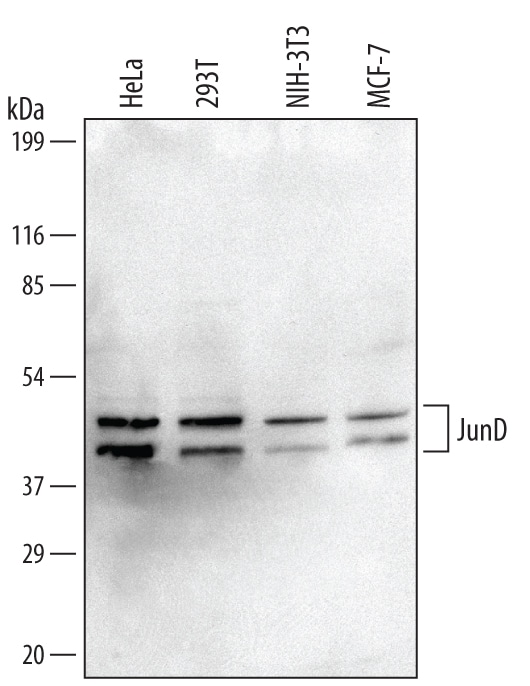
Detection of Human and Mouse JunD by Western Blot.
Western blot shows lysates of HeLa human cervical epithelial carcinoma cell line, 293T human embryonic kidney cell line, NIH-3T3 mouse embryonic fibroblast cell line, and MCF-7 human breast cancer cell line. PVDF Membrane was probed with 1 µg/mL of Goat Anti-Human/Mouse JunD Antigen Affinity-purified Polyclonal Antibody (Catalog # AF5526) followed by HRP-conjugated Anti-Goat IgG Secondary Antibody (Catalog # HAF109). Specific bands were detected for JunD at approximately 40 and 45 kDa (as indicated). This experiment was conducted under reducing conditions and using Immunoblot Buffer Group 2.Applications for JunD Antibody
Application
Recommended Usage
Western Blot
1 µg/mL
Sample: HeLa human cervical epithelial carcinoma cell line, 293T human embryonic kidney cell line, NIH‑3T3 mouse embryonic fibroblast cell line, and MCF‑7 human breast cancer cell line
Sample: HeLa human cervical epithelial carcinoma cell line, 293T human embryonic kidney cell line, NIH‑3T3 mouse embryonic fibroblast cell line, and MCF‑7 human breast cancer cell line
Formulation, Preparation, and Storage
Purification
Antigen Affinity-purified
Reconstitution
Reconstitute at 0.2 mg/mL in sterile PBS. For liquid material, refer to CoA for concentration.
Loading...
Formulation
Lyophilized from a 0.2 μm filtered solution in PBS with Trehalose. *Small pack size (SP) is supplied either lyophilized or as a 0.2 µm filtered solution in PBS.
Shipping
Lyophilized product is shipped at ambient temperature. Liquid small pack size (-SP) is shipped with polar packs. Upon receipt, store immediately at the temperature recommended below.
Stability & Storage
Use a manual defrost freezer and avoid repeated freeze-thaw cycles.
- 12 months from date of receipt, -20 to -70 °C as supplied.
- 1 month, 2 to 8 °C under sterile conditions after reconstitution.
- 6 months, -20 to -70 °C under sterile conditions after reconstitution.
Calculators
Background: JunD
Long Name
JunD Proto-oncogene
Alternate Names
AP-1
Gene Symbol
JUND
UniProt
Additional JunD Products
Product Documents for JunD Antibody
Certificate of Analysis
To download a Certificate of Analysis, please enter a lot or batch number in the search box below.
Note: Certificate of Analysis not available for kit components.
Product Specific Notices for JunD Antibody
For research use only
Citations for JunD Antibody
 Powered by Bioz
Customer Reviews for JunD Antibody
There are currently no reviews for this product. Be the first to review JunD Antibody and earn rewards!
Have you used JunD Antibody?
Submit a review and receive an Amazon gift card!
$25/€18/£15/$25CAN/¥2500 for a review with an image
$10/€7/£6/$10CAN/¥1110 for a review without an image
Submit a review
Protocols
Find general support by application which include: protocols, troubleshooting, illustrated assays, videos and webinars.
- Cellular Response to Hypoxia Protocols
- R&D Systems Quality Control Western Blot Protocol
- Troubleshooting Guide: Western Blot Figures
- Western Blot Conditions
- Western Blot Protocol
- Western Blot Protocol for Cell Lysates
- Western Blot Troubleshooting
- Western Blot Troubleshooting Guide
- View all Protocols, Troubleshooting, Illustrated assays and Webinars
Loading...
Associated Pathways



NOD-like Receptor Signaling Pathways
 Pathogen or Damage-activated C-Type Lectin Receptor Signaling Pathways
 TGF-beta Signaling Pathways
 Th1 Differentiation Pathway
 Toll-Like Receptor Signaling Pathways
 VEGF - VEGF R2 Signaling Pathways
