
TGF-beta Signaling Pathways
CoR
ATF1
ATF2
ATF4
c-Fos
CREB
ER alpha/NR3A1
ER beta/NR3A2
FosB/G0S3
FoxH1
FoxO1/FKHR
FoxO3
FRA-1
GLI-3
GR/NR3C1
GR/NR3C1
HNF-4 alpha/NR2A1
HNF-4 gamma/NR2A2
JunB
c-Jun
JunD
Max
MEF2C
c-Myc
MyoD
NFkB1
NFkB2
OASIS/CREB3L1
PPAR gamma/NR1C3
RelA/NFkB p65
RelB
c-Rel
RUNX1/CBFA2
RUNX2/CBFA1
RUNX3/CBFA3
ATF1
ATF2
ATF4
c-Fos
CREB
ER alpha/NR3A1
ER beta/NR3A2
FosB/G0S3
FoxH1
FoxO1/FKHR
FoxO3
FRA-1
GLI-3
GR/NR3C1
GR/NR3C1
HNF-4 alpha/NR2A1
HNF-4 gamma/NR2A2
JunB
c-Jun
JunD
Max
MEF2C
c-Myc
MyoD
NFkB1
NFkB2
OASIS/CREB3L1
PPAR gamma/NR1C3
RelA/NFkB p65
RelB
c-Rel
RUNX1/CBFA2
RUNX2/CBFA1
RUNX3/CBFA3
Cleavage/ICD Nuclear Translocation
Degradation
Featured Literature

TGF-beta Signaling Regulates the Expression of Multiple Target Genes with Tumor-Suppressing & Tumor-Promoting Effects Poster

Overview of TGF-beta Signaling
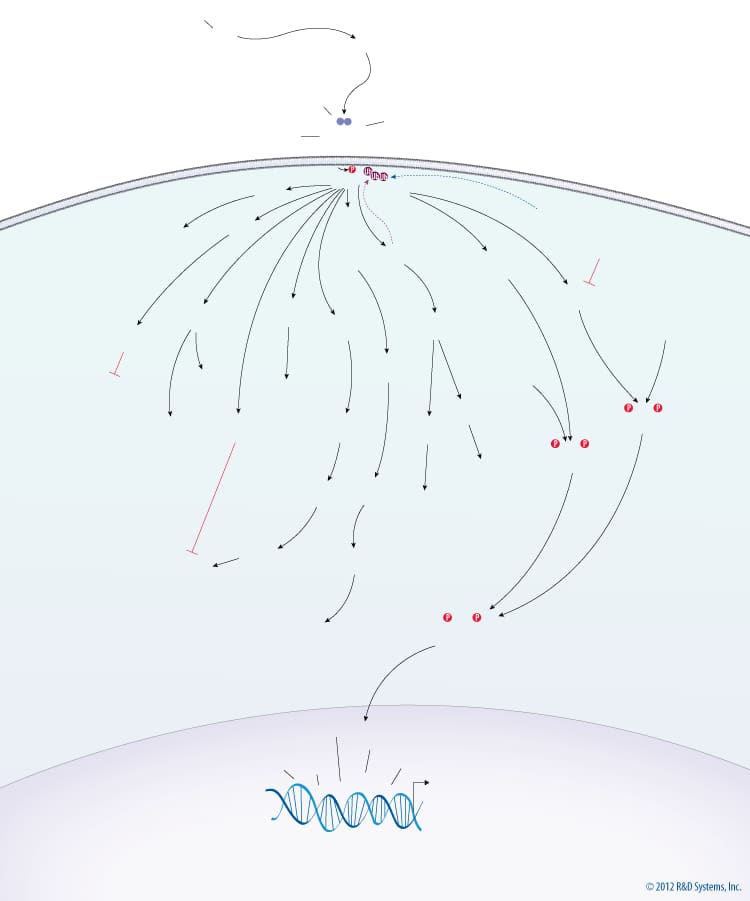
TGF-beta proteins are highly pleiotropic cytokines that regulate a diverse range of processes during development and adult tissue homeostasis, including cell proliferation, apoptosis, autophagy, inflammation, angiogenesis, and epithelial-to-mesenchymal transition. TGF-beta molecules are normally secreted as part of an inactive, latent complex that consists of an N-terminal latency-associated peptide (LAP) and a C-terminal mature TGF-beta monomer. Disulfide-linked homodimers of LAP and TGF-beta remain noncovalently associated after secretion, forming the small latent TGF-beta complex. Covalent linkage of LAP to one of three latent TGF-beta binding proteins (LTBPs) creates a large latent complex that may interact with the extracellular matrix. Activation of TGF-beta is controlled both spatially and temporally by the actions of proteases or select integrins.
TGF-beta signals through a heterotetrameric receptor complex composed of two type I and two type II transmembrane receptor subunits with serine/threonine kinase domains. Following ligand binding, the type II receptor (TGF-beta RII) phosphorylates the type I receptor (TGF-beta RI), leading to recruitment and phosphorylation of Smad2 and Smad3 in most cell types. Alternatively, Smad1 and Smad5 can be activated by TGF-beta signaling in some cell types depending on the type I receptor that is expressed. Activated Smad proteins associate with Smad4 and translocate to the nucleus, where they recruit additional transcriptional regulators, including DNA-binding transcription factors, co-activators, co-repressors, and chromatin remodeling factors, that control the expression of numerous target genes. Differential expression of these factors may be responsible for some of the cell type-specific responses to TGF-beta. Accessory proteins such as soluble or membrane-bound regulators or co-receptors can also affect TGF-beta signaling. In addition, TGF-beta can activate a number of Smad-independent signaling pathways, including Ras/MAPK, PI 3-K/Akt, p38, JNK, and RhoA/ROCK in a cell type-specific and context-dependent manner. Activation of these pathways may also contribute to the cellular responses induced by TGF-beta.
To learn more, please visit our TGF-beta Superfamily Research Area.
