
Progranulin, also known as acrogranin, PC cell-derived growth factor (PCDGF) and epithelin/granulin precursor, is a ubiquitously expressed, 88 kDa, secreted glycoprotein (1‑3). Structurally, it does not belong to any of the well-established growth factor families (4). Human Progranulin is 593 amino acids (aa) in length and contains a 17 aa signal sequence and 5 potential sites for N-linked glycosylation. It has a highly repetitive organization, containing seven tandem copies of a 55‑57 aa consensus motif that contains 12 conserved cysteine residues: VxCx5-6Cx5CCx8CCx6CCxDx2HCCPx4Cx5-6Cx2 (1). There is one alternate splice form for human Progranulin. This has a deletion of aa corresponding to aa 377‑531 of the standard form. Progranulin is secreted as a full length form (2, 4), and may undergo proteolysis leading to the release of numerous peptides made from the seven tandem repeats, called the granulins (5‑7). Human Progranulin shares 75% aa sequence identity with mouse and rat Progranulin. Progranulin is involved in the regulation of cellular proliferation, as well as differentiation, development, and pathological processes (4). It has been isolated as a differentially expressed gene during mesothelial differentiation (8), macrophage development (9), the development of rheumatoid arthritis and osteoarthritis (10), sexual differentiation of the brain (11), and has also been shown to be a mediator of cartilage proliferation and of wound response and tissue repair (4, 12‑13). High levels of Progranulin expression have been found to be associated with several human cancers and are believed to contribute to tumorigenesis in breast cancer, clear cell renal carcinoma, invasive ovarian carcinoma, glioblastoma, adipocyte teratoma, and multiple myeloma
(4‑5, 12, 14‑19). In addition, mutations in the Progranulin gene are a cause of frontotemporal dementia, and increased expression of Progranulin is seen in activated microglia in many neurodegenerative diseases including Creutzfeldt-Jakob disease, motor neuron disease and Alzheimer's disease (20). Mutations in Progranulin causing neurodegenerative disease indicate that Progranulin is important for neuronal survival (20).
Human Progranulin/PGRN Antibody (296628)
R&D Systems | Catalog # MAB2420

Scientific images may be resized, cropped, or adjusted for brightness or contrast for presentation purposes. These updates are limited to presentation and do not affect the underlying scientific interpretation of the data. Where available, additional source data may be provided upon request.
Key Product Details
Species Reactivity
Validated:
Cited:
Applications
Validated:
Cited:
Label
Antibody Source
Product Specifications
Immunogen
Thr18-Leu593
Accession # P28799
Specificity
Clonality
Host
Isotype
Scientific Data Images for Human Progranulin/PGRN Antibody (296628)
Detection of Human Progranulin/PGRN by Western Blot
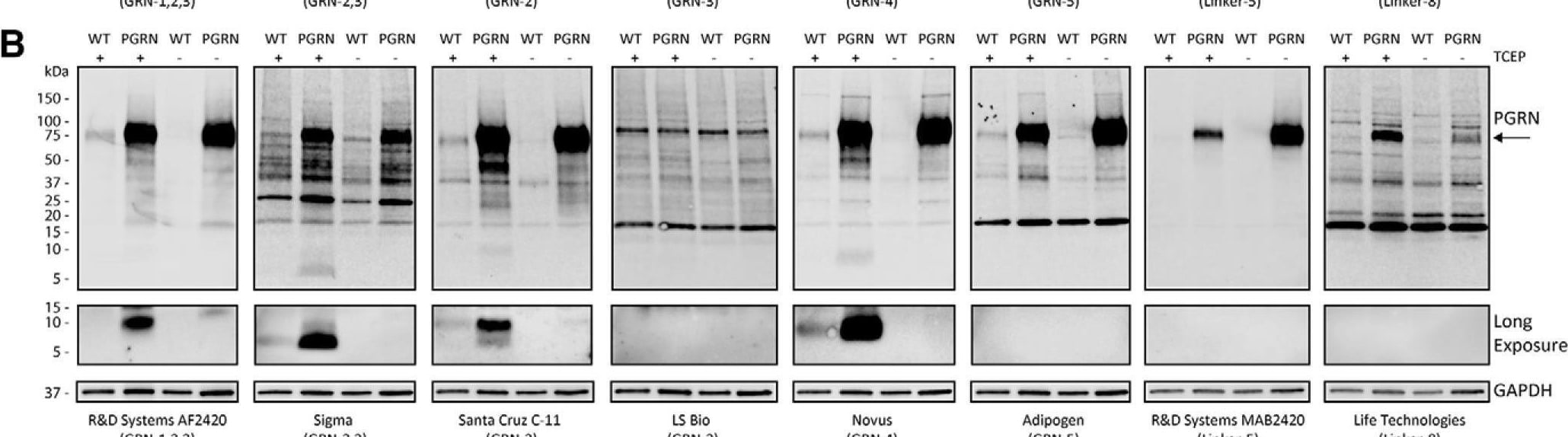
Specificity of PGRN antibodies and detection of multiple endogenous GRNs. A, Whole-cell lysates from HAP1 WT and HAP1 PGRN KO cells, either reduced (+TCEP) or nonreduced (-TCEP), were analyzed for PGRN antibody specificity by immunoblot. The bottoms of the blots (<15 kDa) were exposed longer to reveal levels of endogenous GRNs. B, Whole-cell lysates from HEK293T WT and N-TAP PGRN stable overexpressing (PGRN) cells were analyzed as in A by immunoblot. C, Representative immunofluorescent images of HAP1 PGRN KO and WT cells stained with the corresponding PGRN antibodies as in A and B. Scale bar, 10 µm. Image collected and cropped by CiteAb from the following open publication (https://pubmed.ncbi.nlm.nih.gov/28828399), licensed under a CC-BY license. Not internally tested by R&D Systems.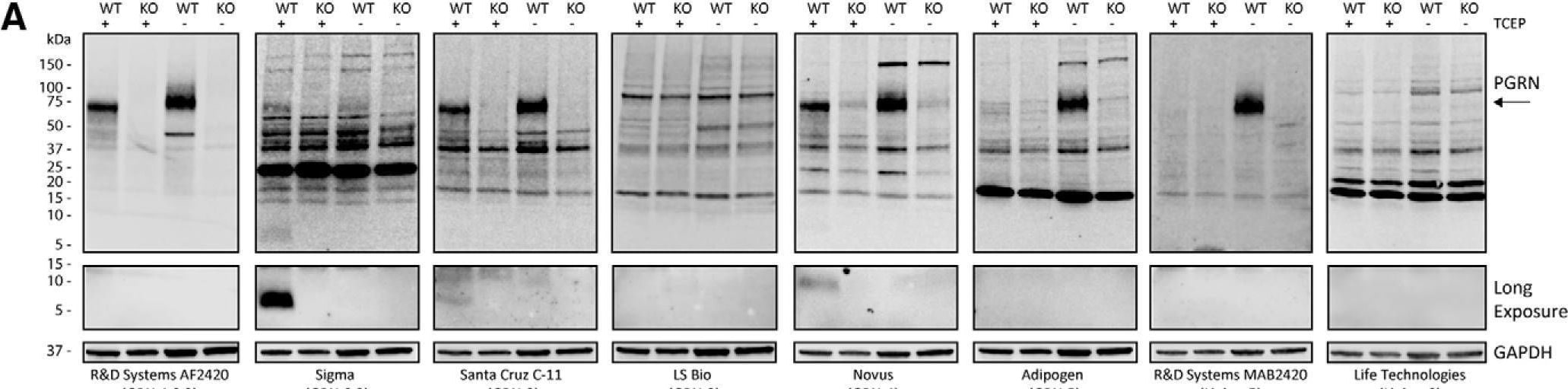
Detection of Human Progranulin/PGRN by Western Blot
Specificity of PGRN antibodies and detection of multiple endogenous GRNs. A, Whole-cell lysates from HAP1 WT and HAP1 PGRN KO cells, either reduced (+TCEP) or nonreduced (-TCEP), were analyzed for PGRN antibody specificity by immunoblot. The bottoms of the blots (<15 kDa) were exposed longer to reveal levels of endogenous GRNs. B, Whole-cell lysates from HEK293T WT and N-TAP PGRN stable overexpressing (PGRN) cells were analyzed as in A by immunoblot. C, Representative immunofluorescent images of HAP1 PGRN KO and WT cells stained with the corresponding PGRN antibodies as in A and B. Scale bar, 10 µm. Image collected and cropped by CiteAb from the following open publication (https://pubmed.ncbi.nlm.nih.gov/28828399), licensed under a CC-BY license. Not internally tested by R&D Systems.Applications for Human Progranulin/PGRN Antibody (296628)
Immunoprecipitation
Sample: Conditioned cell culture medium spiked with Recombinant Human Progranulin (Catalog # 2420-PG), see our available Western blot detection antibodies
Western Blot
Sample: Recombinant Human Progranulin (Catalog # 2420-PG) under non-reducing conditions only
Reviewed Applications
Read 4 reviews rated 4 using MAB2420 in the following applications:
Formulation, Preparation, and Storage
Purification
Reconstitution
Reconstitute at 0.5 mg/mL in sterile PBS. For liquid material, refer to CoA for concentration.
Formulation
Shipping
Stability & Storage
- 12 months from date of receipt, -20 to -70 °C as supplied.
- 1 month, 2 to 8 °C under sterile conditions after reconstitution.
- 6 months, -20 to -70 °C under sterile conditions after reconstitution.
Calculators
Background: Progranulin/PGRN
References
- Plowman, G.D. et al. (1992) J. Biol. Chem. 267:13073.
- Zhou, J. et al. (1993) J. Biol. Chem. 268:10863.
- Liu, Y. et al. (2007) BMC Cancer 7:22.
- Xu, K. et al. (2007) J. Biol. Chem. 282:11347.
- Davidson, B. et al. (2004) Cancer 100:2139.
- Zanocco-Marani, T. et al. (1999) Cancer Res. 59:5331.
- Lu, R. and G. Serrero (2000) Proc. Natl. Acad. Sci. U.S.A. 97:3993.
- Sun, X. et al. (2004) Am. J. Respir. Cell Mol. Biol. 30:510.
- Barreda, D.R. et al. (2004) Dev. Comp. Immunol. 28:727.
- Justen, H.P. et al. (2000) Mol. Cell Biol. Res. Commun. 3:165.
- Suzuki, M. and M. Nishiahara (2002) Mol. Genet. Metab. 75:31.
- He, Z. et al. (2003) Nat. Med. 9:225.
- Zhu, J. et al. (2002) Cell 111:867.
- He, Z. and A. Bateman (2003) J. Mol. Med. 81:600.
- Bateman, A. et al. (1990) Biochem. Biophys. Res. Commun. 173:1161.
- Gonzalez, E.M. et al. (2003) J. Biol. Chem. 278:38113.
- Jones, M.B. et al. (2003) Gynecol. Oncol. 88:S136.
- Wang, W. et al. (2003) Clin. Cancer Res. 9:2221.
- Zhang, H. and G. Serrero (1998) Proc. Natl. Acad. Sci. U.S.A. 95:14202.
- Baker, M. et al. (2006) Nature 442:916.
Alternate Names
Gene Symbol
UniProt
Additional Progranulin/PGRN Products
Product Documents for Human Progranulin/PGRN Antibody (296628)
Certificate of Analysis
To download a Certificate of Analysis, please enter a lot or batch number in the search box below.
Note: Certificate of Analysis not available for kit components.
Product Specific Notices for Human Progranulin/PGRN Antibody (296628)
For research use only
Related Research Areas
Citations for Human Progranulin/PGRN Antibody (296628)
 Powered by Bioz
Customer Reviews for Human Progranulin/PGRN Antibody (296628) (4)
Have you used Human Progranulin/PGRN Antibody (296628)?
Submit a review and receive an Amazon gift card!
$25/€18/£15/$25CAN/¥2500 for a review with an image
$10/€7/£6/$10CAN/¥1110 for a review without an image
Submit a review
Customer Images

-
Application: MicroarraysSample Tested: EDTA PlasmaSpecies: HumanVerified Customer | Posted 06/10/2020

-
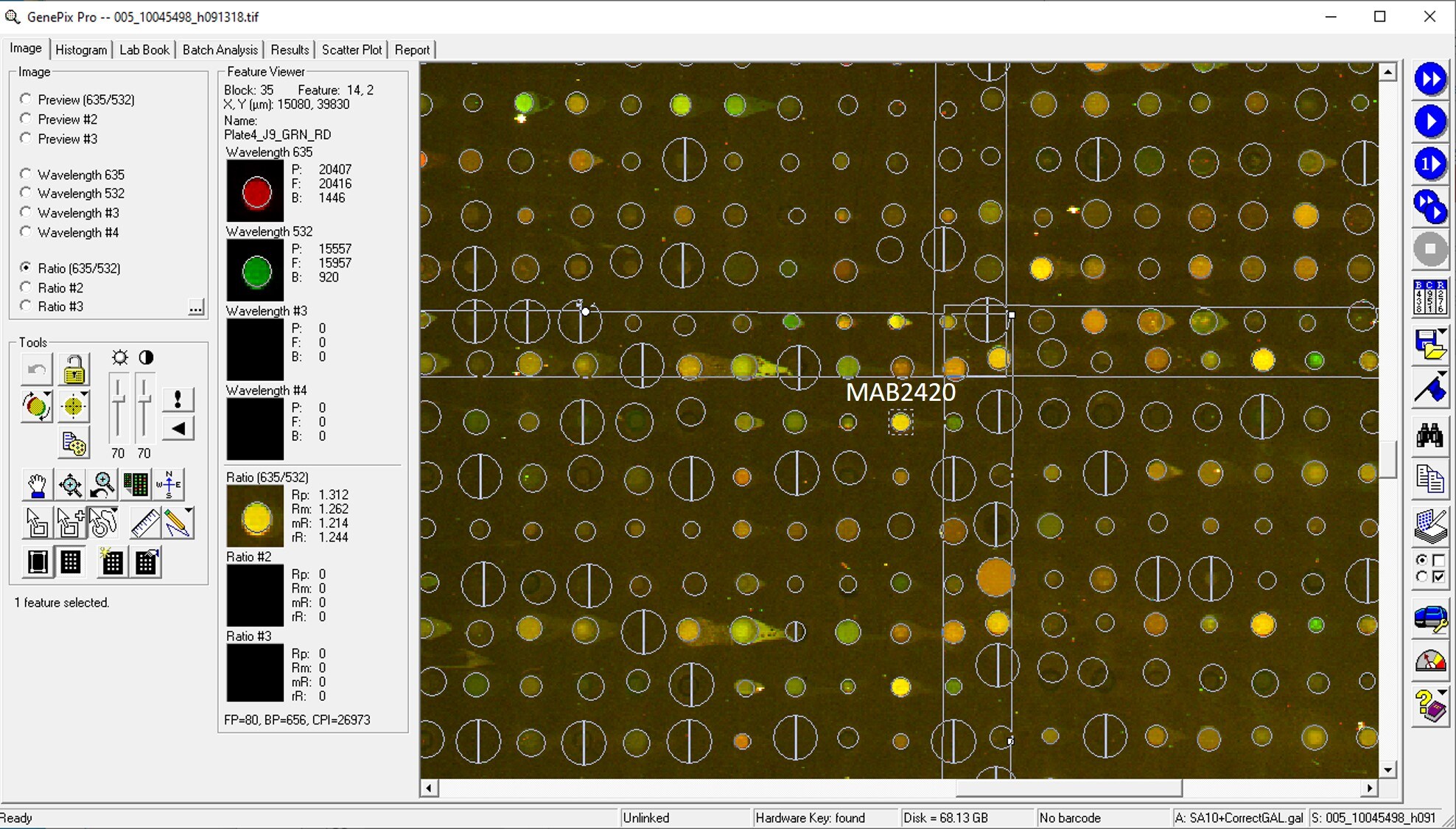
Application: MicroarraySample Tested: EDTA PlasmaSpecies: HumanVerified Customer | Posted 02/07/2020Antibody was printed on custom arrays and incubated with fluorescently labeled human EDTA plasma
-
Application: ELISASample Tested: Serum and PlasmaSpecies: HumanVerified Customer | Posted 11/11/2018
-
Application: MicroarraysSample Tested: EDTA PlasmaSpecies: HumanVerified Customer | Posted 11/07/2018
There are no reviews that match your criteria.
Protocols
Find general support by application which include: protocols, troubleshooting, illustrated assays, videos and webinars.
- Cellular Response to Hypoxia Protocols
- Immunoprecipitation Protocol
- R&D Systems Quality Control Western Blot Protocol
- Troubleshooting Guide: Western Blot Figures
- Western Blot Conditions
- Western Blot Protocol
- Western Blot Protocol for Cell Lysates
- Western Blot Troubleshooting
- Western Blot Troubleshooting Guide
- View all Protocols, Troubleshooting, Illustrated assays and Webinars