Mouse IL-1ra/IL-1F3 DuoSet ELISA

R&D Systems | Catalog # DY480

R&D Systems
Loading...

Key Product Details

Assay Type

Solid Phase Sandwich ELISA

Assay Range

156-10000 pg/mL

Sample Type

Cell culture supernates, serum, and plasma
Note: Diluents for complex matrices, such as serum and plasma, should be evaluated prior to use in this DuoSet

Reactivity

Mouse

Mouse IL-1ra/IL-1F3 DuoSet ELISA Features

  • Optimized capture and detection antibody pairings with recommended concentrations save lengthy development time
  • Development protocols are provided to guide further assay optimization
  • Assay can be customized to your specific needs
  • Economical alternative to complete kits
Loading...

Product Summary for Mouse IL-1ra/IL-1F3 DuoSet ELISA

This DuoSet ELISA Development kit contains the basic components required for the development of sandwich ELISAs to measure natural and recombinant mouse IL-1ra/IL-1F3. The suggested diluent is suitable for the analysis of most cell culture supernate samples. Diluents for complex matrices, such as serum and plasma, should be evaluated prior to use in this DuoSet.

Product Specifications

Assay Format

96-well strip plate (sold separately)

Sample Volume Required

100 µL

Detection Method

Colorimetric ELISA - 450nm (TMB)

Conjugate

Biotin

Label

HRP

Scientific Data Images for Mouse IL-1ra/IL-1F3 DuoSet ELISA

Mouse IL-1ra / IL-1F3 ELISA Standard Curve

Mouse IL-1ra / IL-1F3 ELISA Standard Curve

Kit Contents for Mouse IL-1ra/IL-1F3 DuoSet ELISA

  • Capture Antibody
  • Detection Antibody
  • Recombinant Standard
  • Streptavidin conjugated to horseradish-peroxidase (Streptavidin-HRP)

Other Reagents Required

DuoSet Ancillary Reagent Kit 2 (5 plates): (Catalog # DY008) containing 96 well microplates, plate sealers, substrate solution, stop solution, plate coating buffer (PBS), wash buffer, and Reagent Diluent Concentrate 2.

The components listed above may be purchased separately:

PBS: (Catalog # DY006), or 137 mM NaCl, 2.7 mM KCl, 8.1 mM Na2HPO4, 1.5 mM KH2PO4, pH 7.2 - 7.4, 0.2 µm filtered

Wash Buffer: (Catalog # WA126), or 0.05% Tween® 20 in PBS, pH 7.2-7.4

Reagent Diluent: (Catalog # DY995), or 1% BSA in PBS, pH 7.2-7.4, 0.2 µm filtered

Substrate Solution: 1:1 mixture of Color Reagent A (H2O2) and Color Reagent B (Tetramethylbenzidine) (Catalog # DY999)

Stop Solution: 2 N H2SO4 (Catalog # DY994)

Microplates: R&D Systems (Catalog # DY990)

Plate Sealers: ELISA Plate Sealers (Catalog # DY992)

Preparation and Storage

Shipping

The product is shipped at ambient temperature. Upon receipt, store it immediately at the temperature recommended below.

Stability & Storage

Store the unopened product at 2 - 8 °C. Do not use past expiration date.

Background: IL-1ra/IL-1F3

Mouse Interleukin-1 receptor antagonist (IL-1ra) is a 22-25 kDa glycoprotein produced by a variety of cell types that antagonizes IL-1 activity (1-3). It is a member of the IL-1 family of proteins that includes IL-1 alpha and IL-1 beta. Although there is little amino acid (aa) identity (< 30%) among the three IL-1 family members, all molecules bind to the same receptors, all show a beta -trefoil structure, all are physically placed on mouse chromosome # 2, and all are believed to have evolved from a common ancestral gene (1-4). Mouse IL-1ra is synthesized as a 178 aa precursor that contains a 26 aa signal sequence plus a 152 aa mature region. There is one intrachain disulfide bond and one potential N-linked glycosylation site (3, 5, 6). Mature mouse IL-1ra shares 90%, 77%, 80%, 80%, and 78% aa sequence identity to mature rat (4), human (7), porcine (8), canine (9), and equine (10) IL-1ra, respectively. In humans, three non-secreted IL-1ra isoforms have also been identified (11-14). These result from the use of alternate start sites or exon splicing. In mice, only one of the three human intracellular isoforms has been isolated. This mouse molecule is the ortholog of the 159 aa human intracellular isoform # 1 (6, 12). The mouse intracellular form differs from the secreted precursor by only three amino acids. Cells known to secrete IL-1ra include dermal fibroblasts (15), vascular smooth muscle cells (16), intestinal columnar epithelium (17), chondrocytes (18), macrophages (19), non-keratinized oral stratified squamous epithelium (20), mast cells (21), neutrophils and monocytes (22), Sertoli cells (23), and hepatocytes (24). 
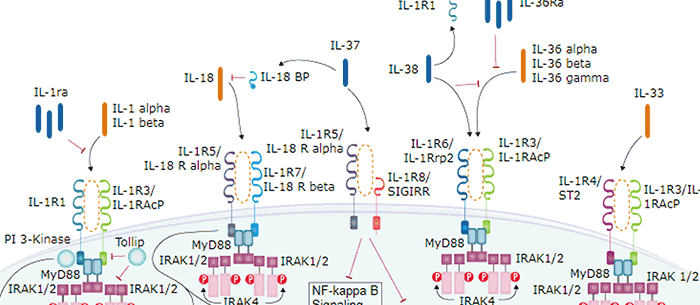
There are two type I transmembrane glycoprotein receptors for IL-1ra: the bioactive 80 kDa type I IL-1 receptor (IL-1 RI), and the inert (decoy) 65 kDa type II IL-1 receptor (IL-1 RII). IL-1ra binding to IL-1 RI competitively blocks IL-1 ( alpha or beta ) binding to the same receptor. Unlike the IL-1/IL-1 RI complex, the IL-1ra/IL-1 RI complex cannot recruit the IL-1 receptor accessory protein that is required for signal transduction. This results in receptor ligation without cell activation (1, 25). IL-1ra also competitively blocks IL-1 binding to the decoy IL-1 RII. In this case, IL-1ra may actually potentiate IL-1 activity by cancelling the functions of both antagonists. 
All activities attributed to IL-1ra are explained by its role as a competitive inhibitor of IL-1 binding to IL-1 RI (1, 2, 26, 27). In general, the ratio of IL-1ra to IL-1 beta is close to 1 in both health and disease (26, 28). To achieve total abrogation of IL-1 activity, more than 95% of all IL-1 RI receptors apparently need to be occupied by IL-1ra (29). Thus, local concentrations of secreted IL-1ra may be the critical determinants of IL-1 activity. The function of intracellular IL-1ra is less clear. While it would seem to be a simple competitor of IL-1 activity, its role may be limited to that of downmodulating non-specific inflammation associated with cell debris and death (14, 27). It has no action intracellularly; only when released through cell death would it then become a functional IL-1 antagonist.

Long Name

Interleukin 1 Receptor Antagonist

Alternate Names

DIRA, ICIL-1ra, IL-1F3, IL-1ra3, IL-1RN, IL1ra, IL1RN, MVCD4

Entrez Gene IDs

3557 (Human); 16181 (Mouse); 60582 (Rat); 397499 (Porcine); 100034236 (Equine)

Gene Symbol

IL1RN

Additional IL-1ra/IL-1F3 Products

Product Documents for Mouse IL-1ra/IL-1F3 DuoSet ELISA

Certificate of Analysis

To download a Certificate of Analysis, please enter a lot or batch number in the search box below.

Note: Certificate of Analysis not available for kit components.

Product Specific Notices for Mouse IL-1ra/IL-1F3 DuoSet ELISA

For research use only

Citations for Mouse IL-1ra/IL-1F3 DuoSet ELISA

Customer Reviews for Mouse IL-1ra/IL-1F3 DuoSet ELISA (1)

5 out of 5
1 Customer Rating
5 Stars
100%
4 Stars
0%
3 Stars
0%
2 Stars
0%
1 Stars
0%

Have you used Mouse IL-1ra/IL-1F3 DuoSet ELISA?

Submit a review and receive an Amazon gift card!

$25/€18/£15/$25CAN/¥2500 Yen for a review with an image

$10/€7/£6/$10CAN/¥1110 Yen for a review without an image

Submit a review
Amazon Gift Card

Customer Images


Showing  1 - 11 review Showing All
Filter By:
  • Mouse IL-1ra/IL-1F3 DuoSet ELISA
    Name: Anonymous
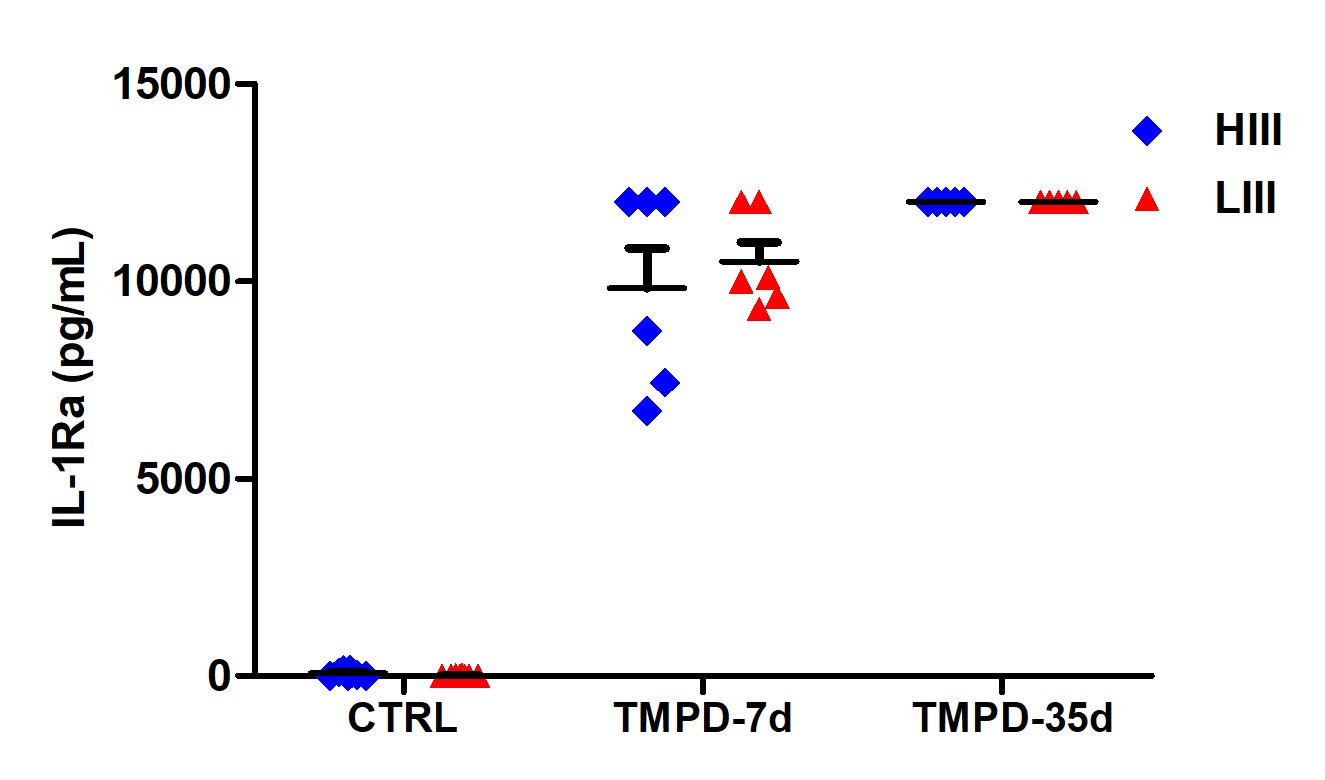
    Sample Tested: peritoneal lavage fluid
    Verified Customer | Posted 04/15/2019
    Mice (HIII and LIII strains) injected i.p. with 2,4,6,10 tetramethylpentadecane (pristane).
    Mouse IL-1ra/IL-1F3 DuoSet ELISA DY480

There are no reviews that match your criteria.

Showing  1 - 11 review Showing All

Protocols

View specific protocols for Mouse IL-1ra/IL-1F3 DuoSet ELISA (DY480):

GENERAL ELISA PROTOCOL

Plate Preparation

  1. Dilute the Capture Antibody to the working concentration in PBS without carrier protein. Immediately coat a 96-well microplate with 100 μL per well of the diluted Capture Antibody. Seal the plate and incubate overnight at room temperature.
  2. Aspirate each well and wash with Wash Buffer, repeating the process two times for a total of three washes. Wash by filling each well with Wash Buffer (400 μL) using a squirt bottle, manifold dispenser, or autowasher. Complete removal of liquid at each step is essential for good performance. After the last wash, remove any remaining Wash Buffer by aspirating or by inverting the plate and blotting it against clean paper towels.
  3. Block plates by adding 300 μL Reagent Diluent to each well. Incubate at room temperature for a minimum of 1 hour.
  4. Repeat the aspiration/wash as in step 2. The plates are now ready for sample addition.

Assay Procedure

  1. Add 100 μL of sample or standards in Reagent Diluent, or an appropriate diluent, per well. Cover with an adhesive strip and incubate 2 hours at room temperature.
  2. Repeat the aspiration/wash as in step 2 of Plate Preparation.
  3. Add 100 μL of the Detection Antibody, diluted in Reagent Diluent, to each well. Cover with a new adhesive strip and incubate 2 hours at room temperature.
  4. Repeat the aspiration/wash as in step 2 of Plate Preparation.
  5. Add 100 μL of the working dilution of Streptavidin-HRP to each well. Cover the plate and incubate for 20 minutes at room temperature. Avoid placing the plate in direct light.
  6. Repeat the aspiration/wash as in step 2.
  7. Add 100 μL of Substrate Solution to each well. Incubate for 20 minutes at room temperature. Avoid placing the plate in direct light.
  8. Add 50 μL of Stop Solution to each well. Gently tap the plate to ensure thorough mixing.
  9. Determine the optical density of each well immediately, using a microplate reader set to 450 nm. If wavelength correction is available, set to 540 nm or 570 nm. If wavelength correction is not available, subtract readings at 540 nm or 570 nm from the readings at 450 nm. This subtraction will correct for optical imperfections in the plate. Readings made directly at 450 nm without correction may be higher and less accurate.

Find general support by application which include: protocols, troubleshooting, illustrated assays, videos and webinars.

FAQs

No product specific FAQs exist for this product.

View all FAQs for ELISA Kits