
PRDC (protein related to DAN and Cerberus) is a secreted cysteine knot-containing BMP antagonist belonging to the Cerberus/DAN (CAN) family. Mammalian CAN family members, including Gremlin, Dan, Cerberus, COCO, SOST, and USAG-1, have the conserved 6 cysteine residues that form a cysteine knot, and two additional cysteine residues located in the loops of the cysteine knot, which form an additional intrasubunit disulfide bond (1, 2). Some members of this family, including PRDC, have an additional cysteine residue used for dimerization (1, 2). Of all the CAN family members, PRDC is most closely related to Gremlin, displaying 52% amino acid sequence identity. PRDC was first identified in a screen for developmentally regulated genes by gene trapping in embryonic stem cells (3). PRDC expression is detected by in situ hybridization in the dorsal edge of the spinal cord at E10.5, in commissural neurons in the caudal part of the spinal cord two days later (3), and in the granulosa cells of selective ovarian follicles (4). In the adult, abundant levels of PRDC are detected by RT-PCR in the mouse ovary, brain, and spleen, and to a lesser degree in the colon, kidney, lung, liver, and uterus (4). PRDC acts as a specific BMP antagonist, binding to and blocking signaling induced by BMP-2 or -4, but not Activin or TGF-beta (4). Thus, PRDC expression in the ovary could be involved in follicular development by antagonizing the inhibitory effects of BMPs on FSH stimulation of progesterone (4).
Mouse PRDC/GREM2 Antibody
R&D Systems | Catalog # AF2069


Scientific images may be resized, cropped, or adjusted for brightness or contrast for presentation purposes. These updates are limited to presentation and do not affect the underlying scientific interpretation of the data. Where available, additional source data may be provided upon request.
Key Product Details
Species Reactivity
Applications
Label
Antibody Source
Product Specifications
Immunogen
Arg22-Gln168
Accession # O88273
Specificity
Clonality
Host
Isotype
Scientific Data Images for Mouse PRDC/GREM2 Antibody
Mouse PRDC / GREM2 ELISA Standard Curve
Recombinant Mouse PRDC/GREM2 (Catalog # 2069-PR) was serially diluted and captured by Goat Anti-Mouse PRDC/GREM2 Antigen Affinity-purified Polyclonal Antibody (Catalog # AF2069) coated on a Clear Polystyrene Microplate (Catalog # DY990). Goat Anti-Mouse PRDC/GREM2 Antigen Affinity-purified Polyclonal Antibody (Catalog # AF2069) was biotinylated and incubated with the protein captured on the plate. Detection of the standard curve was achieved by incubating Streptavidin-HRP (Catalog # DY998)
Mouse PRDC / GREM2 ELISA Standard Curve
Recombinant Mouse PRDC/GREM2 (Catalog # 2069-PR) was serially diluted and captured by Goat Anti-Mouse PRDC/GREM2 Antigen Affinity-purified Polyclonal Antibody (Catalog # AF2069) coated on a Clear Polystyrene Microplate (Catalog # DY990). Goat Anti-Mouse PRDC/GREM2 Antigen Affinity-purified Polyclonal Antibody (Catalog # AF2069) was biotinylated and incubated with the protein captured on the plate. Detection of the standard curve was achieved by incubating Streptavidin-HRP (Catalog # DY998)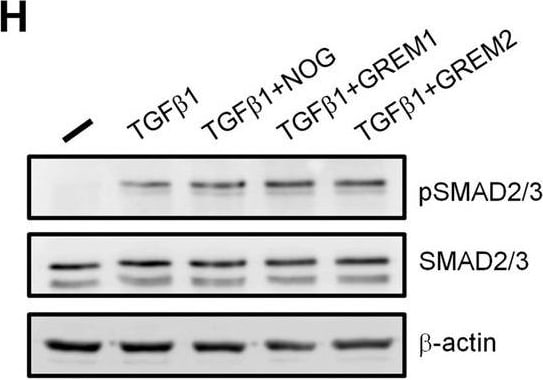
Detection of PRDC/GREM2 by Western Blot
NOG, GREM1, GREM2 have different antagonizing effects on BMP2, TGF-beta 1 and BMP8A. For testing the antagonisms to BMP2, BRE-Luc reporter-containing HEK293T cells were treated with BMP2 (1 nM) and graded doses of NOG (A), GREM1 (B) or GREM2 (C) as indicated. For testing the antagonisms to TGF-beta 1, CAGA-Luc reporter-containing HEK293T cells were treated with TGF-beta 1 (0.3 nM) and graded doses of NOG (E), GREM1 (F) or GREM2 (G) as indicated. For testing the antagonisms to BMP8A, BRE-Luc reporter-containing cells (I–K) or CAGA-Luc reporter-containing cells (M–O) were treated with BMP8A (1 nM) and graded doses of NOG (I and M), GREM1 (J and N) or GREM2 (K and O) as indicated. After treated overnight, reporter activity in the cells was measured. The luciferase data were normalized against the beta -galactosidase levels to correct for transfection efficiency and were expressed as fold changes by normalizing against the values obtained from control cells without treatment. Data are expressed as the mean ± SEM. n = 3. ***P < 0.001. For monitoring the phosphorylated SMAD levels, HEK293T cells were treated with BMP2 (D), TGF-beta 1 (H) or BMP8A (L and P) in the absence or presence of indicated antagonists (1 nM) for 30 min. Cell lysates were subjected to immunoblotting to detect the phosphorylated SMADs. Total forms of SMADs and beta -actin served as loading controls Image collected and cropped by CiteAb from the following open publication (https://pubmed.ncbi.nlm.nih.gov/36443839), licensed under a CC-BY license. Not internally tested by R&D Systems.Applications for Mouse PRDC/GREM2 Antibody
Western Blot
Sample: Recombinant Mouse PRDC (Catalog # 2069-PR)
Mouse PRDC Sandwich Immunoassay
Formulation, Preparation, and Storage
Purification
Reconstitution
Reconstitute at 0.2 mg/mL in sterile PBS. For liquid material, refer to CoA for concentration.
Formulation
Shipping
Stability & Storage
- 12 months from date of receipt, -20 to -70 °C as supplied.
- 1 month, 2 to 8 °C under sterile conditions after reconstitution.
- 6 months, -20 to -70 °C under sterile conditions after reconstitution.
Calculators
Background: PRDC/GREM2
References
- Pearce, J. et al. (1999) Dev. Biol. 209:99.
- Avsian-Kretchmer, O. and A. Hsueh (2004) Molecular Endocrinology 18:1.
- Minabe-Saegusa, C. et al. (1998) Develop. Growth Differ. 40:343.
- Sudo, S. et al. (2004) Jour. Biol. Chem. 279:23134.
Long Name
Alternate Names
Gene Symbol
UniProt
Additional PRDC/GREM2 Products
Product Documents for Mouse PRDC/GREM2 Antibody
Certificate of Analysis
To download a Certificate of Analysis, please enter a lot or batch number in the search box below.
Note: Certificate of Analysis not available for kit components.
Product Specific Notices for Mouse PRDC/GREM2 Antibody
For research use only
Related Research Areas
Citations for Mouse PRDC/GREM2 Antibody
 Powered by Bioz
Customer Reviews for Mouse PRDC/GREM2 Antibody
There are currently no reviews for this product. Be the first to review Mouse PRDC/GREM2 Antibody and earn rewards!
Have you used Mouse PRDC/GREM2 Antibody?
Submit a review and receive an Amazon gift card!
$25/€18/£15/$25CAN/¥2500 for a review with an image
$10/€7/£6/$10CAN/¥1110 for a review without an image
Submit a review
Protocols
Find general support by application which include: protocols, troubleshooting, illustrated assays, videos and webinars.
- Cellular Response to Hypoxia Protocols
- R&D Systems Quality Control Western Blot Protocol
- Troubleshooting Guide: Western Blot Figures
- Western Blot Conditions
- Western Blot Protocol
- Western Blot Protocol for Cell Lysates
- Western Blot Troubleshooting
- Western Blot Troubleshooting Guide
- View all Protocols, Troubleshooting, Illustrated assays and Webinars