
Siglecs (sialic acid binding Ig-like lectins) are I-type (Ig-type) lectins belonging to the Ig superfamily. They are characterized by an N‑terminal Ig-like V-type domain which mediates sialic acid binding, followed by varying numbers of Ig-like C2-type domains (1, 2). Eleven human Siglecs have been cloned and characterized. Among these are sialoadhesin/CD169/Siglec-1, CD22/Siglec-2 and CD33/Siglec-3. To date, no Siglec has been shown to recognize any cell surface ligand other than sialic acid, suggesting that interactions with glycans containing this carbohydrate are important in mediating the biological functions of Siglecs. The cDNA of mouse Siglec-2 (also known as B-cell antigen CD22), encodes an 862 amino acid (aa) protein that contains a 21 aa signal peptide, a 681 aa extracellular region, a 19 aa transmembrane region and a 141 aa cytoplasmic tail (3, 4). The extracellular region contains one N-terminal V-type Ig-like domain followed by six Ig-like C2-type domains. The cytoplasmic domain has 3 immunoreceptor tyrosine-based inhibition motifs (ITIMs). Two splice forms exist, both showing deletions in the V-type Ig domain of 30 aa and 60 aa each. There are also two alleles in mouse that account for a difference of 10 aa in the extracellular region. The extracellular region of mouse Siglec-2 is 60% aa identity to human extracellular Siglec-2. Expression of mouse Siglec-2/CD22 generates a 140 kDa integral membrane glycoprotein that is limited to the B cell compartment of lymphoid tissues. Its expression is upregulated by LPS activtion (5, 6). Siglec-2/CD22 is an adhesion molecule that preferentially binds alpha 2,6- linked sialic acid on the same (cis) or adjacent (trans) cells. Interaction of CD22 with trans ligands on opposing cells was found to be favored over the binding of ligands in cis (7).
Mouse Siglec-2/CD22 Antibody
R&D Systems | Catalog # AF2296


Scientific images may be resized, cropped, or adjusted for brightness or contrast for presentation purposes. These updates are limited to presentation and do not affect the underlying scientific interpretation of the data. Where available, additional source data may be provided upon request.
Key Product Details
Species Reactivity
Validated:
Cited:
Applications
Validated:
Cited:
Label
Antibody Source
Product Specifications
Immunogen
Ser22-Arg702
Accession # P35329
Specificity
Clonality
Host
Isotype
Endotoxin Level
Scientific Data Images for Mouse Siglec-2/CD22 Antibody
Cell Adhesion Mediated by Siglec‑2/CD22 and Neutral-ization by Mouse Siglec‑2/ CD22 Antibody.
Recombinant Mouse Siglec-2/ CD22 Fc Chimera (Catalog # 2296-SL), immobilized onto a microplate, supports the adhesion of human red blood cells in a dose-dependent manner (orange line). Adhesion elicited by Recombinant Mouse Siglec-2/ CD22 Fc Chimera (0.3 µg/mL) is neutralized (green line) by increasing concentrations of Goat Anti-Mouse Siglec-2/CD22 Antigen Affinity-purified Polyclonal Antibody (Catalog # AF2296). The ND50 is typically 0.1-0.5 µg/mL.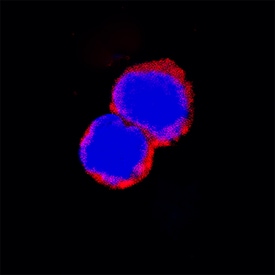
Siglec‑2/CD22 in Mouse Splenocytes.
Siglec-2/CD22 was detected in immersion fixed mouse splenocytes using Goat Anti-Mouse Siglec-2/CD22 Antigen Affinity-purified Polyclonal Antibody (Catalog # AF2296) at 15 µg/mL for 3 hours at room temperature. Cells were stained using the NorthernLights™ 557-conjugated Anti-Goat IgG Secondary Antibody (red; Catalog # NL001) and counterstained with DAPI (blue). Specific staining was localized to cell surfaces. View our protocol for Fluorescent ICC Staining of Non-adherent Cells.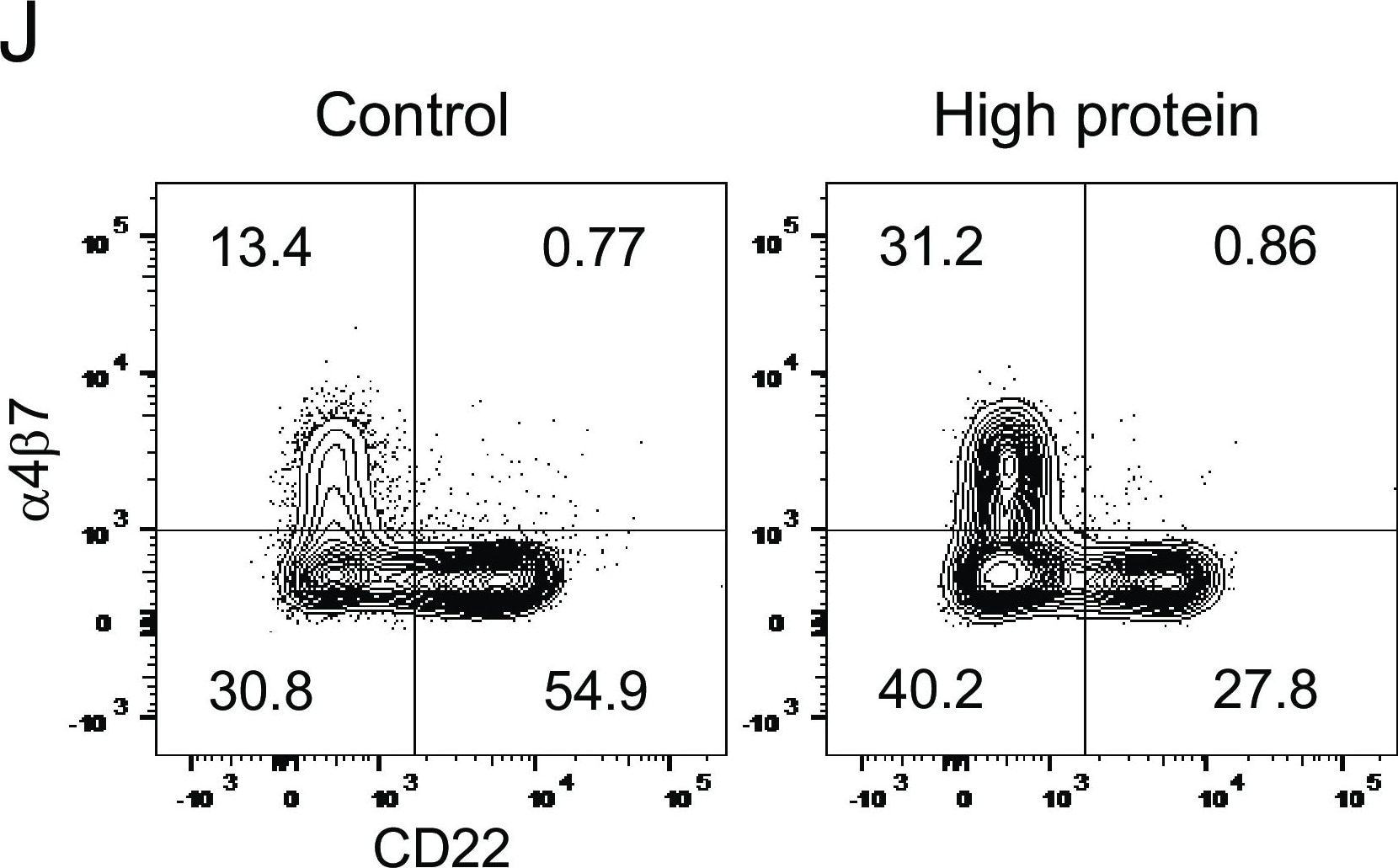
Detection of Siglec-2/CD22 by Flow Cytometry
High-protein diet reduces villus-resident CD22+ eosinophils. (A) Percent of kilocalories (% kCal) from different macronutrients for diets shown in B. RP = reduced (8%) protein, C = control (18% protein), HP = high (70%) protein, and HF = high fat. (B) Eosinophil frequency in the proximal SI lamina propria (LP) of mice fed diets containing variable macronutrient composition for 15 d, representative of at least 3 experiments with 3 to 4 mice per group. (C and D) Eosinophil frequency (C) and number (D) in the proximal SI LP of mice fed diets containing the indicated percentage of protein (15 d), representative of 2 experiments with 4 to 6 mice per group. (E) Eosinophil frequency in proximal SI LP of mice fed either C, HP, or a diet containing elevated amino acids (“HAA”) in amounts equivalent to those in HP (15 d), representative of 2 experiments with 4 mice per group. (F and G) Representative microscopy images (F) and quantification (G) of eosinophils near crypts and in villi, per region, of the proximal SI of mice fed C or HP diets [red = MBP, blue = DAPI, (Scale bar, 100 μm.) “Duod.” = duodenum, “Jejun.” = jejunum]. (H) Eosinophil frequency in LP of the indicated regions of the gastrointestinal (GI) tract in mice fed C or HP diets for 15 d, representative of 2 experiments with 4 mice/group. (I) Percent of eosinophils that were CD22+ in LP of the indicated regions of the GI tract in mice fed C or HP diet for 15 d, representative of 2 experiments with 4 mice per group. (J) Representative flow cytometry plots showing alpha 4 beta 7 and CD22 staining in proximal SI LP eosinophils in mice fed C or HP diet for 15 d. Data are presented as mean ± SEM. All data were analyzed by Student’s t test. ∗∗∗∗P < 0.0001, ∗∗∗P < 0.001, ∗∗P < 0.01, ∗P < 0.05, and ns = not significant (P > 0.05). Image collected and cropped by CiteAb from the following open publication (https://pubmed.ncbi.nlm.nih.gov/38271336), licensed under a CC-BY license. Not internally tested by R&D Systems.Applications for Mouse Siglec-2/CD22 Antibody
Immunocytochemistry
Sample: Immersion fixed mouse splenocytes
Western Blot
Sample: Recombinant Mouse Siglec‑2/CD22 Fc Chimera (Catalog # 2296-SL)
Neutralization
Formulation, Preparation, and Storage
Purification
Reconstitution
Reconstitute at 0.2 mg/mL in sterile PBS. For liquid material, refer to CoA for concentration.
Formulation
Shipping
Stability & Storage
- 12 months from date of receipt, -20 to -70 °C as supplied.
- 1 month, 2 to 8 °C under sterile conditions after reconstitution.
- 6 months, -20 to -70 °C under sterile conditions after reconstitution.
Calculators
Background: Siglec-2/CD22
References
- Nitschke, L. et al. (2001) Scand. J. Immunol. 53:227.
- Crocker, P.R. and A. Varki (2001) Immunology 103:137.
- Law, C-L. et al. (1993) J. Immunol. 151:175.
- Wienands, Y.J. et al. (1999) J. Biol. Chem. 274:18769.
- Wilson, G.L et al. (1991) J. Exp. Med. 173:137.
- Torres, P.M. (1992) J. Immunol. 194:2641.
- Collins, B.E. et al. (2004) Proc. Natl. Acad. Sci. 101:6104.
Long Name
Alternate Names
Gene Symbol
UniProt
Additional Siglec-2/CD22 Products
Product Documents for Mouse Siglec-2/CD22 Antibody
Certificate of Analysis
To download a Certificate of Analysis, please enter a lot or batch number in the search box below.
Note: Certificate of Analysis not available for kit components.
Product Specific Notices for Mouse Siglec-2/CD22 Antibody
For research use only
Citations for Mouse Siglec-2/CD22 Antibody
 Powered by Bioz
Customer Reviews for Mouse Siglec-2/CD22 Antibody
There are currently no reviews for this product. Be the first to review Mouse Siglec-2/CD22 Antibody and earn rewards!
Have you used Mouse Siglec-2/CD22 Antibody?
Submit a review and receive an Amazon gift card!
$25/€18/£15/$25CAN/¥2500 for a review with an image
$10/€7/£6/$10CAN/¥1110 for a review without an image
Submit a review
Protocols
Find general support by application which include: protocols, troubleshooting, illustrated assays, videos and webinars.
- Appropriate Fixation of IHC/ICC Samples
- Cellular Response to Hypoxia Protocols
- ClariTSA™ Fluorophore Kits
- Detection & Visualization of Antibody Binding
- ICC Cell Smear Protocol for Suspension Cells
- ICC Immunocytochemistry Protocol Videos
- ICC for Adherent Cells
- Immunocytochemistry (ICC) Protocol
- Immunocytochemistry Troubleshooting
- Immunofluorescence of Organoids Embedded in Cultrex Basement Membrane Extract
- Immunohistochemistry (IHC) and Immunocytochemistry (ICC) Protocols
- Preparing Samples for IHC/ICC Experiments
- Preventing Non-Specific Staining (Non-Specific Binding)
- Primary Antibody Selection & Optimization
- Protocol for VisUCyte™ HRP Polymer Detection Reagent
- Protocol for the Fluorescent ICC Staining of Cell Smears - Graphic
- Protocol for the Fluorescent ICC Staining of Cultured Cells on Coverslips - Graphic
- Protocol for the Preparation and Fluorescent ICC Staining of Cells on Coverslips
- Protocol for the Preparation and Fluorescent ICC Staining of Non-adherent Cells
- Protocol for the Preparation and Fluorescent ICC Staining of Stem Cells on Coverslips
- Protocol for the Preparation of a Cell Smear for Non-adherent Cell ICC - Graphic
- R&D Systems Quality Control Western Blot Protocol
- TUNEL and Active Caspase-3 Detection by IHC/ICC Protocol
- The Importance of IHC/ICC Controls
- Troubleshooting Guide: Western Blot Figures
- Western Blot Conditions
- Western Blot Protocol
- Western Blot Protocol for Cell Lysates
- Western Blot Troubleshooting
- Western Blot Troubleshooting Guide
- View all Protocols, Troubleshooting, Illustrated assays and Webinars
Associated Pathways
