
ULBP-1, also known as MULT-1 (mouse UL16-binding protein-like Transcript 1), is a 53 kDa, MHC Class I-like molecule that belongs to the mouse family of NKG2D ligands (1‑4). It is a type I transmembrane glycoprotein that is synthesized as a 334 amino acid (aa) precursor. It contains a 25 aa signal sequence, a 186 aa extracellular region, a 19 aa transmembrane segment and a 104 aa cytoplasmic tail (2). The extracellular region contains an alpha 1 and alpha 2 like domain with two intrachain disulfide bonds. ULBP-1 is distantly related to other human and mouse NKG2D ligands, and more distantly related to the MHC class I proteins (3). Unlike most NKG2D ligands, transcripts for ULBP-1 have been detected in a wide variety of mouse tissues and tumor cells lines (3). The receptor for ULBP-1 is NKG2D, a 35 kDa C-type lectin that is found on mouse NK cells, activated CD8+ T cells, epidermal gamma delta T cells, and activated macrophages (1, 5, 6, 7). Recombinant ULBP-1 protein binds to NKG2D with high affinity (KD = 6 nM) (2). Although an activating receptor, general cellular responses to NKG2D ligation depend upon the isoform of NKG2D and the cell type (5). Exposure to immobilized ULBP-1 or ULBP-1-transfected cells elicits IFN-gamma production by NK cells (3). Ectopic expression of ULBP-1 on the RMA mouse tumor cell line leads to tumor rejection in syngeneic mice (3).
Mouse ULBP-1 /MULT-1 Antibody (237104)
R&D Systems | Catalog # MAB2588

Scientific images may be resized, cropped, or adjusted for brightness or contrast for presentation purposes. These updates are limited to presentation and do not affect the underlying scientific interpretation of the data. Where available, additional source data may be provided upon request.
Key Product Details
Species Reactivity
Validated:
Cited:
Applications
Validated:
Cited:
Label
Antibody Source
Product Specifications
Immunogen
Specificity
Clonality
Host
Isotype
Scientific Data Images for Mouse ULBP-1 /MULT-1 Antibody (237104)
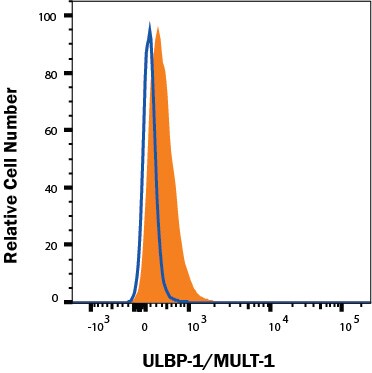
Detection of ULBP‑1 in A20 Mouse Cell Line by Flow Cytometry.
A20 mouse B cell lymphoma cell line was stained with Rat Anti-Mouse ULBP-1 /MULT-1 Monoclonal Antibody (Catalog # MAB2588, filled histogram) or isotype control antibody (MAB006, open histogram) followed by anti-Rat IgG PE-conjugated secondary antibody (F0105B). View our protocol for Staining Membrane-associated Proteins.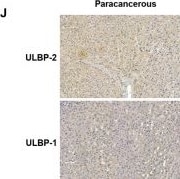
Detection of ULBP-1/MULT-1 by Immunohistochemistry
NKG2DLs are overexpressed in hepatocellular carcinoma and correlate with poor prognosis. A Pan-cancer analysis of NKG2DL expression profiles across multiple tumor types from the TCGA database. B Differential expression of major NKG2DL subtypes between human HCC and matched adjacent non-tumorous liver tissues. C-D Kaplan-Meier overall survival curves of HCC patients stratified by high vs. low expression of ULBP2 (C) and ULBP1 (D). E NKG2DL expression levels across different HCC histological grades. F Survival analysis based on NKG2DL expression within distinct histological grade subgroups. G A nomogram integrating NKG2DL expression and clinical parameters for predicting 1-, 3-, and 5-year overall survival. H Calibration curves assessing the concordance between nomogram-predicted and observed survival probabilities. I Time-dependent receiver operating characteristic (ROC) analysis evaluating the diagnostic performance of NKG2DLs for predicting patient survival. J Representative IHC images of ULBP2 and ULBP1 in human HCC and adjacent non-tumorous tissues. K–N Quantitative IHC scores for ULBP2 (K) and ULBP1 (M) in paired tumor and non-tumor specimens, with their corresponding Kaplan-Meier survival analyses (L, N). O Flow cytometry analysis of NKG2DL surface expression on a panel of murine tumor cell lines. P Schematic diagram of the lentiviral construct designs for GFP-M (control) and NKG2D-targeting CAR-M. Q Efficiency of lentiviral transduction in iBMDM-derived macrophages, as indicated by EGFP reporter expression. R Surface expression levels of the engineered NKG2D-CAR on macrophages, confirmed by flow cytometry Image collected and cropped by CiteAb from the following open publication (https://link.springer.com/10.1186/s12943-025-02538-w), licensed under a CC-BY license. Not internally tested by R&D Systems.Applications for Mouse ULBP-1 /MULT-1 Antibody (237104)
CyTOF-ready
Flow Cytometry
Sample: A20 mouse B cell lymphoma cell line
Flow Cytometry Panel Builder
Bio-Techne Knows Flow Cytometry
Save time and reduce costly mistakes by quickly finding compatible reagents using the Panel Builder Tool.
Advanced Features
- Spectra Viewer - Custom analysis of spectra from multiple fluorochromes
- Spillover Popups - Visualize the spectra of individual fluorochromes
- Antigen Density Selector - Match fluorochrome brightness with antigen density

Formulation, Preparation, and Storage
Purification
Reconstitution
Reconstitute at 0.5 mg/mL in sterile PBS. For liquid material, refer to CoA for concentration.
Formulation
Shipping
Stability & Storage
- 12 months from date of receipt, -20 to -70 °C as supplied.
- 1 month, 2 to 8 °C under sterile conditions after reconstitution.
- 6 months, -20 to -70 °C under sterile conditions after reconstitution.
Calculators
Background: ULBP-1
References
- Raulet, D.H. (2003) Nat. Rev. Immunol. 3:781.
- Carayannopoulos, L. et al. (2002) J. Immunol. 169:4079.
- Diefenbach, A. et al. (2003) Eur. J. Immunol. 33:381.
- Krmpotic, A. et al. (2005) J. Exp. Med. 201:211.
- Diefenbach, A. et al. (2002) Nat. Immunol. 3:1142.
- Ho, E.L. et al. (1998) Proc. Natl. Acad. Sci. USA 95:6320.
- Carayannopoulos, L.N. et al. (2002) Eur. J. Immunol. 32:597.
Long Name
Alternate Names
Gene Symbol
Additional ULBP-1 Products
Product Documents for Mouse ULBP-1 /MULT-1 Antibody (237104)
Certificate of Analysis
To download a Certificate of Analysis, please enter a lot or batch number in the search box below.
Note: Certificate of Analysis not available for kit components.
Product Specific Notices for Mouse ULBP-1 /MULT-1 Antibody (237104)
For research use only
Related Research Areas
Citations for Mouse ULBP-1 /MULT-1 Antibody (237104)
 Powered by Bioz
Customer Reviews for Mouse ULBP-1 /MULT-1 Antibody (237104)
There are currently no reviews for this product. Be the first to review Mouse ULBP-1 /MULT-1 Antibody (237104) and earn rewards!
Have you used Mouse ULBP-1 /MULT-1 Antibody (237104)?
Submit a review and receive an Amazon gift card!
$25/€18/£15/$25CAN/¥2500 for a review with an image
$10/€7/£6/$10CAN/¥1110 for a review without an image
Submit a review
Protocols
Find general support by application which include: protocols, troubleshooting, illustrated assays, videos and webinars.
- 7-Amino Actinomycin D (7-AAD) Cell Viability Flow Cytometry Protocol
- Extracellular Membrane Flow Cytometry Protocol
- Flow Cytometry Protocol for Cell Surface Markers
- Flow Cytometry Protocol for Staining Membrane Associated Proteins
- Flow Cytometry Staining Protocols
- Flow Cytometry Troubleshooting Guide
- Intracellular Flow Cytometry Protocol Using Alcohol (Methanol)
- Intracellular Flow Cytometry Protocol Using Detergents
- Intracellular Nuclear Staining Flow Cytometry Protocol Using Detergents
- Intracellular Staining Flow Cytometry Protocol Using Alcohol Permeabilization
- Intracellular Staining Flow Cytometry Protocol Using Detergents to Permeabilize Cells
- Propidium Iodide Cell Viability Flow Cytometry Protocol
- Protocol for Liperfluo
- Protocol for the Characterization of Human Th22 Cells
- Protocol for the Characterization of Human Th9 Cells
- Protocol: Annexin V and PI Staining by Flow Cytometry
- Protocol: Annexin V and PI Staining for Apoptosis by Flow Cytometry
- Troubleshooting Guide: Fluorokine Flow Cytometry Kits
- View all Protocols, Troubleshooting, Illustrated assays and Webinars