
Automated icIEF with Maurice for Charge Heterogeneity
Enhance charge variant analysis with fast, automated icIEF
Imaged capillary isoelectric focusing (icIEF) is a technique used to assess the charge heterogeneity of biotherapeutic molecules. MauriceFlex™, Maurice™, and Maurice C™ systems automate icIEF to generate high-resolution charge heterogeneity data in minutes.
Using whole-column imaging, these systems eliminate mobilization steps and improve precision and resolution compared to conventional cIEF or IEX, and deliver reproducible charge variant results for mAbs, ADCs, vaccines, fusion proteins, and other biologics.
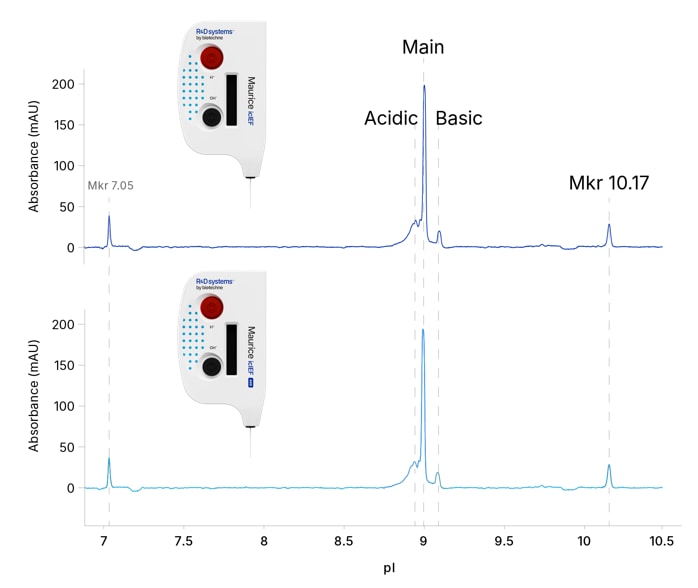
Advantages of icIEF on Maurice for Protein Charge Analysis
Automation, speed, and throughput: The Maurice instrument Maurice automates icIEF to eliminate manual steps, reduce method development time, and deliver high‑quality charge variant data on upto 100 samples per batch, in as little time as 5 minutes per sample!
The icIEF data generated with Maurice platforms can be analyzed with Compass for iCE, Waters™ Empower® 3 Chromatography software, or Thermo Scientific™ Chromeleon® CDS.
Why Choose icIEF on Maurice Platforms
Eliminate:
- Instrument setup, capillary loading, and clean-up
- Protein mobilization, which is a mandatory step in conventional cIEF
- Prolonged method development
- High sample volumes
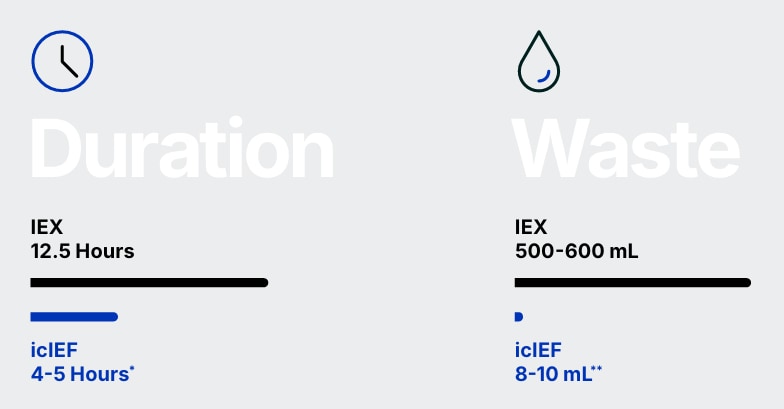
Get:
- Ease of use - plug in the ready-to-use cartridge, load your samples, and hit Start!
- More time back – analyze samples in 5-15 minutes
- High-quality protein charge data in real time
- Data with volumes as low as 50 µL
- icIEF method development in a day
- Seamless method transfer to QC
How icIEF Works
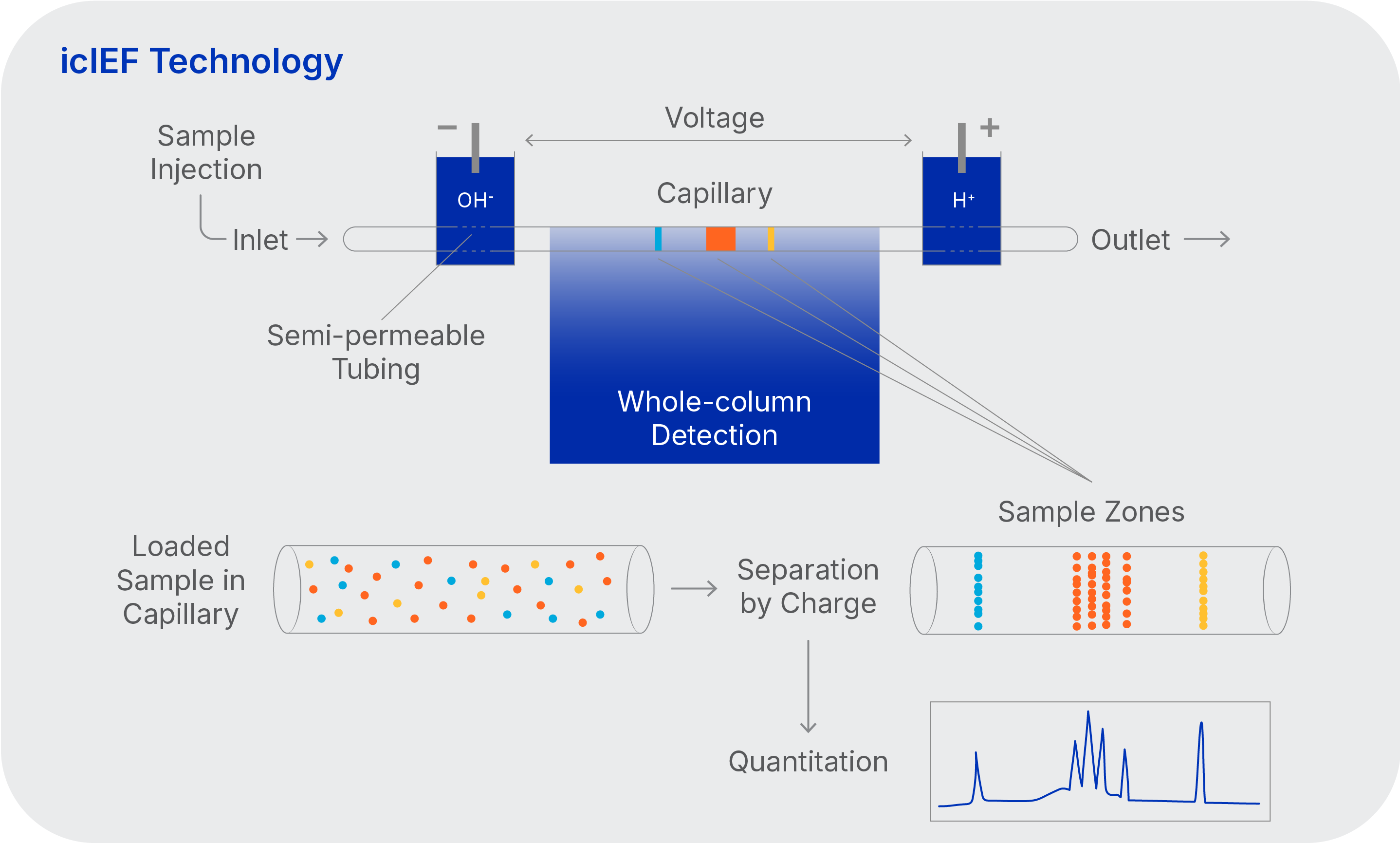
icIEF separates biotherapeutic proteins based on their isoelectric point (pI).
- An electric field is applied across a capillary filled with carrier ampholytes, which self-organize into a stable pH gradient.
- Each protein migrates through the gradient until it reaches the pH zone matching its isoelectric point (pI), where it focuses into a sharp band.
- The entire capillary is imaged at once, delivering fast, high-resolution charge variant analysis without a mobilization step, thus providing better results than cIEF.
Additional Benefits
Get Higher Sensitivity and Conserve Precious Samples
Maurice platforms offer both absorbance and native fluorescence (NF) detection modes for icIEF. NF offers 4X the sensitivity of absorbance, so you can get the data you need while saving your precious samples! Go as low as 0.7 µg/mL, and you can even reduce the amount of urea in some of your methods since samples tend to aggregate less at lower concentrations. Read our Application Note for more details on native fluorescence with Maurice.
Preserve Sample Stability with Automated On-board Mixing (OBM)
Some samples become unstable while sitting in the ampholyte mixture (IEF master mix) for a period of time. Maurice OBM addresses this by letting you add stable stocks of your sample into Maurice at the beginning of your batch. The IEF master mix is automatically mixed in with your sample right before injection. This is also a useful feature if you are running a lot of samples with a platform method, as it saves you hands-on time and minimizes user-to-user variability. Read our Application Note to learn more about Maurice OBM.
Related Products
| Product | Catalog Number |
|---|---|
| MauriceFlex System | 090-158 |
| Maurice System | 090-000 |
| Maurice C. System | 090-002 |
| Maurice cIEF Cartridge (for up to 200 injections) | PS-MC02-C |
| Maurice icIEF 400 Cartridge (for up to 400 injections) | PS-MC02-400C |
| Maurice cIEF Method Development Kit | PS-MDK01-C |
Resources
Webinar
This webinar demonstrates how to achieve high throughput icIEF analysis with the Maurice icIEF 400 cartridge.
Application note
This app note describes a comparison of the icIEF 400 and cIEF cartridges, showing highly comparable peak area precision across diverse molecules and confirming both cartridges deliver fast, reproducible charge heterogeneity analysis for biotherapeutics.
From Your Peers

In this interview, Xiaoping He explains how icIEF overcomes major limitations of slab‑gel IEF and IEX by providing rapid ~10‑minute turnaround, high‑resolution charge variant separation, and true quantitation, making it a robust, platform-ready method for biotherapeutic CQA analysis.
FAQs
What is icIEF used for?
Imaged capillary isoelectric focusing (icIEF) is used to separate and analyze proteins based on their isoelectric point (pI). In biopharmaceutical development, it is primarily used to characterize charge heterogeneity in biologics such as monoclonal antibodies (mAbs), biosimilars, and fusion proteins. icIEF is applied across the full development workflow, from early-stage research through QC release testing.
What is charge heterogeneity?
Charge heterogeneity refers to the presence of multiple charge variants within a protein sample. Proteins carry a net charge determined by the ionization state of their amino acid residues, such as lysine, arginine, aspartate, and glutamate, which depends on the surrounding pH. The pH at which a protein's net charge is zero is its isoelectric point (pI). In practice, however, a biologic such as a monoclonal antibody is rarely a single uniform species. Post-translational modifications and chemical degradation events including deamidation, glycosylation, oxidation, and C-terminal lysine clipping alter the charge state of individual molecules, producing a population of variants with slightly different pI values. These are collectively referred to as acidic and basic charge variants relative to the main species. Because charge heterogeneity can influence a biologic's safety, efficacy, and stability, regulatory agencies expect it to be monitored and controlled throughout development and manufacturing.
How does icIEF help characterize biotherapeutic proteins?
icIEF provides high-resolution separation of a protein's charge variants — typically categorized as acidic, main, and basic species — in a single run. Maurice images the entire capillary simultaneously, delivering a detailed charge variant profile with precise pI assignments. This makes icIEF one of the most informative tools for assessing product quality and consistency in biotherapeutic development.
What is the difference between IEF and cIEF?
Traditional IEF (isoelectric focusing) is performed on a slab gel, where proteins are separated across a pH gradient and detected by staining. cIEF (capillary IEF) performs the same separation inside a capillary, enabling automated, quantitative analysis with much smaller sample volumes and faster turnaround. icIEF is a form of cIEF that uses whole-column imaging, eliminating the need for a mobilization step.
How is icIEF different from ion exchange chromatography (IEX)?
Both icIEF and IEX separate proteins based on charge but operate on different principles. IEX separates charge variants by their interaction with a charged stationary phase and is often used preparatively. icIEF separates proteins by pI in a pH gradient and is primarily an analytical technique. icIEF typically offers higher resolution for charge variant profiling and provides absolute pI values, whereas IEX does not.
What is the difference between icIEF and CE-SDS?
icIEF and CE-SDS are complementary capillary electrophoresis techniques that answer different analytical questions. icIEF separates proteins by charge (pI) and is used for charge variant analysis. CE-SDS separates proteins by size under denaturing conditions and is used to assess purity, molecular weight, and size variants. Maurice runs both techniques on the same instrument platform.
What is the difference between SDS-PAGE and IEF?
SDS-PAGE separates proteins by molecular weight under denaturing conditions, while IEF separates proteins by their isoelectric point in a pH gradient. SDS-PAGE is used for purity and size analysis, whereas IEF is used for charge variant characterization. Both are traditional gel-based methods that have largely been replaced in biopharmaceutical workflows by automated capillary electrophoresis techniques such as CE-SDS and icIEF.
Why is urea used in icIEF?
Urea is added to icIEF sample buffers as a denaturant to prevent protein aggregation and precipitation during the focusing process. Without it, proteins, particularly hydrophobic ones, can crash out of solution as they approach their pI and lose surface charge. Urea keeps proteins solubilized throughout the run, ensuring a clean, reproducible separation.
Is icIEF suitable for QC testing?
Yes. icIEF is widely used in regulated QC environments for batch release and stability testing of biotherapeutics. Maurice supports 21 CFR Part 11-compliant data collection and is compatible with Compass for iCE, Empower 3, and Chromeleon CDS software via dedicated Control Kits, making it straightforward to integrate into existing QC data systems.
How long does an icIEF run take on Maurice?
A typical icIEF run on Maurice takes approximately 10-15 from sample loading to result, including focusing time, but it can be even faster with the SupersonicIEF method, which involves ampholyte blockers and voltage stepping. The whole-column imaging approach eliminates the mobilization step required in traditional cIEF, which significantly reduces overall run time without sacrificing resolution.
What sample volumes are required for icIEF on Maurice?
icIEF on Maurice requires very small sample volumes, typically starting with 50 µL. This makes it well suited for precious or limited samples encountered in early-stage biotherapeutic development.
Does Maurice support Waters Empower 3 software?
Yes. Maurice is compatible with Waters Empower 3 chromatography data software through a dedicated Empower Control Kit. This allows laboratories already operating within an Empower environment to collect, process, and store Maurice data without adopting a separate data system.
Why choose Maurice for icIEF?
Maurice is a fully automated icIEF platform designed specifically for biopharmaceutical protein characterization. It combines whole-column imaging, small sample volume requirements, and a streamlined workflow to deliver high-resolution charge variant profiles with minimal hands-on time. A single Maurice instrument also runs CE-SDS, making it a versatile solution for both charge and size analysis across development and QC. Another instrument from the Maurice family, called the MauriceFlex, not only does icIEF and CE-SDS, but also enables the collection of charge variant fractions that can be used for mass spec, SPR, and mass photometry analysis.