
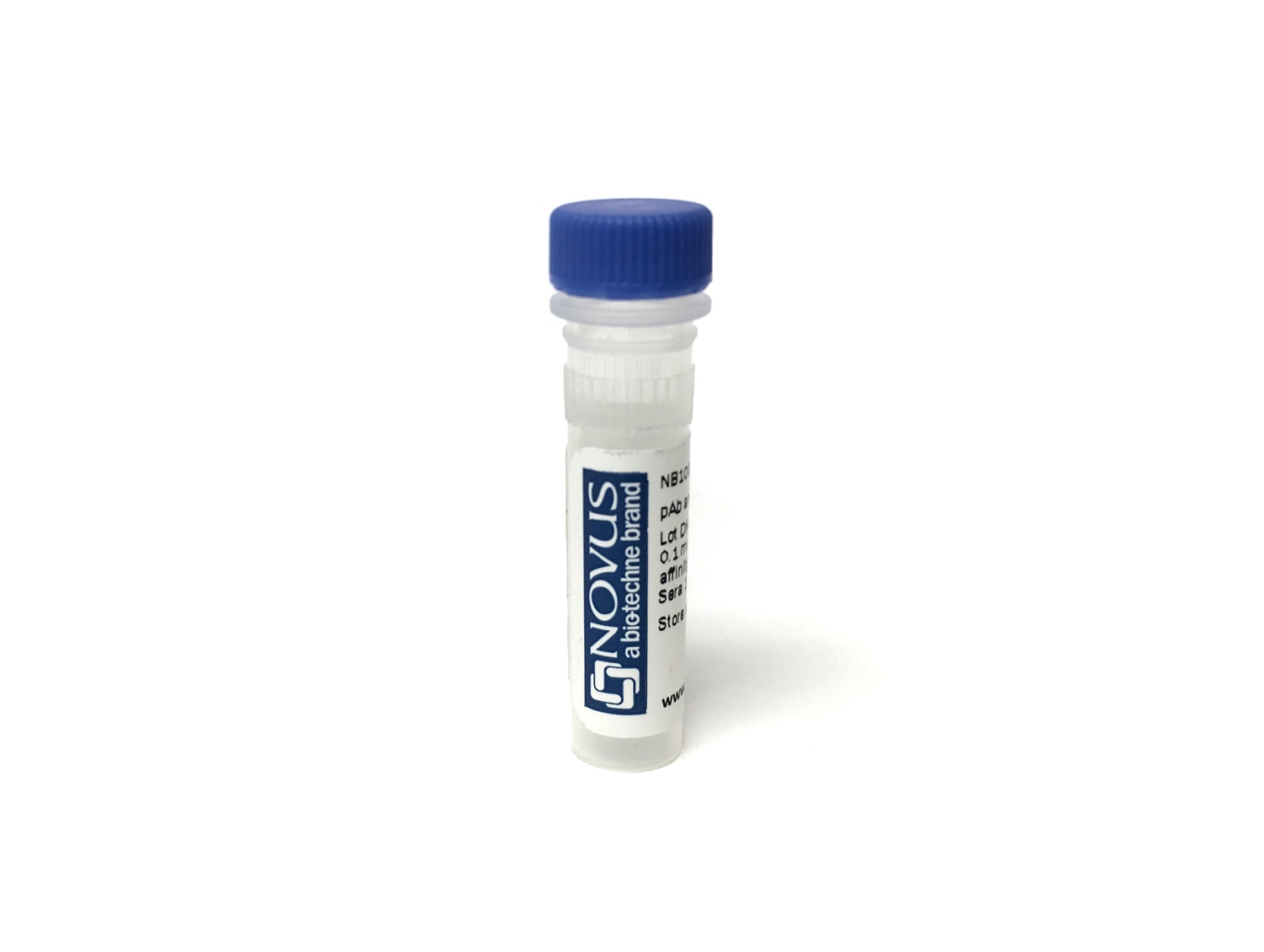
A20/TNFAIP3 Antibody [Biotin]
Novus Biologicals | Catalog # NBP3-78675
Fc Region Site-Specific Biotinylated Antibody

Key Product Details
Species Reactivity
Validated:
Human
Predicted:
Mouse (94%), Rat (94%). Backed by our 100% Guarantee.
Applications
Immunocytochemistry/ Immunofluorescence, Chromatin Immunoprecipitation
Label
Biotin
Antibody Source
Polyclonal Rabbit IgG
Loading...
Product Specifications
Immunogen
This A20/TNFAIP3 Antibody was developed against a recombinant protein corresponding to amino acids: AEQVLPQALYLSNMRKAVKIRERTPEDIFKPTNGIIHHFKTMHRYTLEMFRTCQFCPQFREIIHKALIDRNIQATLESQKKLNWCREV
Clonality
Polyclonal
Host
Rabbit
Isotype
IgG
Description
This conjugate is made on demand and is not held in inventory. As a result, each order represents a unique lot.
Successful site-specific biotin conjugation is confirmed by reducing SDS-PAGE, revealing a mobility shift of the antibody heavy-chain when biotin is covalently attached. Free biotin from the conjugation process has been removed. The antibody concentration is provided on the individual product label.
For specialized conjugation needs, like large quantities, and specific concentrations, bulk and custom antibody conjugation services are available.
Applications for A20/TNFAIP3 Antibody [Biotin]
Application
Recommended Usage
Chromatin Immunoprecipitation
1-10ug per reaction
Immunocytochemistry/ Immunofluorescence
0.25-2 ug/ml
Application Notes
Recommended applications and dilutions are based on validated applications from the unconjugated base product
NBP2-68857
Formulation, Preparation, and Storage
Purification
Affinity purified
Formulation
40% glycerol and PBS (pH 7.2).
Preservative
0.02% Sodium Azide
Concentration
Concentrations vary lot to lot. See vial label for concentration. If unlisted please contact technical services.
Shipping
The product is shipped with polar packs. Upon receipt, store it immediately at the temperature recommended below.
Stability & Storage
Store at 4C short term. Aliquot and store at -20C long term. Avoid freeze-thaw cycles.
Background: A20/TNFAIP3
A20/TNFAIP3 is a highly conserved protein sharing >90% amino acid sequence identity across various mammalian species and is highly expressed in T-cell and B-cells. Coding and non-coding single nucleotide polymorphisms (SNPs) of A20/TNFAIP3 have been associated with multiple autoinflammatory and autoimmune diseases including type 1 diabetes, rheumatoid arthritis, Crohn's disease, and systemic lupus erythematosus (SLE) (3). The two domains of A20/TNFAIP3 cooperate to regulate NF-kB signaling. Its N-terminal ovarian tumor (OTU) domain contains a catalytic cysteine (C103) which functions as a K63 deubiquitinase, whereas the 7 zinc fingers that make up the C-terminal domain mediate K48 polyubiquitination. To regulate NF-kB signaling, A20/TNFAIP3 removes K63-polyubiquitin chains from receptor-interacting protein 1 (RIP1) and NF-kB essential modulator (NEMO), thus preventing interactions with downstream partners. A20/TNFAIP3 also contributes to the degradation of RIP1 and Ubc13 through the addition of K48 polyubiquitin chains (4).
References
1.Dixit VM1, Green S, Sarma V, Holzman LB, Wolf FW, O'Rourke K, Ward PA, Prochownik EV, Marks RM. (1990) Tumor necrosis factor-alpha induction of novel gene products in human endothelial cells including a macrophage-specific chemotaxin. J Biol Chem. 265(5):2973-8. PMID: 2406243
2.Verstrepen L, Verhelst K, van Loo G, Carpentier I, Ley SC, Beyaert R. (2010) Expression, biological activities and mechanisms of action of A20 (TNFAIP3). Biochem Pharmacol. 80(12):2009-20. PMID: 20599425
3.Mele A, Cervantes JR, Chien V, Friedman D, Ferran C. (2014) Single nucleotide polymorphisms at the TNFAIP3/A20 locus and susceptibility/resistance to inflammatory and autoimmune diseases. Adv Exp Med Biol. 809:163-83. PMID: 25302371
4.Das T, Chen Z, Hendriks RW, Kool M. (2018) A20/Tumor Necrosis Factor alpha-Induced Protein 3 in Immune Cells Controls Development of Autoinflammation and Autoimmunity: Lessons from Mouse Models. Front Immunol. 9:104. PMID: 29515565
Alternate Names
OTUD7C, TNFA1P2, TNFAIP3
Gene Symbol
TNFAIP3
Additional A20/TNFAIP3 Products
Product Documents for A20/TNFAIP3 Antibody [Biotin]
Certificate of Analysis
To download a Certificate of Analysis, please enter a lot or batch number in the search box below.
Product Specific Notices for A20/TNFAIP3 Antibody [Biotin]
This product is for research use only and is not approved for use in humans or in clinical diagnosis. Primary Antibodies are guaranteed for 1 year from date of receipt.
Related Research Areas
Customer Reviews for A20/TNFAIP3 Antibody [Biotin]
There are currently no reviews for this product. Be the first to review A20/TNFAIP3 Antibody [Biotin] and earn rewards!
Have you used A20/TNFAIP3 Antibody [Biotin]?
Submit a review and receive an Amazon gift card!
$25/€18/£15/$25CAN/¥2500 for a review with an image
$10/€7/£6/$10CAN/¥1110 for a review without an image
Submit a review
Protocols
Find general support by application which include: protocols, troubleshooting, illustrated assays, videos and webinars.
- Appropriate Fixation of IHC/ICC Samples
- Cellular Response to Hypoxia Protocols
- ClariTSA™ Fluorophore Kits
- Detection & Visualization of Antibody Binding
- ICC Cell Smear Protocol for Suspension Cells
- ICC Immunocytochemistry Protocol Videos
- ICC for Adherent Cells
- Immunocytochemistry (ICC) Protocol
- Immunocytochemistry Troubleshooting
- Immunofluorescence of Organoids Embedded in Cultrex Basement Membrane Extract
- Immunohistochemistry (IHC) and Immunocytochemistry (ICC) Protocols
- Preparing Samples for IHC/ICC Experiments
- Preventing Non-Specific Staining (Non-Specific Binding)
- Primary Antibody Selection & Optimization
- Protocol for VisUCyte™ HRP Polymer Detection Reagent
- Protocol for the Fluorescent ICC Staining of Cell Smears - Graphic
- Protocol for the Fluorescent ICC Staining of Cultured Cells on Coverslips - Graphic
- Protocol for the Preparation and Fluorescent ICC Staining of Cells on Coverslips
- Protocol for the Preparation and Fluorescent ICC Staining of Non-adherent Cells
- Protocol for the Preparation and Fluorescent ICC Staining of Stem Cells on Coverslips
- Protocol for the Preparation of a Cell Smear for Non-adherent Cell ICC - Graphic
- TUNEL and Active Caspase-3 Detection by IHC/ICC Protocol
- The Importance of IHC/ICC Controls
- View all Protocols, Troubleshooting, Illustrated assays and Webinars
FAQs for A20/TNFAIP3 Antibody [Biotin]
Showing
1
-
1 of
1 FAQ
Showing All
-
Q: Following cleavage of A20/TNFAIP3, two full length fragments are released, one with 37 kDa and other one was approx. at 52 kDa. There are mentioning of 75Kda fragment and 37 KDa fragment in scientific papers but not 52 KDa. What is the significance of that specific band?
A: There is data available that explains 52 KDa band in A20/TNFAIP3. Using this antibody in Western Blot will result multiple bands. In LPS treatment, 52 KDa putative cleavage band was observed; however, the same band was not found in untreated THP1 cells.
Loading...