
BPTF/FALZ Antibody
Novus Biologicals | Catalog # NB100-41418

![Western Blot: BPTF/FALZ Antibody [NB100-41418]](https://resources.rndsystems.com/images/products/BPTF-FALZ-Antibody-Western-Blot-NB100-41418-img0015.jpg "Western Blot: BPTF/FALZ Antibody [NB100-41418]")
Scientific images may be resized, cropped, or adjusted for brightness or contrast for presentation purposes. These updates are limited to presentation and do not affect the underlying scientific interpretation of the data. Where available, additional source data may be provided upon request.
Key Product Details
Species Reactivity
Validated:
Cited:
Applications
Validated:
Cited:
Label
Antibody Source
Product Specifications
Immunogen
Clonality
Host
Isotype
Scientific Data Images for BPTF/FALZ Antibody
Western Blot: BPTF/FALZ Antibody [NB100-41418]
BPTF-FALZ-Antibody-Western-Blot-NB100-41418-img0015.jpg![Immunohistochemistry-Paraffin: BPTF/FALZ Antibody [NB100-41418]](https://resources.rndsystems.com/images/products/BPTF-FALZ-Antibody-Immunohistochemistry-Paraffin-NB100-41418-img0014.jpg "Immunohistochemistry-Paraffin: BPTF/FALZ Antibody [NB100-41418]")
Immunohistochemistry-Paraffin: BPTF/FALZ Antibody [NB100-41418]
Immunohistochemistry-Paraffin: BPTF/FALZ Antibody [NB100-41418] - Section of human lung carcinoma. Antibody: Affinity purified rabbit antiFALZ/BPTF used at a dilution of 1:1,000 (0.2ug/ml). Detection: DAB![Western Blot: BPTF/FALZ Antibody [NB100-41418]](https://resources.rndsystems.com/images/products/BPTF-FALZ-Antibody-Western-Blot-NB100-41418-img0006.jpg "Western Blot: BPTF/FALZ Antibody [NB100-41418]")
Western Blot: BPTF/FALZ Antibody [NB100-41418]
Western Blot: BPTF/FALZ Antibody [NB100-41418] - Whole cell lysate (5, 15 and 50 mcg for WB; 1 mg for IP, 20% of IP loaded) from HeLa cells. NB100-41418 used for WB at 0.04 mcg/ml (A) and 0.1 mcg/ml (B) and used for IP at 3 mcg/mg lysate (B).![Western Blot: BPTF/FALZ Antibody [NB100-41418]](https://resources.rndsystems.com/images/products/BPTF-FALZ-Antibody-Western-Blot-NB100-41418-img0012.jpg "Western Blot: BPTF/FALZ Antibody [NB100-41418]")
Western Blot: BPTF/FALZ Antibody [NB100-41418]
Western Blot: BPTF/FALZ Antibody [NB100-41418] - Detection of Human FALZ/BPTF by Western Blot. Samples: Whole cell lysate (15 and 50 ug) from HeLa cells prepared using NETN lysis buffer. Antibody: Affinity purified rabbit anti-FALZ/BPTF antibody NB100-41418 used for WB at 0.04 ug/ml. Detection: Chemiluminescence with an exposure time of 30 seconds.![Immunoprecipitation: BPTF/FALZ Antibody [NB100-41418]](https://resources.rndsystems.com/images/products/BPTF-FALZ-Antibody-Immunoprecipitation-NB100-41418-img0013.jpg "Immunoprecipitation: BPTF/FALZ Antibody [NB100-41418]")
Immunoprecipitation: BPTF/FALZ Antibody [NB100-41418]
Immunoprecipitation: BPTF/FALZ Antibody [NB100-41418] - Detection of human FALZ/BPTF by western blot of immunoprecipitates. Samples: Whole cell lysate (0.5 or 1.0 mg per IP reaction; 20% of IP loaded) from HeLa cells prepared using NETN lysis buffer. Antibodies: Affinity purified rabbit anti-FALZ/BPTF antibody NB100-41418 used for IP at 6 ug per reaction. For blotting immunoprecipitated FALZ/BPTF, NB100-41418 was used at 0.1 ug/ml. Detection: Chemiluminescence with an exposure time of 30 seconds.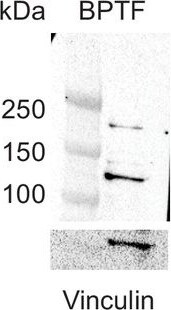
Western Blot: BPTF/FALZ Antibody [NB100-41418] -
Western Blot: BPTF/FALZ Antibody [NB100-41418] - Identification of alternative BPTF species in human cancer cells.(A) Reactivity of anti-BPTF antibodies with lysates from human cancer cells. Cell line-specific patterns were observed, with bands of the same mobility being detected across lines & detected with independent antibodies. The findings suggest the occurrence of multiple BPTF-related protein species in human cancer cells. A representative western blot is shown. (B) Gel bands selected for BPTF Mass Spectrometry identification according to the localization of the BPTF signal detected by western blotting in MCF-7 cells. (Left, NP-40 lysis buffer, gel bands A1 & A2; Right, Laemmli buffer, B1 & B2). The detection of low molecular weight species upon direct cell lysis in Laemmli buffer strongly supports the notion that the findings do not result from artifactual proteolysis. (C) Sequence coverage of BPTF protein. Peptides identified by LC-MS/MS are highlighted in color. (D) BPTF peptide intensity (arbitrary units) calculated by MaxQuant in the gel bands A1, A2/B1, B2. Image collected & cropped by CiteAb from the following publication (https://pubmed.ncbi.nlm.nih.gov/31498079), licensed under a CC-BY license. Not internally tested by Novus Biologicals.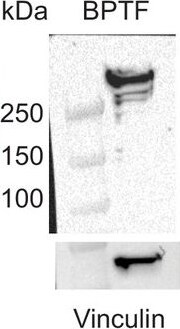
Western Blot: BPTF/FALZ Antibody [NB100-41418] -
Western Blot: BPTF/FALZ Antibody [NB100-41418] - Identification of alternative BPTF species in human cancer cells.(A) Reactivity of anti-BPTF antibodies with lysates from human cancer cells. Cell line-specific patterns were observed, with bands of the same mobility being detected across lines & detected with independent antibodies. The findings suggest the occurrence of multiple BPTF-related protein species in human cancer cells. A representative western blot is shown. (B) Gel bands selected for BPTF Mass Spectrometry identification according to the localization of the BPTF signal detected by western blotting in MCF-7 cells. (Left, NP-40 lysis buffer, gel bands A1 & A2; Right, Laemmli buffer, B1 & B2). The detection of low molecular weight species upon direct cell lysis in Laemmli buffer strongly supports the notion that the findings do not result from artifactual proteolysis. (C) Sequence coverage of BPTF protein. Peptides identified by LC-MS/MS are highlighted in color. (D) BPTF peptide intensity (arbitrary units) calculated by MaxQuant in the gel bands A1, A2/B1, B2. Image collected & cropped by CiteAb from the following publication (https://pubmed.ncbi.nlm.nih.gov/31498079), licensed under a CC-BY license. Not internally tested by Novus Biologicals.Applications for BPTF/FALZ Antibody
Immunohistochemistry
Immunohistochemistry-Paraffin
Immunoprecipitation
Western Blot
Formulation, Preparation, and Storage
Purification
Formulation
Preservative
Concentration
Shipping
Stability & Storage
Background: BPTF/FALZ
Long Name
Alternate Names
Entrez Gene IDs
Gene Symbol
UniProt
Additional BPTF/FALZ Products
Product Documents for BPTF/FALZ Antibody
Certificate of Analysis
To download a Certificate of Analysis, please enter a lot or batch number in the search box below.
Product Specific Notices for BPTF/FALZ Antibody
This product is for research use only and is not approved for use in humans or in clinical diagnosis. Primary Antibodies are guaranteed for 1 year from date of receipt.
Citations for BPTF/FALZ Antibody
 Powered by Bioz
Customer Reviews for BPTF/FALZ Antibody
There are currently no reviews for this product. Be the first to review BPTF/FALZ Antibody and earn rewards!
Have you used BPTF/FALZ Antibody?
Submit a review and receive an Amazon gift card!
$25/€18/£15/$25CAN/¥2500 for a review with an image
$10/€7/£6/$10CAN/¥1110 for a review without an image
Submit a review
Protocols
Find general support by application which include: protocols, troubleshooting, illustrated assays, videos and webinars.
- Antigen Retrieval Protocol (PIER)
- Antigen Retrieval for Frozen Sections Protocol
- Appropriate Fixation of IHC/ICC Samples
- Cellular Response to Hypoxia Protocols
- Chromogenic IHC Staining of Formalin-Fixed Paraffin-Embedded (FFPE) Tissue Protocol
- Chromogenic Immunohistochemistry Staining of Frozen Tissue
- ClariTSA™ Fluorophore Kits
- Detection & Visualization of Antibody Binding
- Fluorescent IHC Staining of Frozen Tissue Protocol
- Graphic Protocol for Heat-induced Epitope Retrieval
- Graphic Protocol for the Preparation and Fluorescent IHC Staining of Frozen Tissue Sections
- Graphic Protocol for the Preparation and Fluorescent IHC Staining of Paraffin-embedded Tissue Sections
- Graphic Protocol for the Preparation of Gelatin-coated Slides for Histological Tissue Sections
- IHC Sample Preparation (Frozen sections vs Paraffin)
- Immunofluorescent IHC Staining of Formalin-Fixed Paraffin-Embedded (FFPE) Tissue Protocol
- Immunohistochemistry (IHC) and Immunocytochemistry (ICC) Protocols
- Immunohistochemistry Frozen Troubleshooting
- Immunohistochemistry Paraffin Troubleshooting
- Immunoprecipitation Protocol
- Preparing Samples for IHC/ICC Experiments
- Preventing Non-Specific Staining (Non-Specific Binding)
- Primary Antibody Selection & Optimization
- Protocol for Heat-Induced Epitope Retrieval (HIER)
- Protocol for Making a 4% Formaldehyde Solution in PBS
- Protocol for VisUCyte™ HRP Polymer Detection Reagent
- Protocol for the Preparation & Fixation of Cells on Coverslips
- Protocol for the Preparation and Chromogenic IHC Staining of Frozen Tissue Sections
- Protocol for the Preparation and Chromogenic IHC Staining of Frozen Tissue Sections - Graphic
- Protocol for the Preparation and Chromogenic IHC Staining of Paraffin-embedded Tissue Sections
- Protocol for the Preparation and Chromogenic IHC Staining of Paraffin-embedded Tissue Sections - Graphic
- Protocol for the Preparation and Fluorescent IHC Staining of Frozen Tissue Sections
- Protocol for the Preparation and Fluorescent IHC Staining of Paraffin-embedded Tissue Sections
- Protocol for the Preparation of Gelatin-coated Slides for Histological Tissue Sections
- R&D Systems Quality Control Western Blot Protocol
- TUNEL and Active Caspase-3 Detection by IHC/ICC Protocol
- The Importance of IHC/ICC Controls
- Troubleshooting Guide: Immunohistochemistry
- Troubleshooting Guide: Western Blot Figures
- Western Blot Conditions
- Western Blot Protocol
- Western Blot Protocol for Cell Lysates
- Western Blot Troubleshooting
- Western Blot Troubleshooting Guide
- View all Protocols, Troubleshooting, Illustrated assays and Webinars
FAQs for BPTF/FALZ Antibody
-
Q: Can you comment on BPTF being an histone bound protein, hence difficult to solubilize with a "simple" lysis buffer? You use here a NP-40 0.5% buffer also to be loaded directly for WB? Is the solubilization efficient enough?
A: All of the information I have shows that we successfully used this antibody in IP using this standard protocol, so it doesn't appear you need any special lysis buffer or treatment.
-
Q: I am interesting by anti-BPTF antibody. I would like to know if a large protein like that could be revealed in PVDF membrane?
A: Regarding your question, nucleosome-remodeling factor subunit (BPTF) is a very large protein as you have also mentioned (338KD). There are some tips for efficient transfer of these proteins in western blot for instance: 1) Make sure to use a low percentage gel, for BPTF in particular I suggest you use 7% gel or even lower (5%). 2) You can use either Nitrocellulose or PVDF, to my knowledge the binding efficiency is higher for nitrocellulose while PVDF is a better choice of membrane if you are planning to do re-probing and stripping. If you are going to use PVDF, make sure to wet it in 100% methanol before use. Furthermore, PVDF membrane exhibits better binding efficiency of electroblotted material in the presence of SDS in the transfer buffer. However SDS added to facilitate transfer of large proteins should not exceed 0.05% as it will interfere with the binding of the protein to the membrane. 3) For transfer you can either use the semi-dry or wet transfer but you decide doing wet transfer, I strongly recommend you doing the transfer in low voltage (at 50v) for instance in order to obtain an efficient transfer. These are some suggestions I can provide for a better and more efficient transfer for large proteins like BPTF.
-
Q: Can you comment on BPTF being an histone bound protein, hence difficult to solubilize with a "simple" lysis buffer? You use here a NP-40 0.5% buffer also to be loaded directly for WB? Is the solubilization efficient enough?
A: All of the information I have shows that we successfully used this antibody in IP using this standard protocol, so it doesn't appear you need any special lysis buffer or treatment.
-
Q: I am interesting by anti-BPTF antibody. I would like to know if a large protein like that could be revealed in PVDF membrane?
A: Regarding your question, nucleosome-remodeling factor subunit (BPTF) is a very large protein as you have also mentioned (338KD). There are some tips for efficient transfer of these proteins in western blot for instance: 1) Make sure to use a low percentage gel, for BPTF in particular I suggest you use 7% gel or even lower (5%). 2) You can use either Nitrocellulose or PVDF, to my knowledge the binding efficiency is higher for nitrocellulose while PVDF is a better choice of membrane if you are planning to do re-probing and stripping. If you are going to use PVDF, make sure to wet it in 100% methanol before use. Furthermore, PVDF membrane exhibits better binding efficiency of electroblotted material in the presence of SDS in the transfer buffer. However SDS added to facilitate transfer of large proteins should not exceed 0.05% as it will interfere with the binding of the protein to the membrane. 3) For transfer you can either use the semi-dry or wet transfer but you decide doing wet transfer, I strongly recommend you doing the transfer in low voltage (at 50v) for instance in order to obtain an efficient transfer. These are some suggestions I can provide for a better and more efficient transfer for large proteins like BPTF.