
EDEM2 Antibody - BSA Free
Novus Biologicals | Catalog # NBP2-37921

![Western Blot: EDEM2 Antibody [NBP2-37921]](https://resources.rndsystems.com/images/products/EDEM2-Antibody-Western-Blot-NBP2-37921-img0002.jpg "Western Blot: EDEM2 Antibody [NBP2-37921]")
Loading...
Key Product Details
Species Reactivity
Human
Applications
Immunohistochemistry, Immunohistochemistry-Paraffin, Western Blot
Label
Unconjugated
Antibody Source
Polyclonal Rabbit IgG
Format
BSA Free
Loading...
Product Specifications
Immunogen
This antibody was developed against a recombinant protein corresponding to amino acids: FDPTNFIHNNGSTFDAVITPYGECILGAGGYIFNTEAHPIDPAALHCCQRLKEEQWEVEDLMREFYSLKRSRSKFQKNTVSSGPWEPPARPGTLFSP
Reactivity Notes
Immunogen displays the following percentage of sequence identity for non-tested species: Mouse (80%), Rat (84%)
Clonality
Polyclonal
Host
Rabbit
Isotype
IgG
Scientific Data Images for EDEM2 Antibody - BSA Free
Western Blot: EDEM2 Antibody [NBP2-37921]
Western Blot: EDEM2 Antibody [NBP2-37921] - Lane 1: Marker [kDa] 250, 130, 95, 72, 55, 36, 28, 17, 10. Lane 2: Human cell line RT-4. Lane 3: Human cell line U-251MG. Lane 4: Human Plasma![Immunohistochemistry-Paraffin: EDEM2 Antibody [NBP2-37921]](https://resources.rndsystems.com/images/products/EDEM2-Antibody-Immunohistochemistry-Paraffin-NBP2-37921-img0007.jpg "Immunohistochemistry-Paraffin: EDEM2 Antibody [NBP2-37921]")
Immunohistochemistry-Paraffin: EDEM2 Antibody [NBP2-37921]
Immunohistochemistry-Paraffin: EDEM2 Antibody [NBP2-37921] - Staining of human prostate shows moderate granular cytoplasmic positivity in glandular cells.![Immunohistochemistry-Paraffin: EDEM2 Antibody [NBP2-37921]](https://resources.rndsystems.com/images/products/EDEM2-Antibody-Immunohistochemistry-Paraffin-NBP2-37921-img0003.jpg "Immunohistochemistry-Paraffin: EDEM2 Antibody [NBP2-37921]")
Immunohistochemistry-Paraffin: EDEM2 Antibody [NBP2-37921]
Immunohistochemistry-Paraffin: EDEM2 Antibody [NBP2-37921] - Staining of human small intestine shows strong cytoplasmic positivity in glandular cells.![Immunohistochemistry-Paraffin: EDEM2 Antibody [NBP2-37921]](https://resources.rndsystems.com/images/products/EDEM2-Antibody-Immunohistochemistry-Paraffin-NBP2-37921-img0004.jpg "Immunohistochemistry-Paraffin: EDEM2 Antibody [NBP2-37921]")
Immunohistochemistry-Paraffin: EDEM2 Antibody [NBP2-37921]
Immunohistochemistry-Paraffin: EDEM2 Antibody [NBP2-37921] - Staining of human placenta shows strong granular cytoplasmic positivity in trophoblastic cells.![Immunohistochemistry-Paraffin: EDEM2 Antibody [NBP2-37921]](https://resources.rndsystems.com/images/products/EDEM2-Antibody-Immunohistochemistry-Paraffin-NBP2-37921-img0006.jpg "Immunohistochemistry-Paraffin: EDEM2 Antibody [NBP2-37921]")
Immunohistochemistry-Paraffin: EDEM2 Antibody [NBP2-37921]
Immunohistochemistry-Paraffin: EDEM2 Antibody [NBP2-37921] - Staining of human kidney shows moderate granular cytoplasmic positivity in cells in tubules.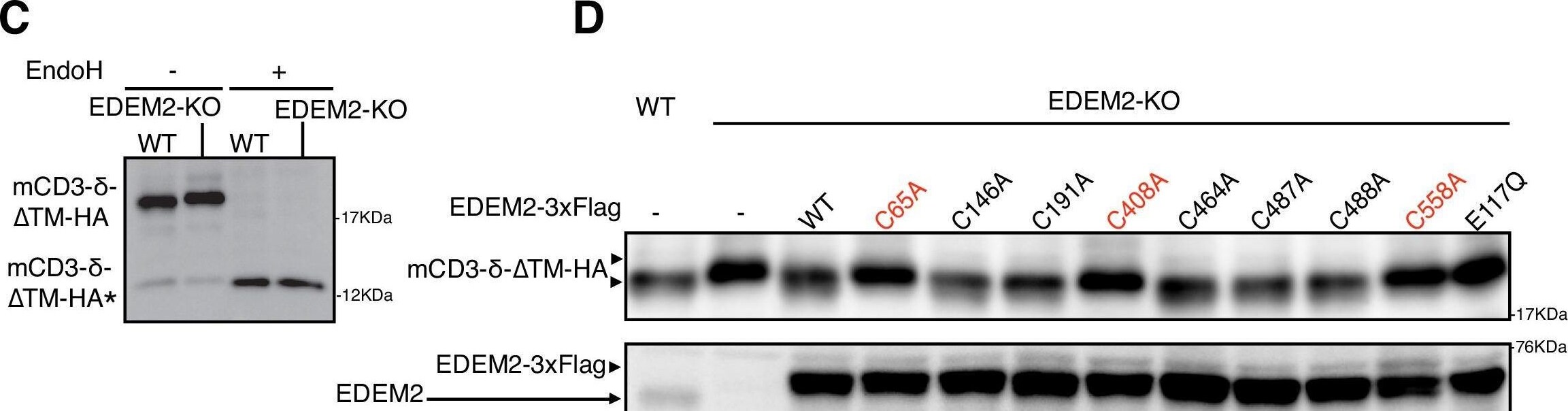
Western Blot: EDEM2 Antibody - BSA Free [NBP2-37921] -
Effect of mutation of various cysteine residues in EDEM2 on gpERAD.(A) Structure of Glc3Man9GlcNAc2 is schematically shown. Mannose residues are alpha 1,2-bonded or alpha 1,6-bonded as indicated. (B) Structures of human EDEM2 and yeast Htm1p are schematically shown with cysteine residues (C) highlighted together with their positions (black bars underneath C indicate conserved cysteine residues, whereas white bars over C indicate non-conserved cysteine residues). The purple and yellow boxes denote the signal sequence and mannosidase homology domain (MHD), respectively. Sequence comparison around the four cysteine residues conserved between EDEM2 and Htm1p (marked in red color) is shown below (asterisk and colon indicate identical and similar amino acids, respectively). (C) Cell lysates were prepared from WT and EDEM2-KO cells expressing mCD3-delta -delta TM-HA by transfection, treated with (+) or without (-) EndoH, and analyzed by immunoblotting using anti-HA antibody. mCD3-delta -delta TM-HA* denotes deglycosylated mCD3-delta -delta TM-HA. (D) Cell lysates were prepared from WT and EDEM2-KO cells expressing WT or one of various cysteine mutants of 3x Flag-tagged EDEM2 together with mCD3-delta -delta TM-HA by transfection, and analyzed by immunoblotting using anti-HA and anti-EDEM2 antibodies. E117Q is an enzymatically inactive mutant of EDEM2. (E) Cycloheximide chase was conducted to determine the degradation rate of mCD3-delta -delta TM-HA in WT and EDEM2-KO cells expressing WT or one of the three cysteine mutants of 3x Flag-tagged EDEM2 by transfection, and analyzed by immunoblotting using anti-HA antibody (n = 3). Quantified data are shown on the right. Image collected and cropped by CiteAb from the following open publication (https://pubmed.ncbi.nlm.nih.gov/32065582), licensed under a CC-BY license. Not internally tested by Novus Biologicals.Applications for EDEM2 Antibody - BSA Free
Application
Recommended Usage
Immunohistochemistry
1:20 - 1:50
Immunohistochemistry-Paraffin
1:20 - 1:50
Western Blot
0.04 - 0.4 ug/ml
Application Notes
For IHC-Paraffin, HIER pH 6 retrieval is recommended.
Formulation, Preparation, and Storage
Purification
Affinity purified
Formulation
PBS (pH 7.2) and 40% Glycerol
Format
BSA Free
Preservative
0.02% Sodium Azide
Concentration
Concentrations vary lot to lot. See vial label for concentration. If unlisted please contact technical services.
Shipping
The product is shipped with polar packs. Upon receipt, store it immediately at the temperature recommended below.
Stability & Storage
Store at 4C short term. Aliquot and store at -20C long term. Avoid freeze-thaw cycles.
Background: EDEM2
Alternate Names
bA4204.1, C20orf31, C20orf49, chromosome 20 open reading frame 31, ER degradation enhancer, mannosidase alpha-like 2, ER degradation-enhancing alpha-mannosidase-like 2, ER degradation-enhancing-mannosidase-like protein 2, FLJ10783
Gene Symbol
EDEM2
UniProt
Additional EDEM2 Products
Product Documents for EDEM2 Antibody - BSA Free
Certificate of Analysis
To download a Certificate of Analysis, please enter a lot or batch number in the search box below.
Product Specific Notices for EDEM2 Antibody - BSA Free
This product is for research use only and is not approved for use in humans or in clinical diagnosis. Primary Antibodies are guaranteed for 1 year from date of receipt.
Customer Reviews for EDEM2 Antibody - BSA Free
There are currently no reviews for this product. Be the first to review EDEM2 Antibody - BSA Free and earn rewards!
Have you used EDEM2 Antibody - BSA Free?
Submit a review and receive an Amazon gift card!
$25/€18/£15/$25CAN/¥2500 Yen for a review with an image
$10/€7/£6/$10CAN/¥1110 Yen for a review without an image
Submit a review
Protocols
Find general support by application which include: protocols, troubleshooting, illustrated assays, videos and webinars.
- Antigen Retrieval Protocol (PIER)
- Antigen Retrieval for Frozen Sections Protocol
- Appropriate Fixation of IHC/ICC Samples
- Cellular Response to Hypoxia Protocols
- Chromogenic IHC Staining of Formalin-Fixed Paraffin-Embedded (FFPE) Tissue Protocol
- Chromogenic Immunohistochemistry Staining of Frozen Tissue
- ClariTSA™ Fluorophore Kits
- Detection & Visualization of Antibody Binding
- Fluorescent IHC Staining of Frozen Tissue Protocol
- Graphic Protocol for Heat-induced Epitope Retrieval
- Graphic Protocol for the Preparation and Fluorescent IHC Staining of Frozen Tissue Sections
- Graphic Protocol for the Preparation and Fluorescent IHC Staining of Paraffin-embedded Tissue Sections
- Graphic Protocol for the Preparation of Gelatin-coated Slides for Histological Tissue Sections
- IHC Sample Preparation (Frozen sections vs Paraffin)
- Immunofluorescent IHC Staining of Formalin-Fixed Paraffin-Embedded (FFPE) Tissue Protocol
- Immunohistochemistry (IHC) and Immunocytochemistry (ICC) Protocols
- Immunohistochemistry Frozen Troubleshooting
- Immunohistochemistry Paraffin Troubleshooting
- Preparing Samples for IHC/ICC Experiments
- Preventing Non-Specific Staining (Non-Specific Binding)
- Primary Antibody Selection & Optimization
- Protocol for Heat-Induced Epitope Retrieval (HIER)
- Protocol for Making a 4% Formaldehyde Solution in PBS
- Protocol for VisUCyte™ HRP Polymer Detection Reagent
- Protocol for the Preparation & Fixation of Cells on Coverslips
- Protocol for the Preparation and Chromogenic IHC Staining of Frozen Tissue Sections
- Protocol for the Preparation and Chromogenic IHC Staining of Frozen Tissue Sections - Graphic
- Protocol for the Preparation and Chromogenic IHC Staining of Paraffin-embedded Tissue Sections
- Protocol for the Preparation and Chromogenic IHC Staining of Paraffin-embedded Tissue Sections - Graphic
- Protocol for the Preparation and Fluorescent IHC Staining of Frozen Tissue Sections
- Protocol for the Preparation and Fluorescent IHC Staining of Paraffin-embedded Tissue Sections
- Protocol for the Preparation of Gelatin-coated Slides for Histological Tissue Sections
- R&D Systems Quality Control Western Blot Protocol
- TUNEL and Active Caspase-3 Detection by IHC/ICC Protocol
- The Importance of IHC/ICC Controls
- Troubleshooting Guide: Immunohistochemistry
- Troubleshooting Guide: Western Blot Figures
- Western Blot Conditions
- Western Blot Protocol
- Western Blot Protocol for Cell Lysates
- Western Blot Troubleshooting
- Western Blot Troubleshooting Guide
- View all Protocols, Troubleshooting, Illustrated assays and Webinars
Loading...