
FGF acidic/FGF1, also known as ECGF and HBGF-1, is a secreted mitogen that stimulates the proliferation of all cells of mesodermal origin and many cells of neuroectodermal, ectodermal, and endodermal origin. It plays a number of roles in development, regeneration, and angiogenesis. FGF1 is released extracellularly as a disulfide-linked homodimer and is stored in complex with extracellular heparan sulfate. The association of FGF1 with heparan sulfate is a prerequisite for its subsequent interaction with FGF receptors. Internalized FGF1 can translocate to the cytosol and to the nucleus. Intracellular FGF1 functions as a survival factor by inhibiting p53 activity and proapoptotic signaling.
FGF acidic/FGF1 Antibody (OTI4D2) [DyLight 650]
Novus Biologicals | Catalog # NBP2-70717C

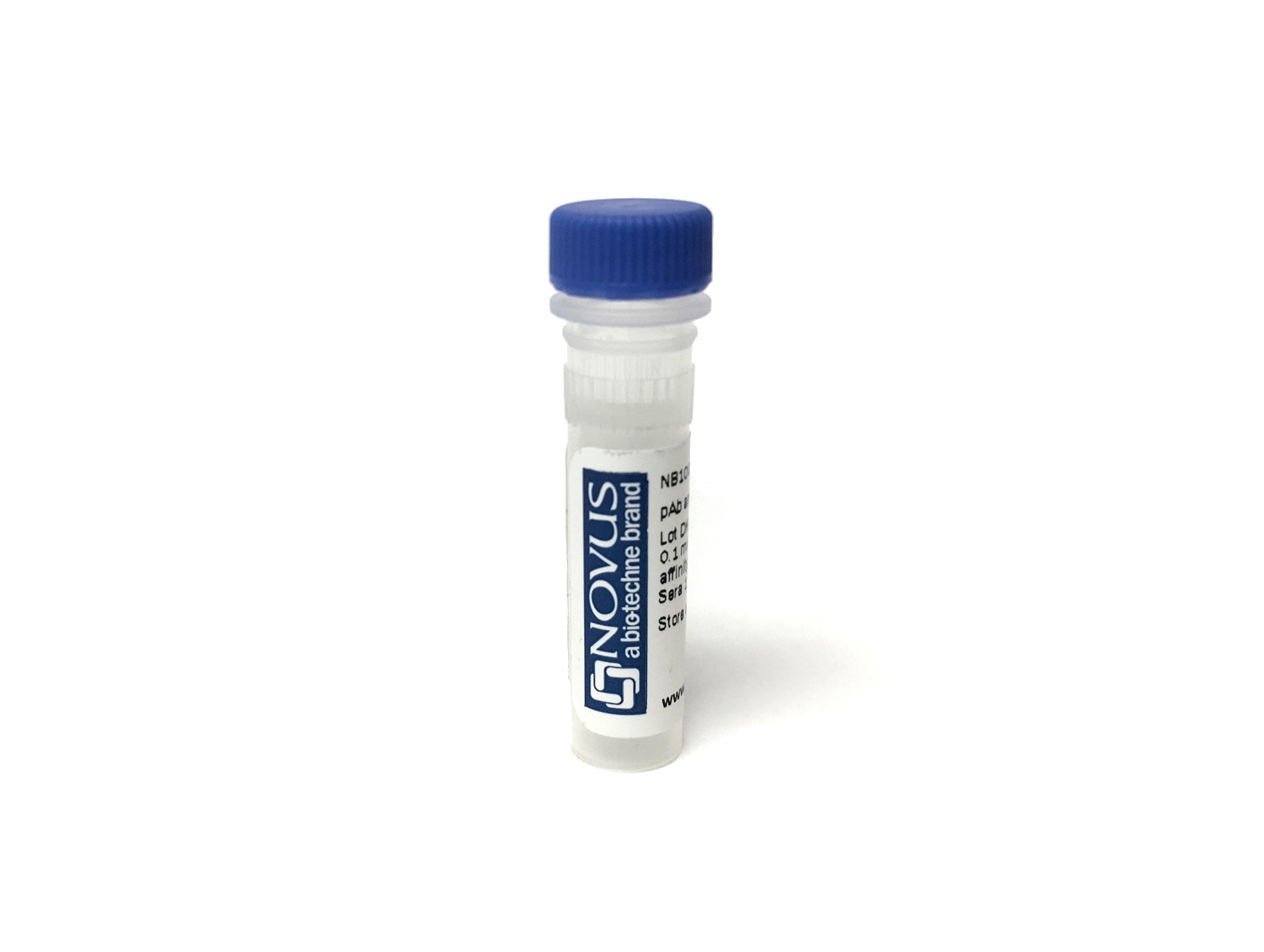
Discontinued Product
NBP2-70717C has been discontinued.
View all FGF acidic/FGF1 products.
Key Product Details
Species Reactivity
Human, Mouse, Rat
Applications
Western Blot, Immunocytochemistry/ Immunofluorescence
Label
DyLight 650 (Excitation = 652 nm, Emission = 672 nm)
Antibody Source
Monoclonal Mouse IgG1 Clone # OTI4D2
Loading...
Product Specifications
Immunogen
Recombinant protein fragment corresponding to amino acids 16-155 of human FGF acidic/FGF1 (NP_000791) produced in E.coli.
Reactivity Notes
Please note that this antibody is reactive to Mouse and derived from the same host, Mouse. Mouse-On-Mouse blocking reagent may be needed for IHC and ICC experiments to reduce high background signal. You can find these reagents under catalog numbers PK-2200-NB and MP-2400-NB. Please contact Technical Support if you have any questions.
Clonality
Monoclonal
Host
Mouse
Isotype
IgG1
Applications for FGF acidic/FGF1 Antibody (OTI4D2) [DyLight 650]
Application
Recommended Usage
Immunocytochemistry/ Immunofluorescence
Optimal dilutions of this antibody should be experimentally determined.
Western Blot
Optimal dilutions of this antibody should be experimentally determined.
Application Notes
Optimal dilution of this antibody should be experimentally determined.
Formulation, Preparation, and Storage
Purification
Immunogen affinity purified
Formulation
50mM Sodium Borate
Preservative
0.05% Sodium Azide
Concentration
Please see the vial label for concentration. If unlisted please contact technical services.
Shipping
The product is shipped with polar packs. Upon receipt, store it immediately at the temperature recommended below.
Stability & Storage
Store at 4C in the dark.
Background: FGF acidic/FGF1
Long Name
Fibroblast Growth Factor acidic
Alternate Names
alpha-ECGF, beta-ECGF, FGF acidic, FGF-1, HBGF-1
Gene Symbol
FGF1
Additional FGF acidic/FGF1 Products
Product Documents for FGF acidic/FGF1 Antibody (OTI4D2) [DyLight 650]
Certificate of Analysis
To download a Certificate of Analysis, please enter a lot or batch number in the search box below.
Product Specific Notices for FGF acidic/FGF1 Antibody (OTI4D2) [DyLight 650]
DyLight (R) is a trademark of Thermo Fisher Scientific Inc. and its subsidiaries.
This product is for research use only and is not approved for use in humans or in clinical diagnosis. Primary Antibodies are guaranteed for 1 year from date of receipt.
Related Research Areas
Customer Reviews for FGF acidic/FGF1 Antibody (OTI4D2) [DyLight 650]
There are currently no reviews for this product. Be the first to review FGF acidic/FGF1 Antibody (OTI4D2) [DyLight 650] and earn rewards!
Have you used FGF acidic/FGF1 Antibody (OTI4D2) [DyLight 650]?
Submit a review and receive an Amazon gift card!
$25/€18/£15/$25CAN/¥2500 Yen for a review with an image
$10/€7/£6/$10CAN/¥1110 Yen for a review without an image
Submit a review
Protocols
Find general support by application which include: protocols, troubleshooting, illustrated assays, videos and webinars.
- Appropriate Fixation of IHC/ICC Samples
- Cellular Response to Hypoxia Protocols
- ClariTSA™ Fluorophore Kits
- Detection & Visualization of Antibody Binding
- ICC Cell Smear Protocol for Suspension Cells
- ICC Immunocytochemistry Protocol Videos
- ICC for Adherent Cells
- Immunocytochemistry (ICC) Protocol
- Immunocytochemistry Troubleshooting
- Immunofluorescence of Organoids Embedded in Cultrex Basement Membrane Extract
- Immunohistochemistry (IHC) and Immunocytochemistry (ICC) Protocols
- Preparing Samples for IHC/ICC Experiments
- Preventing Non-Specific Staining (Non-Specific Binding)
- Primary Antibody Selection & Optimization
- Protocol for VisUCyte™ HRP Polymer Detection Reagent
- Protocol for the Fluorescent ICC Staining of Cell Smears - Graphic
- Protocol for the Fluorescent ICC Staining of Cultured Cells on Coverslips - Graphic
- Protocol for the Preparation and Fluorescent ICC Staining of Cells on Coverslips
- Protocol for the Preparation and Fluorescent ICC Staining of Non-adherent Cells
- Protocol for the Preparation and Fluorescent ICC Staining of Stem Cells on Coverslips
- Protocol for the Preparation of a Cell Smear for Non-adherent Cell ICC - Graphic
- R&D Systems Quality Control Western Blot Protocol
- TUNEL and Active Caspase-3 Detection by IHC/ICC Protocol
- The Importance of IHC/ICC Controls
- Troubleshooting Guide: Western Blot Figures
- Western Blot Conditions
- Western Blot Protocol
- Western Blot Protocol for Cell Lysates
- Western Blot Troubleshooting
- Western Blot Troubleshooting Guide
- View all Protocols, Troubleshooting, Illustrated assays and Webinars
FAQs for FGF acidic/FGF1 Antibody (OTI4D2) [DyLight 650]
Showing
1
-
1 of
1 FAQ
Showing All
-
Q: What is the heparin binding activity of FGF and VEGF?
A: These proteins are not assayed for their ability to bind Heparin. More information about the FGF family of growth factors is available in this review article: Basilico, C. (1992) Adv. Can. Res. 59:115.
Loading...