
Histone H3 [Crotonyl Lys9] Antibody (RM339)
Novus Biologicals | Catalog # NBP2-77404
Recombinant Monoclonal Antibody

Scientific images may be resized, cropped, or adjusted for brightness or contrast for presentation purposes. These updates are limited to presentation and do not affect the underlying scientific interpretation of the data. Where available, additional source data may be provided upon request.
Key Product Details
Species Reactivity
Human, Vertebrate
Applications
Multiplex Immunofluorescence, Western Blot, Dot Blot
Label
Unconjugated
Antibody Source
Recombinant Monoclonal Rabbit IgG Clone # RM339 expressed in HEK293
Loading...
Product Specifications
Immunogen
This Histone H3 [Crotonyl Lys9] antibody (RM339) was raised against a crotonyl-peptide corresponding to Histone H3 [Crotonyl Lys9].
Modification
Crotonyl Lys9
Specificity
This Histone H3 [Crotonyl Lys9] antibody (RM339) reacts to Histone H3 crotonylated at Lysine 9, and does not cross-react with acetylated or butyrylated Lysine 9. No cross reactivity with other crotonylated Lysines in Histone H3
Clonality
Monoclonal
Host
Rabbit
Isotype
IgG
Theoretical MW
15 kDa.
Disclaimer note: The observed molecular weight of the protein may vary from the listed predicted molecular weight due to post translational modifications, post translation cleavages, relative charges, and other experimental factors.
Disclaimer note: The observed molecular weight of the protein may vary from the listed predicted molecular weight due to post translational modifications, post translation cleavages, relative charges, and other experimental factors.
Scientific Data Images for Histone H3 [Crotonyl Lys9] Antibody (RM339)
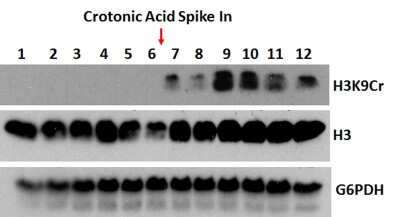
Western Blot: Histone H3 [Crotonyl Lys9] Antibody (RM339) [NBP2-77404] - Western Blot using NBP2-77404 against H3K9cr [Crotonyl-Histone H3 (Lys9)]. Anti-Histone H3 and anti-G6PDH were used as controls. A crotonylation inducing metabolite was used to increase the H3K9cr signal. Theoretical molecular weight is ~15 kDa
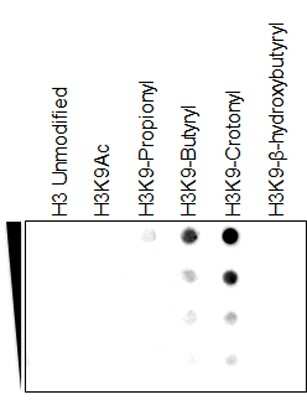
Dot Blot: Histone H3 [Crotonyl Lys9] Antibody (RM339) [NBP2-77404] - A Peptide dot blot showing NBP2-77404 reacts specifically to Histone H3 crotonylated at Lysine 9 (H3K9-Crotonyl), and NBP2-77404's cross-reactivity with different peptides.
Applications for Histone H3 [Crotonyl Lys9] Antibody (RM339)
Application
Recommended Usage
Dot Blot
0.5 ug/ml - 2 ug/ml
Western Blot
1 ug/ml - 5 ug/ml
Formulation, Preparation, and Storage
Purification
Protein A purified
Formulation
50% Glycerol/PBS, 1% BSA
Preservative
0.09% Sodium Azide
Concentration
1 mg/ml
Shipping
The product is shipped with polar packs. Upon receipt, store it immediately at the temperature recommended below.
Stability & Storage
Store at -20C. Avoid freeze-thaw cycles.
Background: Histone H3
Histones are nuclear proteins responsible for the nucleosome structure of the chromosomal fiber in eukaryotes. Changes in chromatin structure play a large role in the regulation of transcription. The chromatin fibers are compacted through the interaction of a linker histone, H1, with the DNA between the nucleosomes to form higher order chromatin structures.
Common histone modifications include methylation of lysine and arginine, acetylation of lysine, phosphorylation of threonine and serine, and sumoylation, biotinylation, and ubiquitylation of lysine. Posttranslational modifications such as acetylation of core histones regulates gene expression, thus altering protein function and regulation (1). Histone H3 is primarily acetylated at lysines 9, 14, 18, and 23 and have a theoretical molecular weight of 15 kDa. Acetylation at lysine 9 and 14 appears to control histone deposition, chromatin assembly and active transcription. Methylation of arginine residues within histone H3 has also been linked to transcription regulation. Histone H3 has been linked to various types of cancer as a biomarker through the aberrant expression of histone deacetylase (HDAC) enzymes and changes to chromatins (2-4).
References
1. Zhang, Y. X., Akumuo, R. C., Espana, R. A., Yan, C. X., Gao, W. J., & Li, Y. C. (2018). The histone demethylase KDM6B in the medial prefrontal cortex epigenetically regulates cocaine reward memory. Neuropharmacology, 141, 113-125. doi:10.1016/j.neuropharm.2018.08.030
2. Nandakumar, V., Hansen, N., Glenn, H. L., Han, J. H., Helland, S., Hernandez, K,...Meldrum, D. R. (2016). Vorinostat differentially alters 3D nuclear structure of cancer and non-cancerous esophageal cells. Sci Rep, 6, 30593. doi:10.1038/srep30593
3. Zhou, M., Li, Y., Lin, S., Chen, Y., Qian, Y., Zhao, Z., & Fan, H. (2019). H3K9me3, H3K36me3, and H4K20me3 Expression Correlates with Patient Outcome in Esophageal Squamous Cell Carcinoma as Epigenetic Markers. Dig Dis Sci, 64(8), 2147-2157. doi:10.1007/s10620-019-05529-2
4. Li, Y., Guo, D., Sun, R., Chen, P., Qian, Q., & Fan, H. (2019). Methylation Patterns of Lys9 and Lys27 on Histone H3 Correlate with Patient Outcome in Gastric Cancer. Dig Dis Sci, 64(2), 439-446. doi:10.1007/s10620-018-5341-8
Alternate Names
H3F3A
Gene Symbol
H3C14
Additional Histone H3 Products
Product Documents for Histone H3 [Crotonyl Lys9] Antibody (RM339)
Certificate of Analysis
To download a Certificate of Analysis, please enter a lot or batch number in the search box below.
Product Specific Notices for Histone H3 [Crotonyl Lys9] Antibody (RM339)
This product is for research use only and is not approved for use in humans or in clinical diagnosis. Primary Antibodies are guaranteed for 1 year from date of receipt.
Related Research Areas
Customer Reviews for Histone H3 [Crotonyl Lys9] Antibody (RM339)
There are currently no reviews for this product. Be the first to review Histone H3 [Crotonyl Lys9] Antibody (RM339) and earn rewards!
Have you used Histone H3 [Crotonyl Lys9] Antibody (RM339)?
Submit a review and receive an Amazon gift card!
$25/€18/£15/$25CAN/¥2500 for a review with an image
$10/€7/£6/$10CAN/¥1110 for a review without an image
Submit a review
Protocols
Find general support by application which include: protocols, troubleshooting, illustrated assays, videos and webinars.
- Cellular Response to Hypoxia Protocols
- R&D Systems Quality Control Western Blot Protocol
- Troubleshooting Guide: Western Blot Figures
- Western Blot Conditions
- Western Blot Protocol
- Western Blot Protocol for Cell Lysates
- Western Blot Troubleshooting
- Western Blot Troubleshooting Guide
- View all Protocols, Troubleshooting, Illustrated assays and Webinars
Loading...