
Human B7-H4 Antibody (935317) [PE]
R&D Systems | Catalog # FAB6576P

Scientific images may be resized, cropped, or adjusted for brightness or contrast for presentation purposes. These updates are limited to presentation and do not affect the underlying scientific interpretation of the data. Where available, additional source data may be provided upon request.
Discontinued Product
FAB6576P has been discontinued.
View all B7-H4 products.
Key Product Details
Species Reactivity
Human
Applications
Flow Cytometry
Label
Phycoerythrin (Excitation = 488 nm, Emission = 565-605 nm)
Antibody Source
Monoclonal Mouse IgG2B Clone # 935317
Loading...
Product Specifications
Immunogen
NS0 mouse myeloma cell line transfected with human B7-H4
Phe29-Ser258
Accession # Q7Z7D3
Phe29-Ser258
Accession # Q7Z7D3
Specificity
Stains human B7-H4 transfectants but not irrelevant transfectants in flow cytometry.
Clonality
Monoclonal
Host
Mouse
Isotype
IgG2B
Scientific Data Images for Human B7-H4 Antibody (935317) [PE]
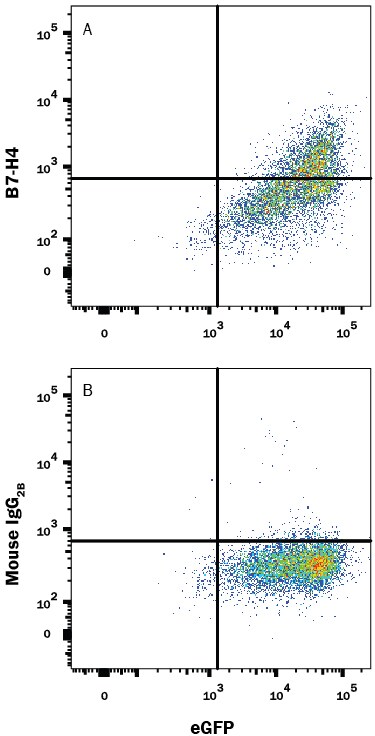
Detection of B7‑H4 in HEK293 Human Cell Line Transfected with Human B7-H4 and eGFP by Flow Cytometry.
HEK293 human embryonic kidney cell line transfected with human B7-H4 and eGFP were stained with either (A) Mouse Anti-Human B7-H4 PE-conjugated Monoclonal Antibody (Catalog # FAB6576P) or (B) Mouse IgG2BPhycoerythrin Isotype Control (Catalog # IC0041P). View our protocol for Staining Membrane-associated Proteins.Applications for Human B7-H4 Antibody (935317) [PE]
Application
Recommended Usage
Flow Cytometry
10 µL/106 cells
Sample: HEK293 human embryonic kidney cell line transfected with human B7-H4 and eGFP
Sample: HEK293 human embryonic kidney cell line transfected with human B7-H4 and eGFP
Spectra Viewer
Plan Your Experiments
Use our spectra viewer to interactively plan your experiments, assessing multiplexing options. View the excitation and emission spectra for our fluorescent dye range and other commonly used dyes.
Spectra Viewer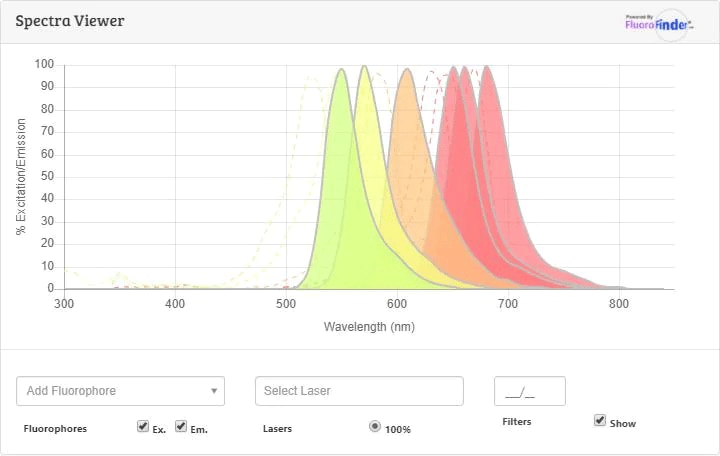
Flow Cytometry Panel Builder
Bio-Techne Knows Flow Cytometry
Save time and reduce costly mistakes by quickly finding compatible reagents using the Panel Builder Tool.
Advanced Features
- Spectra Viewer - Custom analysis of spectra from multiple fluorochromes
- Spillover Popups - Visualize the spectra of individual fluorochromes
- Antigen Density Selector - Match fluorochrome brightness with antigen density

Formulation, Preparation, and Storage
Purification
Protein A or G purified from hybridoma culture supernatant
Formulation
Supplied in a saline solution containing BSA and Sodium Azide.
Shipping
The product is shipped with polar packs. Upon receipt, store it immediately at the temperature recommended below.
Stability & Storage
Protect from light. Do not freeze.
- 12 months from date of receipt, 2 to 8 °C as supplied.
Background: B7-H4
(4-8). Following binding to activated T cells, B7-H4 serves as a co‑inhibitor of the T cell response. This is accomplished by reverse signaling that can induce either cell cycle arrest, or apoptosis in B7-H4 expressing cells (2-5, 9, 10). B7‑H4 is up‑regulated in several carcinomas in correlation with tumor progression and metastasis (2, 7, 11, 12). A soluble form of B7-H4 is elevated in the serum of ovarian cancer, renal cell carcinoma, and rheumatoid arthritis patients, and is correlated with advanced disease status (13-15). Soluble B7‑H4 functions as a decoy molecule that blocks the inhibitory influence of B7‑H4 on immune activation (15). Despite evidence for the involvement of B7-H4 in immune regulation, mice deficient in its expression do not show significant immune deficiencies, suggesting compensation by other molecules in vivo (16).
References
- Yi, K.H. and L. Chen (2009) Immunol. Rev. 229:145.
- Guo, Y. and A.Y. Wang (2015) Front. Immunol. 6:421.
- Zang, X. et al. (2003) Proc. Natl. Acad. Sci. USA 100:10388.
- Prasad, V.R. et al. (2003) Immunity 18:863.
- Sica, G.L. et al. (2003) Immunity 18:849.
- Kryczek, I. et al. (2006) J. Exp. Med. 203:871.
- Tringler, B. et al. (2005) Clin. Cancer Res. 11:1842.
- Xue, Q. et al. (2010) Stem Cells Dev. 19:27.
- Song, H. et al. (2008) Cancer Lett. 266:227.
- Park, G.B. et al. (2009) Immunology 128:360.
- Zang, X. et al. (2007) Proc. Natl. Acad. Sci. USA 104:19458.
- Krambeck, A.E. et al. (2006) Proc. Natl. Acad. Sci. USA 103:10391.
- Simon, I. et al. (2006) Cancer Res. 66:1570.
- Thompson, R.H. et al. (2008) Cancer Res. 68:6054.
- Azuma, T. et al. (2009) PloS Med. 6:e1000166.
- Suh, W.-K. et al. (2006) Mol. Cell. Biol. 26:6403.
Long Name
B7 Homolog 4
Alternate Names
B7H4, B7S1, B7x, Vtcn1
Gene Symbol
VTCN1
UniProt
Additional B7-H4 Products
Product Documents for Human B7-H4 Antibody (935317) [PE]
Certificate of Analysis
To download a Certificate of Analysis, please enter a lot or batch number in the search box below.
Note: Certificate of Analysis not available for kit components.
Product Specific Notices for Human B7-H4 Antibody (935317) [PE]
For research use only
Related Research Areas
Customer Reviews for Human B7-H4 Antibody (935317) [PE]
There are currently no reviews for this product. Be the first to review Human B7-H4 Antibody (935317) [PE] and earn rewards!
Have you used Human B7-H4 Antibody (935317) [PE]?
Submit a review and receive an Amazon gift card!
$25/€18/£15/$25CAN/¥2500 for a review with an image
$10/€7/£6/$10CAN/¥1110 for a review without an image
Submit a review
Protocols
Find general support by application which include: protocols, troubleshooting, illustrated assays, videos and webinars.
- 7-Amino Actinomycin D (7-AAD) Cell Viability Flow Cytometry Protocol
- Extracellular Membrane Flow Cytometry Protocol
- Flow Cytometry Protocol for Cell Surface Markers
- Flow Cytometry Protocol for Staining Membrane Associated Proteins
- Flow Cytometry Staining Protocols
- Flow Cytometry Troubleshooting Guide
- Intracellular Flow Cytometry Protocol Using Alcohol (Methanol)
- Intracellular Flow Cytometry Protocol Using Detergents
- Intracellular Nuclear Staining Flow Cytometry Protocol Using Detergents
- Intracellular Staining Flow Cytometry Protocol Using Alcohol Permeabilization
- Intracellular Staining Flow Cytometry Protocol Using Detergents to Permeabilize Cells
- Propidium Iodide Cell Viability Flow Cytometry Protocol
- Protocol for Liperfluo
- Protocol for the Characterization of Human Th22 Cells
- Protocol for the Characterization of Human Th9 Cells
- Protocol: Annexin V and PI Staining by Flow Cytometry
- Protocol: Annexin V and PI Staining for Apoptosis by Flow Cytometry
- Troubleshooting Guide: Fluorokine Flow Cytometry Kits
- View all Protocols, Troubleshooting, Illustrated assays and Webinars
Loading...