


Human Fas/TNFRSF6/CD95 Fluorescein‑conjugated Antibody

R&D Systems | Catalog # FAB142F

Clone DX2 was used by HLDA to establish CD designation
R&D Systems
Discontinued Product
FAB142F has been discontinued. An alternative/replacement product is available: MAB142. View all Fas/TNFRSF6/CD95 products.

Key Product Details

Species Reactivity

Validated:

Human

Cited:

Human

Applications

Validated:

Flow Cytometry

Cited:

Flow Cytometry

Label

Fluorescein (Excitation = 488 nm, Emission = 515-545 nm)

Antibody Source

Monoclonal Mouse IgG1 Clone # DX2
Loading...

Product Specifications

Immunogen

L cells transfected with human Fas

Specificity

Detects human Fas in direct ELISAs and Western blots. Does not cross-react with rhCD27, rmCD27, rhCD30, rmCD30, rhCD40, rmCD40, rhDR3, rmDR3, rhHVEM, rmHVEM, rhLymphotoxin beta R, rmLymphotoxin beta R, rhTRAIL R1, rmTRAIL R1, rhTRAIL R2, rmTRAIL R2, rhTRAIL R3, or rhTRAIL R4,

Clonality

Monoclonal

Host

Mouse

Isotype

IgG1

Scientific Data Images for Human Fas/TNFRSF6/CD95 Fluorescein‑conjugated Antibody

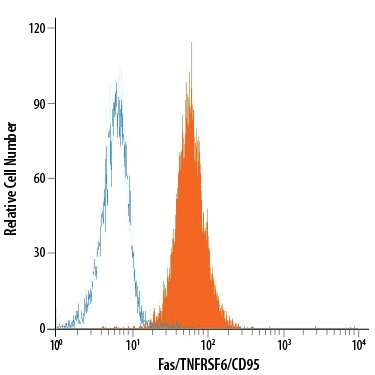
Detection of Fas/TNFRSF6/CD95 antibody in Jurkat Human Cell Line antibody by Flow Cytometry.

Detection of Fas/TNFRSF6/CD95 in Jurkat Human Cell Line by Flow Cytometry.

Jurkat human acute T cell leukemia cell line was stained with Mouse Anti-Human Fas/TNFRSF6/CD95 Fluorescein-conjugated Monoclonal Antibody (Catalog # FAB142F, filled histogram) or isotype control antibody (Catalog # IC002F, open histogram). View our protocol for Staining Membrane-associated Proteins.

Applications for Human Fas/TNFRSF6/CD95 Fluorescein‑conjugated Antibody

Application
Recommended Usage

Flow Cytometry

10 µL/106 cells
Sample: Jurkat human acute T cell leukemia cell line

Spectra Viewer

Plan Your Experiments

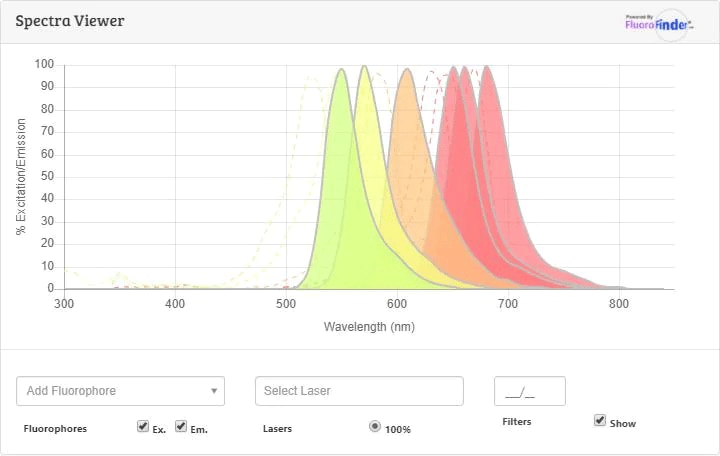
Use our spectra viewer to interactively plan your experiments, assessing multiplexing options. View the excitation and emission spectra for our fluorescent dye range and other commonly used dyes.

Spectra Viewer

Flow Cytometry Panel Builder

Bio-Techne Knows Flow Cytometry

Save time and reduce costly mistakes by quickly finding compatible reagents using the Panel Builder Tool.

Advanced Features

  • Spectra Viewer - Custom analysis of spectra from multiple fluorochromes
  • Spillover Popups - Visualize the spectra of individual fluorochromes
  • Antigen Density Selector - Match fluorochrome brightness with antigen density
Build Your Panel Now

Formulation, Preparation, and Storage

Purification

Protein A or G purified from hybridoma culture supernatant

Formulation

Supplied in a saline solution containing BSA and Sodium Azide.

Shipping

The product is shipped with polar packs. Upon receipt, store it immediately at the temperature recommended below.

Stability & Storage

Protect from light. Do not freeze.
  • 12 months from date of receipt, 2 to 8 °C as supplied.

Background: Fas/TNFRSF6/CD95

Fas, also known as APO-1, CD95, and TNFRSF6, was originally identified as a cell-surface protein which binds to monoclonal antibodies that were cytolytic for various human cell lines. In the TNF Receptor superfamily nomenclature, Fas is referred to as TNFRSF6. Human Fas cDNA encodes a 325 amino acid (aa) residue type 1 membrane protein that belongs to the TNF and NGF receptor family. Alternatively spliced cDNAs encoding multiple Fas isoforms, including a soluble form of Fas lacking the transmembrane domain, have also been identified. Fas is highly expressed in epithelial cells, hepatocytes, activated mature lymphocytes, virus-transformed lymphocytes, and other tumor cells. Fas expression has also been detected in mouse thymus, liver, heart, lung, kidney, and ovary. The ligand for Fas (FasL) has been identified and shown to be a member of the TNF family of type 2 membrane proteins. FasL is predominantly expressed by activated T‑lymphocytes, NK cells, and in tissues with immune-privileged sites. Soluble FasL can be produced by proteolysis of membrane-associated Fas.

Ligation of Fas by FasL or anti-Fas antibody has been shown to induce apoptotic cell death in Fas-bearing cells. Fas plays a role in the down-regulation of the immune reaction and has been shown to be a key mediator of activation-induced death of activated T lymphocytes. Fas-mediated cell death has also been shown to be important for the deletion of activated or autoreactive B lymphocytes. Besides the perforin/granzyme-based mechanism, the Fas system has been identified as the alternate pathway for CTL-mediated cytotoxicity. FasL has also been shown to function in immunological privileged sites by killing infiltrating Fas-bearing lymphocytes and inflammatory cells.

References

  1. Nagata, S. and P. Golstein (1995) Science 267:1449.
  2. Nagata, S. (1997) Cell 88:355.
  3. Parijs, L. and A.K. Abbas (1996) Current Opinion in Immunol. 8:355.
  4. Green, D.R. and C.F. Ware (1997) Proc. Natl. Acad. Sci. USA 94:5986.

Long Name

Fibroblast-associated

Alternate Names

Apo-1, APT1, CD95, TNFRSF6

Entrez Gene IDs

355 (Human); 14102 (Mouse); 246097 (Rat); 102140989 (Cynomolgus Monkey); 493881 (Feline)

Gene Symbol

FAS

Additional Fas/TNFRSF6/CD95 Products

Product Documents for Human Fas/TNFRSF6/CD95 Fluorescein‑conjugated Antibody

Certificate of Analysis

To download a Certificate of Analysis, please enter a lot or batch number in the search box below.

Note: Certificate of Analysis not available for kit components.

Product Specific Notices for Human Fas/TNFRSF6/CD95 Fluorescein‑conjugated Antibody

For research use only

Citations for Human Fas/TNFRSF6/CD95 Fluorescein‑conjugated Antibody

Customer Reviews for Human Fas/TNFRSF6/CD95 Fluorescein‑conjugated Antibody

There are currently no reviews for this product. Be the first to review Human Fas/TNFRSF6/CD95 Fluorescein‑conjugated Antibody and earn rewards!

Have you used Human Fas/TNFRSF6/CD95 Fluorescein‑conjugated Antibody?

Submit a review and receive an Amazon gift card!

$25/€18/£15/$25CAN/¥2500 Yen for a review with an image

$10/€7/£6/$10CAN/¥1110 Yen for a review without an image

Submit a review
Amazon Gift Card

FAQs

No product specific FAQs exist for this product.

View all FAQs for Antibodies
