
PRSS (Protease; serine) genes produce three isoforms of pancreatic trypsinogen. Based on their electrophoretic mobilities, they are named cationic trypsinogen (trypsin 1/PRSS1), anionic trypsinogen (trypsin 2/PRSS2) and meso- (or "in the middle") trypsinogen (trypsin 3/PRSS3). PRSS1 is the predominant form (67%). Following secretion from the pancreas, active trypsin is generated in the duodenum through the interaction of brush-border duodenal enterokinase with trypsinogen.
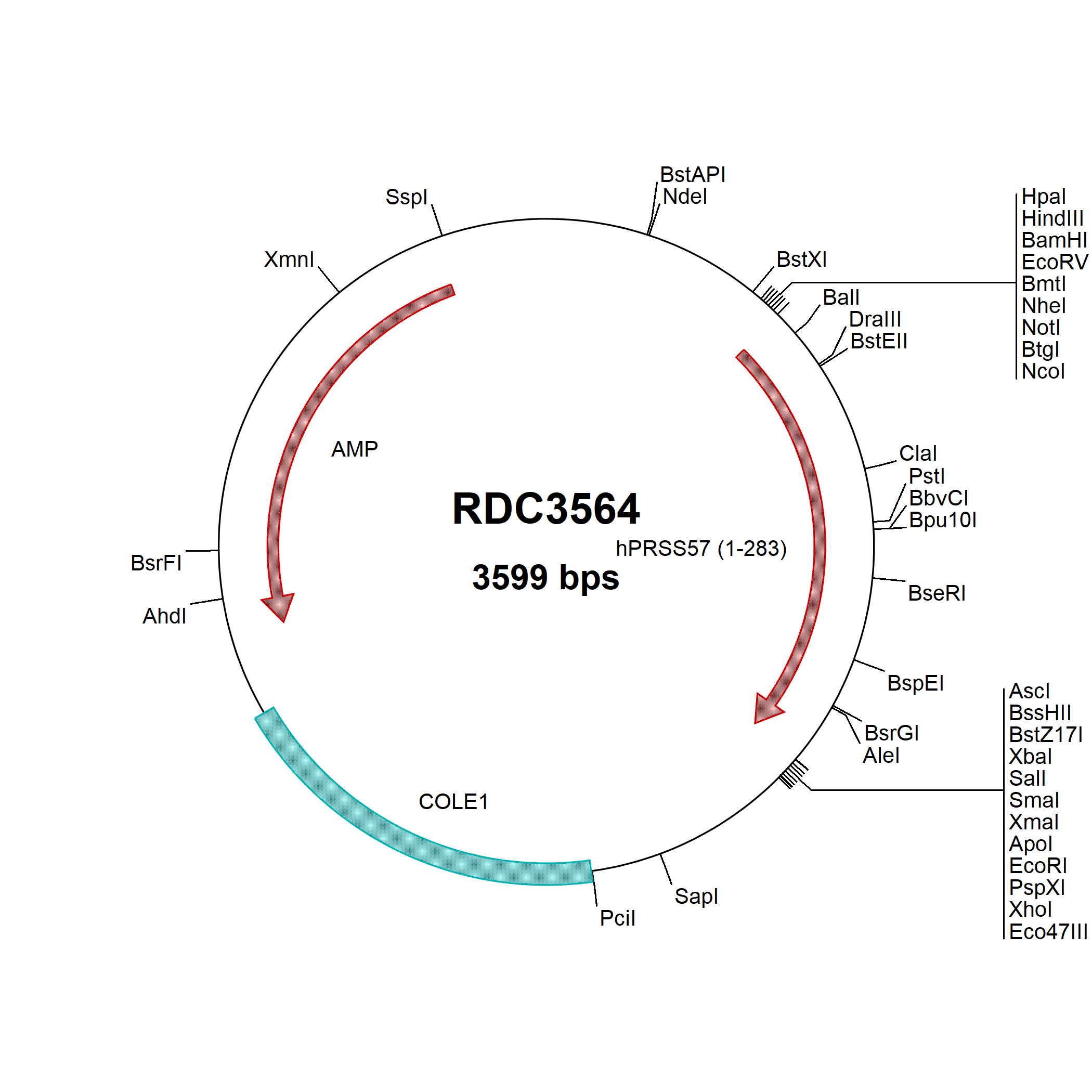
Human PRSS57 (NP_999875.2) VersaClone cDNA
R&D Systems | Catalog # RDC3564

Loading...
Loading...
Formulation, Preparation, and Storage
Shipping
The product is shipped at ambient temperature. Upon receipt, store it immediately at the temperature recommended below.
Storage
Store the unopened product at -20 to -70 °C. Use a manual defrost freezer and avoid repeated freeze-thaw cycles. Do not use past expiration date.
Background: PRSS57
Long Name
Serine Protease 57
Alternate Names
NSP4, PRSS1L, UNQ782
Entrez Gene IDs
400668 (Human)
Gene Symbol
PRSS57
UniProt
Additional PRSS57 Products
Product Documents for Human PRSS57 (NP_999875.2) VersaClone cDNA
Certificate of Analysis
To download a Certificate of Analysis, please enter a lot or batch number in the search box below.
Note: Certificate of Analysis not available for kit components.
Product Specific Notices for Human PRSS57 (NP_999875.2) VersaClone cDNA
For research use only
Related Research Areas
Customer Reviews for Human PRSS57 (NP_999875.2) VersaClone cDNA
There are currently no reviews for this product. Be the first to review Human PRSS57 (NP_999875.2) VersaClone cDNA and earn rewards!
Have you used Human PRSS57 (NP_999875.2) VersaClone cDNA?
Submit a review and receive an Amazon gift card!
$25/€18/£15/$25CAN/¥2500 for a review with an image
$10/€7/£6/$10CAN/¥1110 for a review without an image
Submit a review
Loading...