
Melanocortin-1 R/MC1R Antibody - BSA Free
Novus Biologicals | Catalog # NLS1040

![Immunohistochemistry-Paraffin: Melanocortin-1 R/MC1R Antibody - BSA Free [NLS1040]](https://resources.rndsystems.com/images/products/Melanocortin-1-R-MC1R-Antibody-Immunohistochemistry-Paraffin-NLS1040-img0002.jpg "Immunohistochemistry-Paraffin: Melanocortin-1 R/MC1R Antibody - BSA Free [NLS1040]")
Scientific images may be resized, cropped, or adjusted for brightness or contrast for presentation purposes. These updates are limited to presentation and do not affect the underlying scientific interpretation of the data. Where available, additional source data may be provided upon request.
Key Product Details
Species Reactivity
Validated:
Predicted:
Applications
Label
Antibody Source
Format
Product Specifications
Immunogen
Epitope
Reactivity Notes
Specificity
Clonality
Host
Isotype
Description
Scientific Data Images for Melanocortin-1 R/MC1R Antibody - BSA Free
Immunohistochemistry-Paraffin: Melanocortin-1 R/MC1R Antibody - BSA Free [NLS1040]
Immunohistochemistry-Paraffin: Melanocortin-1 R/MC1R Antibody [NLS1040] - Human Adrenal: Formalin-Fixed, Paraffin-Embedded (FFPE)![Immunohistochemistry-Paraffin: Melanocortin-1 R/MC1R Antibody - BSA Free [NLS1040]](https://resources.rndsystems.com/images/products/Melanocortin-1-R-MC1R-Antibody-Immunohistochemistry-Paraffin-NLS1040-img0001.jpg "Immunohistochemistry-Paraffin: Melanocortin-1 R/MC1R Antibody - BSA Free [NLS1040]")
Immunohistochemistry-Paraffin: Melanocortin-1 R/MC1R Antibody - BSA Free [NLS1040]
Immunohistochemistry-Paraffin: Melanocortin-1 R/MC1R Antibody [NLS1040] - Human Kidney: Formalin-Fixed, Paraffin-Embedded (FFPE)Applications for Melanocortin-1 R/MC1R Antibody - BSA Free
Immunohistochemistry-Paraffin
Reviewed Applications
Read 1 review rated 5 using NLS1040 in the following applications:
Formulation, Preparation, and Storage
Purification
Formulation
Format
Preservative
Concentration
Shipping
Stability & Storage
Background: Melanocortin-1 R/MC1R
Long Name
Alternate Names
Entrez Gene IDs
Gene Symbol
Additional Melanocortin-1 R/MC1R Products
Product Documents for Melanocortin-1 R/MC1R Antibody - BSA Free
Certificate of Analysis
To download a Certificate of Analysis, please enter a lot or batch number in the search box below.
Product Specific Notices for Melanocortin-1 R/MC1R Antibody - BSA Free
This product is for research use only and is not approved for use in humans or in clinical diagnosis. Primary Antibodies are guaranteed for 1 year from date of receipt.
Customer Reviews for Melanocortin-1 R/MC1R Antibody - BSA Free (1)
Have you used Melanocortin-1 R/MC1R Antibody - BSA Free?
Submit a review and receive an Amazon gift card!
$25/€18/£15/$25CAN/¥2500 for a review with an image
$10/€7/£6/$10CAN/¥1110 for a review without an image
Submit a review
Customer Images
-
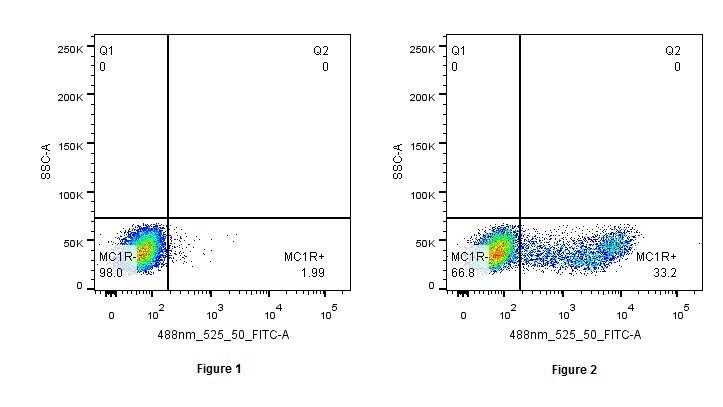
Application: Flow CytometrySample Tested: Blood mononuclear cells (PBMCs)Species: HumanVerified Customer | Posted 02/05/2019Figure 1 shows Lymphocytes stained with Alexa Fluor 488 Donkey anti-rabbit IgG alone, and Figure 2 shows Lymphocytes stained with human MC1R and Alexa Fluor 488 Donkey anti-rabbit IgG.Blocking: Natural Goat Serum Primary antibody: 2 uL (1 ug) Secondary antibody: Alexa Fluor 488 Donkey anti-rabbit IgG (2.5 uL / 1 ug) Details: Human lymphocytes were isolated from PBMCs. Lymphocytes were blocked with Natural Goat Serum for 15 minutes, and then stained and subsequently incubated at -20 C with anti-human MC1R primary antibody for 30 minutes. After washing, cells were stained with Alexa Fluor 488 Donkey anti-rabbit IgG and incubated at -20 C for 40 minutes. After washing, cells were detected using a Fortessa 4-15 flow cytometer.

There are no reviews that match your criteria.
Protocols
View specific protocols for Melanocortin-1 R/MC1R Antibody - BSA Free (NLS1040):
Immunohistochemistry
1. Prepare tissue with formalin fixation and by embedding it in paraffin wax.
2. Make 4-um sections and place on pre-cleaned and charged microscope slides.
3. Heat in a tissue-drying oven for 45 minutes at 60 degrees Celcius.
4. Deparaffinize the tissues by wash drying the slides in 3 changes of xylene approximately 5 minutes each @ RT.
5. Rehydrate the tissues by washing the slides in 3 changes of 100% alcohol approximately 3 minutes each @ RT.
6. Wash the slides in 2 changes of 95% alcohol approximately 3 minutes each @ RT.
7. Wash the slides in 1 change of 80% alcohol approximately 3 minutes @ RT.
8. Rinse the slides in gentle running distilled water approximately 5 minutes @ RT.
9. Perform antigen retrieval by steaming the slides in 0.01M sodium citrate buffer (pH 6.0) @ 99-100 degrees Celcius for 20 minutes.
10. Remove the slides from the heat and let stand in buffer @ RT for 20 minutes.
11. Rinse the slides in 1X TBS-T for 1 minute @ RT.
**Do not allow the tissues to dry at any time during the staining procedure**
12. Begin the immunostaining by applying a universal protein block approximately 20 minutes @ RT.
13. Drain protein block from the slides and apply the diluted primary antibody approximately 45 minutes @ RT.
14. Rinse the slide in 1X TBS-T approximately 1 minute @ RT.
15. Apply a biotinylated anti-rabbit IgG (H+L) secondary approximately 30 minutes @ RT.
16. Rinse the slide in 1X TBS-T approximately 1 minute at RT.
17. Apply an alkaline phosphatase steptavidin approximately 30 minutes at RT.
18. Rinse the slide in 1X TBS-T approximately 1 minute at RT.
19. Apply an alkaline phosphatase chromagen substrate approximately 30 minutes at RT.
20. Rinse the slide in distilled water approximately 1 minute @ RT.
**This method should only be used if the chromagen substrate is alcohol insoluble (ie: Vector Red, DAB)**
21. Dehydrate the tissue by washing the slides in 2 changes of 80% alcohol approximately 1 minute each @ RT.
22. Wash the slides in 2 changes of 95% alcohol approximately 1 minute each @ RT.
23. Wash the slides in 3 changes of 100% alcohol approximately 1 minute each @ RT.
24. Wash the slides in 3 changes of xyleneapproximately 1 minute each @ RT.
25. Apply cover slip.
Find general support by application which include: protocols, troubleshooting, illustrated assays, videos and webinars.
- Antigen Retrieval Protocol (PIER)
- Antigen Retrieval for Frozen Sections Protocol
- Appropriate Fixation of IHC/ICC Samples
- Cellular Response to Hypoxia Protocols
- Chromogenic IHC Staining of Formalin-Fixed Paraffin-Embedded (FFPE) Tissue Protocol
- Chromogenic Immunohistochemistry Staining of Frozen Tissue
- ClariTSA™ Fluorophore Kits
- Detection & Visualization of Antibody Binding
- Fluorescent IHC Staining of Frozen Tissue Protocol
- Graphic Protocol for Heat-induced Epitope Retrieval
- Graphic Protocol for the Preparation and Fluorescent IHC Staining of Frozen Tissue Sections
- Graphic Protocol for the Preparation and Fluorescent IHC Staining of Paraffin-embedded Tissue Sections
- Graphic Protocol for the Preparation of Gelatin-coated Slides for Histological Tissue Sections
- IHC Sample Preparation (Frozen sections vs Paraffin)
- Immunofluorescent IHC Staining of Formalin-Fixed Paraffin-Embedded (FFPE) Tissue Protocol
- Immunohistochemistry (IHC) and Immunocytochemistry (ICC) Protocols
- Immunohistochemistry Frozen Troubleshooting
- Immunohistochemistry Paraffin Troubleshooting
- Preparing Samples for IHC/ICC Experiments
- Preventing Non-Specific Staining (Non-Specific Binding)
- Primary Antibody Selection & Optimization
- Protocol for Heat-Induced Epitope Retrieval (HIER)
- Protocol for Making a 4% Formaldehyde Solution in PBS
- Protocol for VisUCyte™ HRP Polymer Detection Reagent
- Protocol for the Preparation & Fixation of Cells on Coverslips
- Protocol for the Preparation and Chromogenic IHC Staining of Frozen Tissue Sections
- Protocol for the Preparation and Chromogenic IHC Staining of Frozen Tissue Sections - Graphic
- Protocol for the Preparation and Chromogenic IHC Staining of Paraffin-embedded Tissue Sections
- Protocol for the Preparation and Chromogenic IHC Staining of Paraffin-embedded Tissue Sections - Graphic
- Protocol for the Preparation and Fluorescent IHC Staining of Frozen Tissue Sections
- Protocol for the Preparation and Fluorescent IHC Staining of Paraffin-embedded Tissue Sections
- Protocol for the Preparation of Gelatin-coated Slides for Histological Tissue Sections
- TUNEL and Active Caspase-3 Detection by IHC/ICC Protocol
- The Importance of IHC/ICC Controls
- Troubleshooting Guide: Immunohistochemistry
- View all Protocols, Troubleshooting, Illustrated assays and Webinars