
Platelet endothelial aggregation receptor 1 (PEAR1) is a 150 kDa type I transmembrane protein and member of the MEGF family of proteins. Human PEAR1 is synthesized as a 1037 amino acid (aa) precursor that contains a 20 aa signal sequence, a 735 aa extracellular domain (ECD), a 21 aa transmembrane region, and a 261 aa cytoplasmic region. The ECD consists of 15 EGF-like repeats that vary in length from 39 to 42 aa and contain a consensus sequence of CX1-2GX2GX2-4CX3CX1-3CX1-2GX1-2CX4GX1CX1CX2GX2GX2C. The consensus repeat contains six conserved glycine residues and eight conserved cysteine residues, suggesting four disulfide-bonded cysteine pairs in each EGF repeat. Within the ECD, there are also five potential sites for N-linked glycosylation. The cytoplasmic region contains five potential Src homology 3-binding, proline-rich domains. Mature human PEAR1 is 84% aa identical to mature mouse PEAR1. PEAR1 is most highly expressed in platelets and endothelial cells. Functionally, PEAR1 is a receptor for a yet undetermined ligand that signals upon the formation of platelet-platelet contacts induced both by platelet aggregations and by platelet centrifugation. The signaling enhances and stabilizes platelet thrombi. Upon aggregation, the surface-expressed protein is tyrosine-phosphorylated. This phosphorylation event is inhibited by the alphaIIbbeta3 antagonist eptifibatide, thus demonstrating that PEAR1 tyrosine phosphorylation is dependent on surface contacts between activated platelets. PEAR1 can be phosphorylated in an alphaIIbbeta3 integrin-dependent manner on tyrosine (Tyr925) and serine residues (Ser593 and Ser1029) and, potentially, at Tyr804, Tyr943, and Tyr979. Inherited PEAR1 variations that alter expression or function of the platelet signaling molecule could modify agonist-induced aggregation in native platelets. In addition, a genetic variant in PEAR1 could be an important determinant of residual platelet function during aspirin treatment, because the COX1/thromboxane A2 pathway will be strongly inhibited by aspirin, and maximal aggregation will then be dependent on other secondary signaling pathways.
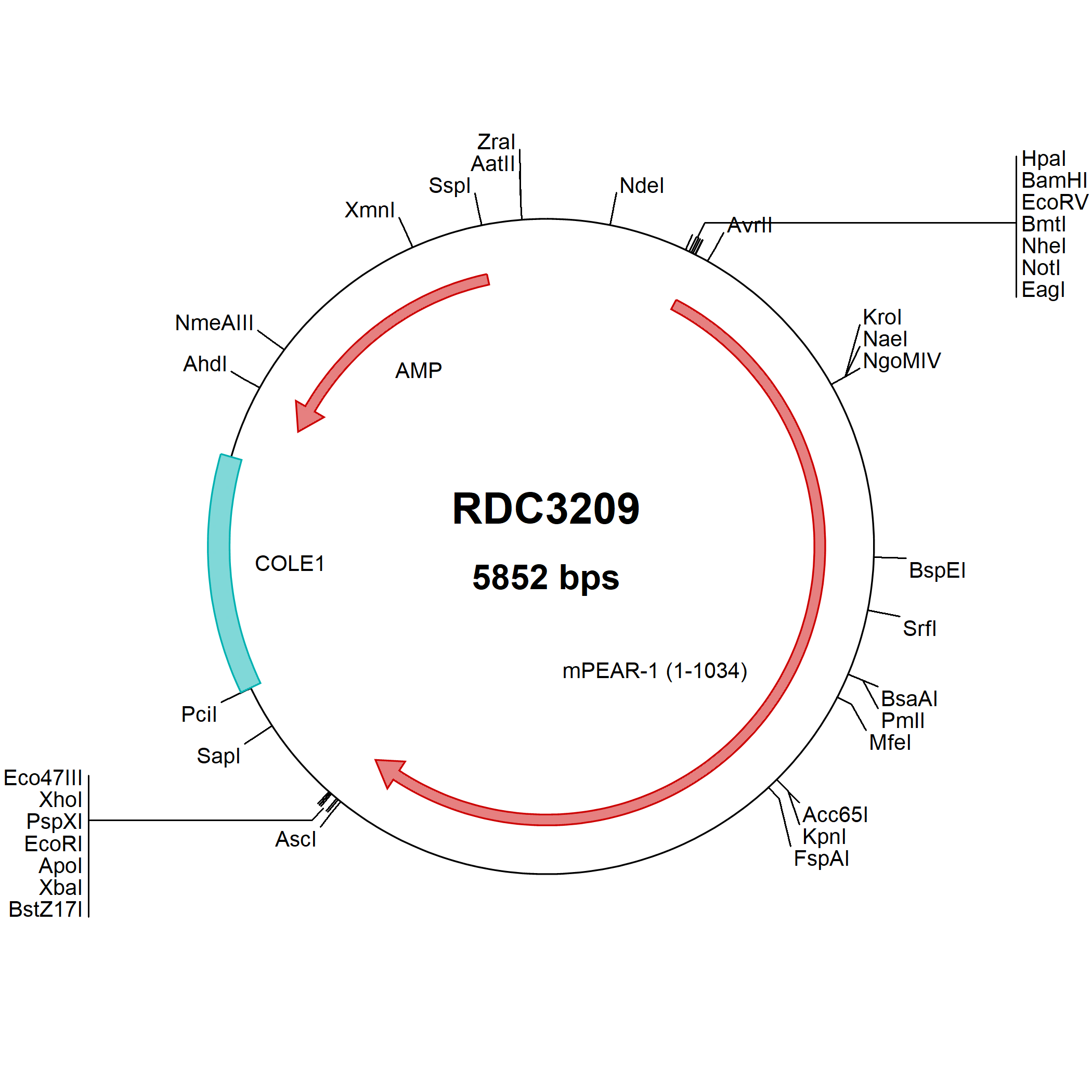
Mouse PEAR1 (NP_690012.2) VersaClone cDNA
R&D Systems | Catalog # RDC3209

Loading...
Loading...
Formulation, Preparation, and Storage
Shipping
The product is shipped at ambient temperature. Upon receipt, store it immediately at the temperature recommended below.
Storage
Store the unopened product at -20 to -70 °C. Use a manual defrost freezer and avoid repeated freeze-thaw cycles. Do not use past expiration date.
Background: PEAR1
Long Name
Platelet endothelial aggregation receptor 1
Alternate Names
Jedi
Gene Symbol
PEAR1
UniProt
Additional PEAR1 Products
Product Documents for Mouse PEAR1 (NP_690012.2) VersaClone cDNA
Certificate of Analysis
To download a Certificate of Analysis, please enter a lot or batch number in the search box below.
Note: Certificate of Analysis not available for kit components.
Product Specific Notices for Mouse PEAR1 (NP_690012.2) VersaClone cDNA
For research use only
Related Research Areas
Customer Reviews for Mouse PEAR1 (NP_690012.2) VersaClone cDNA
There are currently no reviews for this product. Be the first to review Mouse PEAR1 (NP_690012.2) VersaClone cDNA and earn rewards!
Have you used Mouse PEAR1 (NP_690012.2) VersaClone cDNA?
Submit a review and receive an Amazon gift card!
$25/€18/£15/$25CAN/¥2500 for a review with an image
$10/€7/£6/$10CAN/¥1110 for a review without an image
Submit a review
Loading...
Associated Pathways
