
Recombinant Human Activin E Protein, CF
R&D Systems | Catalog # 11779-AE

Loading...
Key Product Details
Source
E. coli
Accession Number
Structure / Form
Disulfide-linked homodimer
Applications
Bioactivity
Loading...
Product Specifications
Source
E. coli-derived human INHBE protein
Thr237-Ser350
Thr237-Ser350
Purity
>95%, by SDS-PAGE visualized with Silver Staining and quantitative densitometry by Coomassie® Blue Staining.
Endotoxin Level
<0.10 EU per 1 μg of the protein by the LAL method.
N-terminal Sequence Analysis
Met-Thr237
Predicted Molecular Mass
13 kDa
SDS-PAGE
12-15 kDa, under reducing conditions.
Activity
Measured
by its ability to activate CAGA-SEAP reporter in HEK293 human embryonic kidney
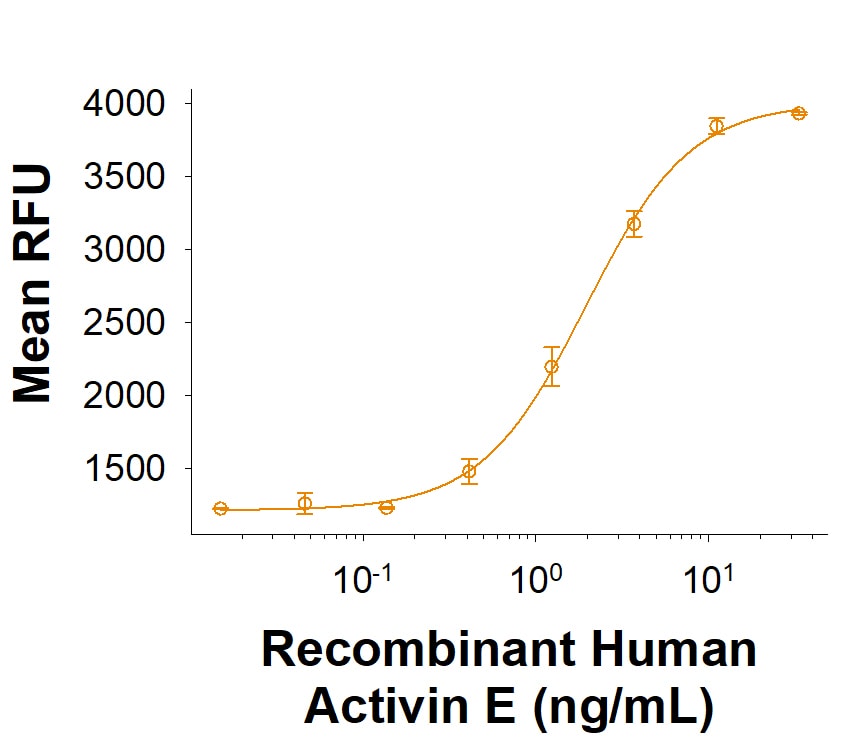
cells transfected with human ALK7. The ED50 for this effect is 1.00-10.0 ng/mL.
Scientific Data Images for Recombinant Human Activin E Protein, CF
Recombinant Human Activin E Protein Bioactivity.
Measured by its ability to activate ALK7-dependent SEAP reporter activity in HEK293 human embryonic kidney cells. The ED50 for this effect is 1.00-10.0 ng/mL.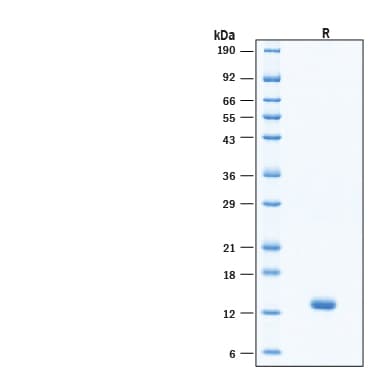
Recombinant Human Activin E Protein SDS-PAGE.
2 μg/lane of Recombinant Human Activin E Protein (Catalog # 11779-AE) was resolved with SDS-PAGE under reducing (R) condition and visualized by Coomassie® Blue staining, showing bands at 12-15 kDa.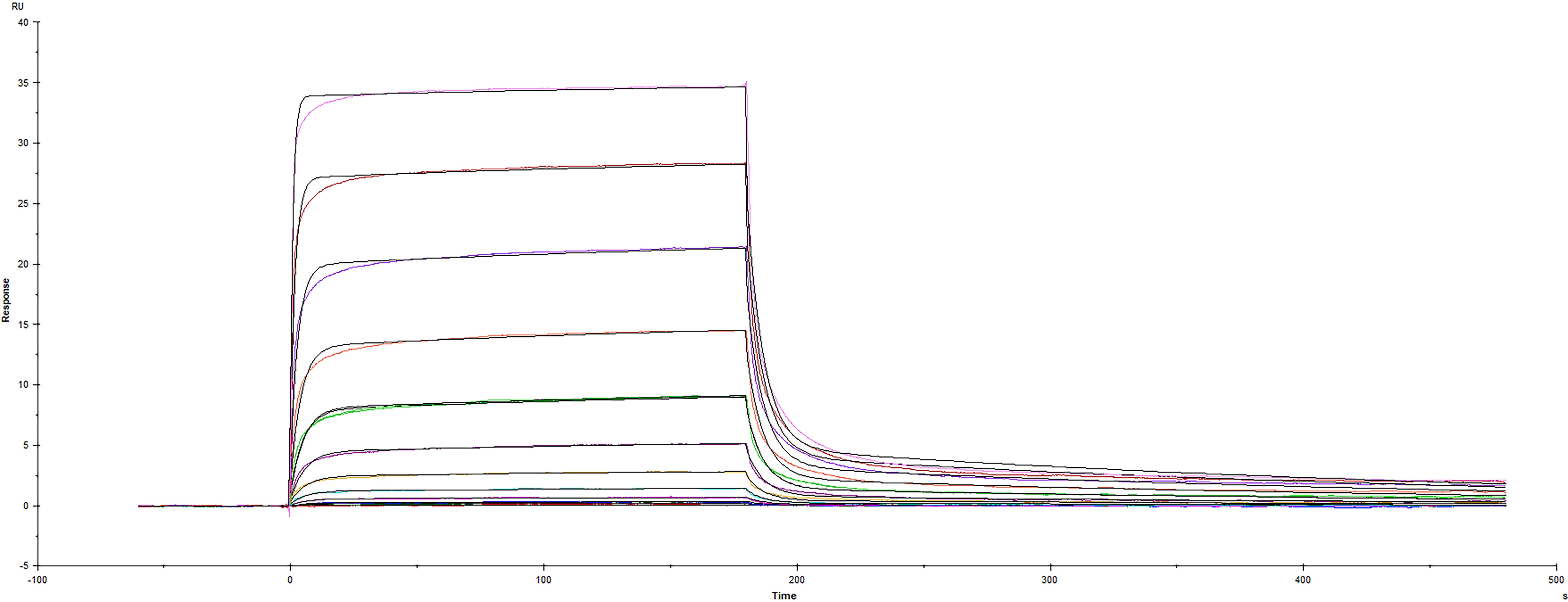
SPR Analysis of Activin E Binding to Activin RIIA.
Binding of Recombinant Human Activin E (Catalog # 11779-AE) to Recombinant Human Activin RIIA Fc Chimera (340-RC2) captured via Recombinant Protein A/G/L (NBP2-34985) was evaluated by Surface Plasmon Resonance (SPR). Analysis of the interaction was characterized based on a series of Recombinant Human Activin E concentrations, yielding an equilibrium dissociation constant (KD) of 142 nM. Representative sensorgrams are shown.Formulation, Preparation, and Storage
11779-AE
| Formulation | Lyophilized from a 0.2 μm filtered solution in HCl with Trehalose. |
| Reconstitution | Reconstitute at 250 μg/mL in water. |
| Shipping | The product is shipped at ambient temperature. Upon receipt, store it immediately at the temperature recommended below. |
| Stability & Storage | Use a manual defrost freezer and avoid repeated freeze-thaw cycles.
|
Calculators
Background: INHBE
References
- Morita, M. Hashimoto, O. (2019) Molecular Biology Reports 46:1603.
- Adam, R.C. et al. (2023) Proc Natl Acad Sci U S A 120:e2309967120
- Sugiyama, M. et al. (2018) Plos one 13:e0194798.
- Deaton, A.M. et. al. (2022) Nat Commun. 13: 4319.
- Park, S.Y. et al. (2025) Exp Mol Med 57:466.
Long Name
Inhibin Subunit Beta E
Alternate Names
Inhibin Beta E, MGC4638
Gene Symbol
INHBE
UniProt
Additional INHBE Products
Product Documents for Recombinant Human Activin E Protein, CF
Certificate of Analysis
To download a Certificate of Analysis, please enter a lot or batch number in the search box below.
Note: Certificate of Analysis not available for kit components.
Product Specific Notices for Recombinant Human Activin E Protein, CF
For research use only
Related Research Areas
Customer Reviews for Recombinant Human Activin E Protein, CF
There are currently no reviews for this product. Be the first to review Recombinant Human Activin E Protein, CF and earn rewards!
Have you used Recombinant Human Activin E Protein, CF?
Submit a review and receive an Amazon gift card!
$25/€18/£15/$25CAN/¥2500 for a review with an image
$10/€7/£6/$10CAN/¥1110 for a review without an image
Submit a review
Loading...