
Best Seller
Recombinant Human Angiopoietin-1 Protein
R&D Systems | Catalog # 923-AN


Loading...
Key Product Details
- R&D Systems NS0-derived Recombinant Human Angiopoietin-1 Protein (923-AN)
- Quality control testing to verify active proteins with lot specific assays by in-house scientists
- All R&D Systems proteins are covered with a 100% guarantee
Source
NS0
Accession Number
Structure / Form
Oligomer
Applications
Bioactivity
Loading...
Product Specifications
Source
Mouse myeloma cell line, NS0-derived human Angiopoietin-1 protein
Ser20-Phe498, with a C-terminal 6-His tag
Ser20-Phe498, with a C-terminal 6-His tag
Purity
>90%, by SDS-PAGE visualized with Silver Staining and quantitative densitometry by Coomassie® Blue Staining.
Endotoxin Level
<1.0 EU per 1 μg of the protein by the LAL method.
N-terminal Sequence Analysis
Ser20
Predicted Molecular Mass
56 kDa
SDS-PAGE
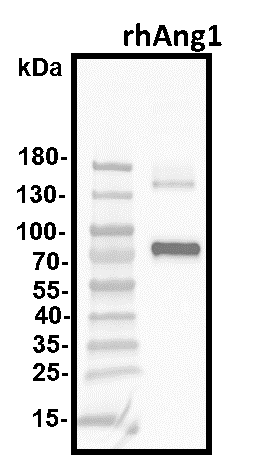
70 kDa, reducing conditions
Activity
Measured by its ability to inhibit serum deprivation induced apoptosis in HUVEC human umbilical vein endothelial cells. Kwak, H.J. et al. (1999) FEBS Letters 448:249.
The ED50 for this effect is 10-40 ng/mL in the presence of 5 µg/mL of a
cross-linking antibody, Mouse Anti-polyHistidine Monoclonal Antibody (Catalog # MAB050).
The ED50 for this effect is 10-40 ng/mL in the presence of 5 µg/mL of a
cross-linking antibody, Mouse Anti-polyHistidine Monoclonal Antibody (Catalog # MAB050).
Reviewed Applications
Read 6 reviews rated 4.5 using 923-AN in the following applications:
Formulation, Preparation, and Storage
Carrier Free
What does CF mean?CF stands for Carrier Free (CF). We typically add Bovine Serum Albumin (BSA) as a carrier protein to our recombinant proteins. Adding a carrier protein enhances protein stability, increases shelf-life, and allows the recombinant protein to be stored at a more dilute concentration. The carrier free version does not contain BSA.
What formulation is right for me?In general, we advise purchasing the recombinant protein with BSA for use in cell or tissue culture, or as an ELISA standard. In contrast, the carrier free protein is recommended for applications, in which the presence of BSA could interfere.
Carrier: 923-AN
| Formulation | Lyophilized from a 0.2 μm filtered solution in Tris-Citrate and NaCl with BSA as a carrier protein. |
| Reconstitution | Reconstitute at 100 μg/mL in sterile PBS containing at least 0.1% human or bovine serum albumin. |
| Shipping | The product is shipped at ambient temperature. Upon receipt, store it immediately at the temperature recommended below. |
| Stability & Storage | Use a manual defrost freezer and avoid repeated freeze-thaw cycles.
|
Carrier Free: 923-AN/CF
| Formulation | Lyophilized from a 0.2 μm filtered solution in Tris-Citrate and NaCl. |
| Reconstitution | Reconstitute at 100 μg/mL in sterile PBS. |
| Shipping | The product is shipped at ambient temperature. Upon receipt, store it immediately at the temperature recommended below. |
| Stability & Storage | Use a manual defrost freezer and avoid repeated freeze-thaw cycles.
|
Calculators
Background: Angiopoietin-1
disulfide-linked homotrimers, tetramers, and pentamers (3, 5). Angiopoietin-1 binds and activates the receptor tyrosine kinase Tie-2, and its association into tetramers is important for full Tie-2 activation (3, 4). Angiopoietin-1 ligation of Tie-2 on vascular endothelial cells (EC) induces the development and branching of blood vessels (6, 7). In sub-confluent EC (i.e. during angiogenesis), Angiopoietin-1 promotes EC motility and Tie-2 localization at the trailing edge of the cell (8). In confluent EC (i.e. in homeostasis), multimeric Angiopoietin-1 enhances vascular integrity by promoting the in trans homotypic association of Tie-2 between EC or with the substratum (8, 9). In addition, Angiopoietin-1 suppresses several VEGF-induced effects on the vasculature including endothelial permeability, stretch-induced release of Angiopoietin-2, and up-regulation of the leukocyte adhesion molecules VCAM-1, ICAM-1, and E-Selectin (10-12). Angiopoietin-1 also interacts with a variety of integrins and the extracellular matrix independently of Tie-2 (13, 14). These interactions support the adhesion, migration and stress resistance of EC, fibroblasts, and myocytes (13, 14). Angiopoietin-1 can protect against pulmonary arterial hypertension (5), reduce the extent of fibrosis and remodeling in infarcted diabetic myocardium (15), and enhance tumor progression and metastasis (16).
References
- Koh, G.Y. (2012) Trends Mol. Med. 19:31.
- Suri, C. et al. (1996) Cell 87:1171.
- Davis, S. et al. (1996) Cell 87:1161.
- Kim, K.-T. et al. (2005) J. Biol. Chem. 280:20126.
- Kugathasan, L. et al. (2009) J. Exp. Med. 206:2221.
- Suri, C. et al. (1998) Science 282:468.
- Jeansson, M. et al. (2011) J. Clin. Invest. 121:2278.
- Saharinen, P. et al. (2008) Nat. Cell. Biol. 10:527.
- Fukuhara, S. et al. (2008) Nat. Cell Biol. 10:513.
- Jho, D. et al. (2005) Circ. Res. 96:1282.
- Korff, T. et al. (2012) Cardiovasc. Res. 94:510.
- Kim, I. et al. (2001) Circ. Res. 89:477.
- Carlson, T.R. et al. (2001) J. Biol. Chem. 276:26516.
- Dallabrida, S.M. et al. (2005) Cardiovasc. Res. 96:e8.
- Samuel, S.M. et al. (2010) Diabetes 59:51.
- Holopainen, T. et al. (2009) Cancer Res. 69:4656.
Alternate Names
ANGPT1
Gene Symbol
ANGPT1
UniProt
Additional Angiopoietin-1 Products
Product Documents for Recombinant Human Angiopoietin-1 Protein
Certificate of Analysis
To download a Certificate of Analysis, please enter a lot or batch number in the search box below.
Note: Certificate of Analysis not available for kit components.
Product Specific Notices for Recombinant Human Angiopoietin-1 Protein
For research use only
Citations for Recombinant Human Angiopoietin-1 Protein
 Powered by Bioz
Customer Reviews for Recombinant Human Angiopoietin-1 Protein (6)
4.5 out of 5
6 Customer Ratings
Have you used Recombinant Human Angiopoietin-1 Protein?
Submit a review and receive an Amazon gift card!
$25/€18/£15/$25CAN/¥2500 for a review with an image
$10/€7/£6/$10CAN/¥1110 for a review without an image
Submit a review
Customer Images
Showing
1
-
5 of
6 reviews
Showing All
Filter By:
-
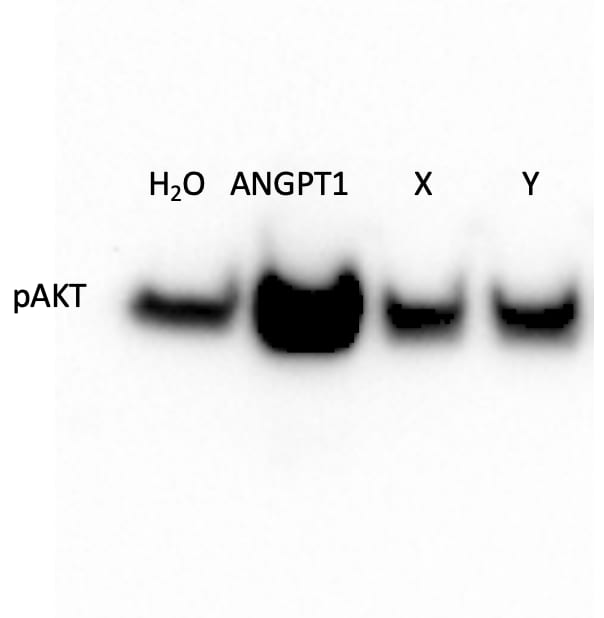
Application: In vitro bioactivity in cell cultureVerified Customer | Posted 04/10/2024

-
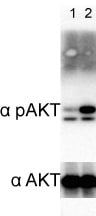
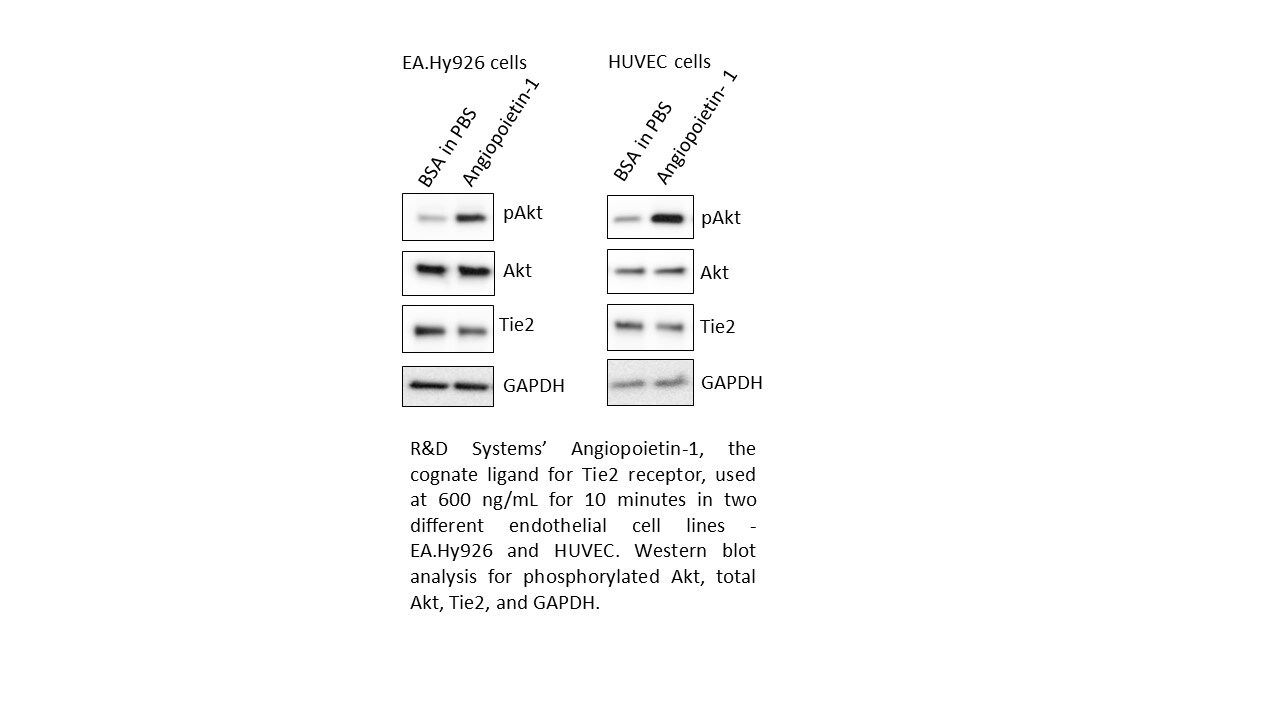
Application: In vitro bioactivity in cell cultureVerified Customer | Posted 11/22/2019HMEC-1 cells were grown to confluence and then serum starved overnight. The next days cells were washed and either left untreated (lane 1) or stimulated with 600 ng/mL Ang-1 for 15min (lane 2). Cells were scraped and analyzed by western blot for AKT and pAKT and showed clear And-1 dependent AKT activation.
-
Application: SDS-PAGE ControlVerified Customer | Posted 09/03/2019
-
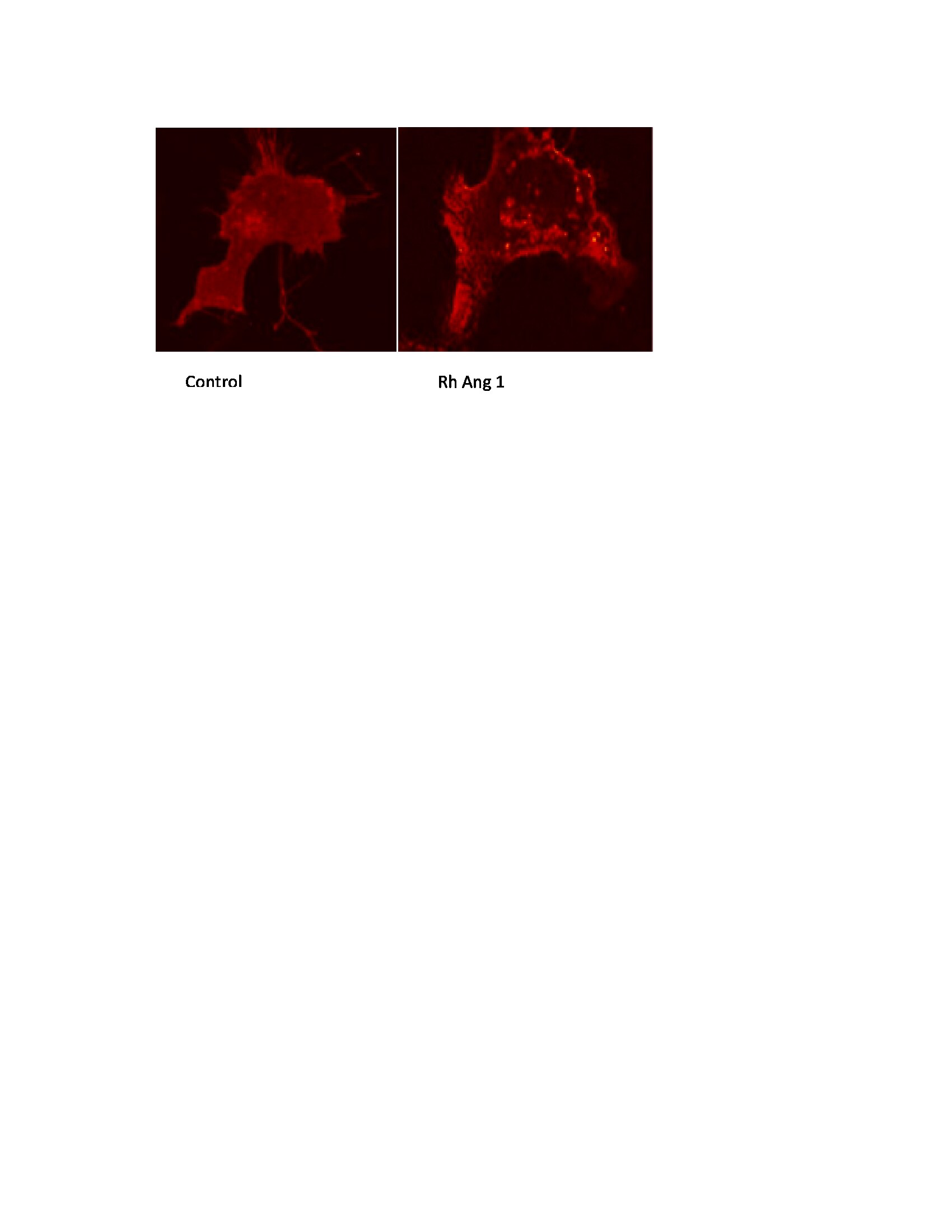
Application: endothelial cells clustering Tie2 when being treated with RH Ang1Verified Customer | Posted 10/16/2018
-
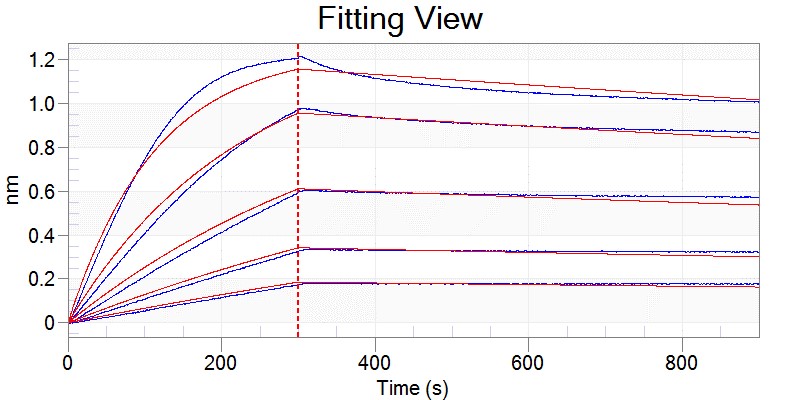
Application: Binding assay/Protein-protein interactionVerified Customer | Posted 12/06/2017
-
Application: SDS-PAGE ControlVerified Customer | Posted 12/03/2017
There are no reviews that match your criteria.
FAQs for Recombinant Human Angiopoietin-1 Protein
Showing
1
-
1 of
1 FAQ
Showing All
-
Q:
This protein datasheet indicates I need to use a cross-linking antibody, Catalog # MAB050, for biological activity. What is this antibody and is it really necessary?
A: The antibody is directed against a 6x histidine repeat and is recommended for use as a cross-linker of proteins with 6x his-tag. Crosslinking is often used for proteins that require receptor trimerization and can result greater biological activity. R&D Systems Quality Control tests the performance of these proteins in the presence of the cross-linking antibody. Therefore, it is necessary to use this antibody when trying to achieve the same level of specific activity described in the datasheet.
Loading...