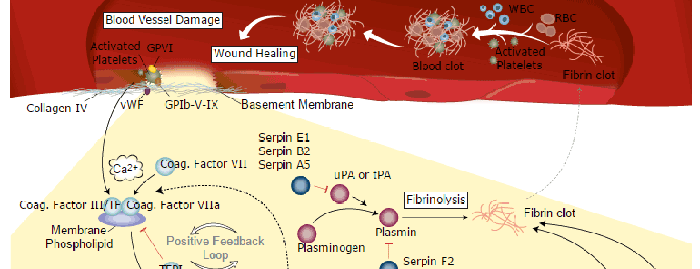
Coagulation Factors VII and VIIa refer to the pro and active forms of the same protease, respectively (1). Factor VII is synthesized in the liver and circulates in the plasma where it binds to tissue factor (TF), an integral membrane protein found in a variety of cell types. Upon binding of TF, Factor VII is rapidly converted into VIIa. The resulting 1:1 complex of VIIa and TF initiates the coagulation pathway and has also important coagulation-independent functions such as angiognesis (2). The cleavage and activation of Coagulation Factors VII, IX and X by VIIa:TF is phospholipid-dependent whereas the cleavage of small peptide substrates is not (1). The predominant splicing variant of Factor VII in normal liver corresponds to the 444 amino acid precursor (3, 4). After a signal peptide (residues 1 to 38), the mature chain can be further processed into the light chain (residues 39 to 190) and the heavy chain (residues 191 to 444). The purified Recombinant Human Factor VII corresponds to the mature chain, which can be processed and activated by treatment with thermolysin and binding with Recombinant Human Coagulation Factor III/Tissue Factor (Catalog # http://www.rndsystems.com/product_results.aspx?k=2339-PA">2339-PA) under the conditions described above.
Recombinant Human Coagulation Factor VII Protein, CF
R&D Systems | Catalog # 2338-SE


Key Product Details
- R&D Systems NS0-derived Recombinant Human Coagulation Factor VII Protein (2338-SE)
- Quality control testing to verify active proteins with lot specific assays by in-house scientists
- All R&D Systems proteins are covered with a 100% guarantee
Source
Accession Number
Structure / Form
Applications
Product Specifications
Source
Ala39-Pro444, with a C-terminal 10-His tag
Purity
Endotoxin Level
N-terminal Sequence Analysis
Predicted Molecular Mass
SDS-PAGE
Activity
The specific activity is >50 pmol/min/µg, as measured under the described conditions.
Reviewed Applications
Read 1 review rated 5 using 2338-SE in the following applications:
Formulation, Preparation, and Storage
2338-SE
| Formulation | Supplied as a 0.2 μm filtered solution in Sodium Acetate and NaCl. |
| Shipping | The product is shipped with polar packs. Upon receipt, store it immediately at the temperature recommended below. |
| Stability & Storage | Use a manual defrost freezer and avoid repeated freeze-thaw cycles.
|
Background: Coagulation Factor VII
References
- Morrissey, J.H. (2004) in Handbook of Proteolytic Enzymes, Barrett, A.J. et al. eds. p. 1659.
- Versteeg, H.H. et al. (2003) Carcinogenesis 24:1009.
- Hagen, F.S, et al. (1986) Proc. Natl. Acad. Sci. USA 83:2412.
- O’Hara, P.J. et al. (1987) Proc. Natl. Acad. Sci. USA 84:5158.
Long Name
Alternate Names
Gene Symbol
UniProt
Additional Coagulation Factor VII Products
Product Documents for Recombinant Human Coagulation Factor VII Protein, CF
Certificate of Analysis
To download a Certificate of Analysis, please enter a lot or batch number in the search box below.
Note: Certificate of Analysis not available for kit components.
Product Specific Notices for Recombinant Human Coagulation Factor VII Protein, CF
For research use only
Related Research Areas
Citations for Recombinant Human Coagulation Factor VII Protein, CF
 Powered by Bioz
Customer Reviews for Recombinant Human Coagulation Factor VII Protein, CF (1)
Have you used Recombinant Human Coagulation Factor VII Protein, CF?
Submit a review and receive an Amazon gift card!
$25/€18/£15/$25CAN/¥2500 for a review with an image
$10/€7/£6/$10CAN/¥1110 for a review without an image
Submit a review
-
Application: Enzymatic activity in vitroVerified Customer | Posted 08/03/2016
There are no reviews that match your criteria.
Protocols
View specific protocols for Recombinant Human Coagulation Factor VII Protein, CF (2338-SE):
- Processing Buffer: 50 mM Tris, 0.15 M NaCl, 10 mM CaCl2, 0.05% (w/v) Brij-35, pH 7.5
- Assay Buffer: 50 mM Tris, 2.5 mM CaCl2, pH 8.5
- Recombinant Human Coagulation Factor VII (rhF7) (Catalog # 2338-SE)
- Substrate: BOC-Val-Pro-Arg-AMC, (Catalog # ES011), 10 mM stock in DMSO
- Bacterial Thermolysin (Thermolysin) (Catalog # 3097-ZN)
- 1,10-Phenanthroline, 0.6 M stock in DMSO
- Recombinant Human Coagulation Factor III/Tissue Factor (rhTF) (Catalog # 2339-PA)
- Black 96-well Plate
- Plate Reader with Fluorescence Read Capability
- Processing
- Incubate rhF7 at 100 µg/mL with Thermolysin at 6.25 µg/mL in Processing Buffer for 20 minutes at 37 °C.
- Stop Thermolysin activity by adding 1,10-Phenanthroline, diluted in Processing Buffer, to a final concentration of 10 mM.
- Incubation at room temperature for 5 minutes.
- Activation
- Dilute the above processed rhF7 to 32 µg/mL with Assay Buffer.
- Dilute rhTF to 35.5 µg/mL with Assay Buffer.
- Combine equal volumes of rhF7 (now at 16 µg/mL) and rhTF (now at 17.75 µg/mL) and incubate for 5 minutes at 37 °C.
- Activity Assay
- Dilute substrate to 200 µM in Assay Buffer.
- Transfer 50 µL of activated rhF7 into wells of a black well plate.
- Start the reaction by adding 50 μL of 200 µM substrate per well.
- Read (top read) in kinetic mode for 5 minutes at excitation and emission wavelengths of 380 nm and 460 nm, respectively.
- Calculate specific activity:
|
Specific Activity (pmoles/min/µg) = |
Adjusted Vmax* (RFU/min) x Conversion Factor** (pmole/RFU) |
| amount of enzyme (µg) |
*Adjusted for Substrate Blank
**Derived using calibration standard 7-Amino, 4-Methyl Coumarin.
Per Well:
- rhF7: 0.8 µg
- rhTF: 0.89 µg
- Substrate: 100 µM
FAQs for Recombinant Human Coagulation Factor VII Protein, CF
-
Q: Is the addition of Coagulation Factor III/Tissue Factor necessary for the activity of Coagulation Factor VII?
A: Our testing has shown minimal detectable kinetic activity of Coagulation Factor VII following cleavage with Thermolysin in the absence of Tissue Factor.
Upon binding with Tissue Factor (TF), Coagulation Factor VII is rapidly converted into Coagulation Factor VIIa. The resulting 1:1 complex of VIIa and TF initiates the coagulation pathway. This complex also has important coagulation-independent functions such as angiogenesis.
Associated Pathways