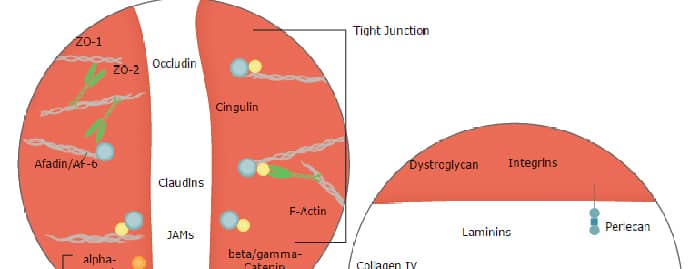
Fibronectin (FN) is a large modular glycoprotein that is found in a polymeric fibrillar network in the extracellular matrix (ECM). It also forms a soluble disulfide-linked dimeric protomers in plasma and other body fluids (1,2). The protein subunit is made up of three types of homologous structural motifs termed FN type I, type II, and type III repeats (3-5). Alternative splicing generates multiple isoforms of fibronectin which may have insertions of extra type III domains (EDA and EDB) or alteration of the type III connecting segment (IIICS) (5). Fibronectin is a ligand for fibrin, heparin, chondroitin sulfate, collagen/gelatin, and integrins. It is involved in multiple cellular processes including cell adhesion/migration, blood clotting, morphogenesis, tissue repair, and cell signaling. Fibronectin functions are mediated by the insoluble polymeric fibrils in the ECM. Conversion of soluble fibronectin to fibronectin fibrils in the ECM is initiated by binding to cell surface integrins, resulting in exposure of cryptic epitopes necessary for polymerization (1). FN1.4 contains one type III domain, the IIICS domain, three type I domains, and the site of interchain disulfide linkage. Within FN1.4, human fibronectin shares 91% and 88% aa sequence identity with mouse and rat fibronectin, respectively. FN1.4 contains regions that enable association with heparin and fibrin. The IIICS domain contains two sites (CS1 and CS2) that interact with integrin alpha 4 beta 1 (6-8). The CS1 sequence is not accessible in full length fibronectin but is exposed by protease digestion, thereby enabling cell adhesion via integrin alpha 4 beta 1 (9). This is distinct from integrin alpha 5 beta 1-mediated adhesion through an RGD motif located N-terminal to FN1.4 (10). Differential splicing within the IIICS domain determines the presence of CS1 and CS2 sequences and the sensitivity to proteases (6,11).
Recombinant Human Fibronectin Fragment 4 Protein, CF
R&D Systems | Catalog # 3624-FN


Loading...
Key Product Details
- R&D Systems NS0-derived Recombinant Human Fibronectin Fragment 4 Protein (3624-FN)
- Quality control testing to verify active proteins with lot specific assays by in-house scientists
- All R&D Systems proteins are covered with a 100% guarantee
Source
NS0
Accession Number
Applications
Bioactivity
Loading...
Product Specifications
Source
Mouse myeloma cell line, NS0-derived human Fibronectin protein
Val1913-Glu2477, with a C-terminal 6-His tag
Val1913-Glu2477, with a C-terminal 6-His tag
Purity
>95%, by SDS-PAGE under reducing conditions and visualized by silver stain.
Endotoxin Level
<0.01 EU per 1 μg of the protein by the LAL method.
N-terminal Sequence Analysis
Val1913
Predicted Molecular Mass
63.5 kDa
SDS-PAGE
70-95 kDa, reducing conditions
Activity
Measured by the ability of the immobilized protein to support the adhesion of B16‑F1 mouse melanoma cells.
The ED50 for this effect is 0.05-0.35 μg/mL.
The ED50 for this effect is 0.05-0.35 μg/mL.
Formulation, Preparation, and Storage
3624-FN
| Formulation | Lyophilized from a 0.2 μm filtered solution in PBS. |
| Reconstitution | Reconstitute at 100 μg/mL in sterile PBS.
Loading...
|
| Shipping | The product is shipped at ambient temperature. Upon receipt, store it immediately at the temperature recommended below. |
| Stability & Storage | Use a manual defrost freezer and avoid repeated freeze-thaw cycles.
|
Calculators
Background: Fibronectin
References
- Mao, Y. and J.E. Schwarzbauer (2005) Matrix Biol. 24:389.
- Potts, J.R. and I.D. Campbell (1996) Matrix Biol. 15:313.
- Bernard, M.P. et al. (1985) Biochemistry 24:2698.
- Kornblihtt, A.R. et al. (1983) Proc. Natl. Acad. Sci. 80:3218.
- Kornblihtt, A.R. et al. (1985) EMBO J. 4:1755.
- Mould, A.P. et al. (1991) J. Biol. Chem. 266:3579.
- Komoriya, A., et al. (1991) J. Biol. Chem. 266:15075.
- Wayner, E.A., et al. (1989) J. Cell Biol. 109:1321.
- Ugarova, T.P. et al. (1996) Biochemistry 35:10913.
- Pytela, R. et al. (1985) Cell 40:191.
- Abe, Y. et al. (2005) Biochem. Biophys. Res. Commun. 338:1640.
Alternate Names
CIG, ED-B, FINC, FN1, FNZ, GFND2, LETS, SMDCF
Gene Symbol
FN1
UniProt
Additional Fibronectin Products
Product Documents for Recombinant Human Fibronectin Fragment 4 Protein, CF
Certificate of Analysis
To download a Certificate of Analysis, please enter a lot or batch number in the search box below.
Note: Certificate of Analysis not available for kit components.
Product Specific Notices for Recombinant Human Fibronectin Fragment 4 Protein, CF
For research use only
Citations for Recombinant Human Fibronectin Fragment 4 Protein, CF
 Powered by Bioz
Customer Reviews for Recombinant Human Fibronectin Fragment 4 Protein, CF
There are currently no reviews for this product. Be the first to review Recombinant Human Fibronectin Fragment 4 Protein, CF and earn rewards!
Have you used Recombinant Human Fibronectin Fragment 4 Protein, CF?
Submit a review and receive an Amazon gift card!
$25/€18/£15/$25CAN/¥2500 for a review with an image
$10/€7/£6/$10CAN/¥1110 for a review without an image
Submit a review