Recombinant Human Frizzled-4 Protein, CF

R&D Systems | Catalog # 5847-FZ

R&D Systems
Loading...

Key Product Details

  • R&D Systems NS0-derived Recombinant Human Frizzled-4 Protein (5847-FZ)
  • Quality control testing to verify active proteins with lot specific assays by in-house scientists
  • All R&D Systems proteins are covered with a 100% guarantee

Source

NS0

Accession Number

Structure / Form

Disulfide-linked homodimer

Applications

Bioactivity
Loading...

Product Specifications

Source

Mouse myeloma cell line, NS0-derived human Frizzled-4 protein
Human Frizzled-4
(Phe37-Glu180)
Accession # Q9ULV1
IEGRMD Human IgG1
(Pro100-Lys330)
N-terminus C-terminus

Purity

>95%, by SDS-PAGE under reducing conditions and visualized by silver stain.

Endotoxin Level

<0.10 EU per 1 μg of the protein by the LAL method.

N-terminal Sequence Analysis

Phe37

Predicted Molecular Mass

42.8 kDa (monomer)

SDS-PAGE

58-60 kDa, reducing conditions

Activity

Measured by its binding ability in a functional ELISA.
In a 100 µL reaction mixture containing biotinylated rmWnt-5a at 100 ng/mL and rhFrizzled-4/Fc Chimera dilutions at 0.1-2,000 ng/mL, the concentration of rhFrizzled-4/Fc Chimera that produces 50% of the optimal binding response is found to be approximately 15-60 ng/mL.
Optimal concentrations should be determined by each laboratory for each application.

Formulation, Preparation, and Storage

5847-FZ
Formulation Lyophilized from a 0.2 μm filtered solution in PBS.
Reconstitution

Reconstitute at 400 μg/mL in PBS.


Loading...
Shipping The product is shipped at ambient temperature. Upon receipt, store it immediately at the temperature recommended below.
Stability & Storage Use a manual defrost freezer and avoid repeated freeze-thaw cycles.
  • 12 months from date of receipt, -20 to -70 °C as supplied.
  • 1 month, 2 to 8 °C under sterile conditions after reconstitution.
  • 3 months, -20 to -70 °C under sterile conditions after reconstitution.

Calculators

The reconstitution calculator allows you to quickly calculate the volume of a reagent to reconstitute your vial. Simply enter the mass of reagent and the target concentration and the calculator will determine the rest.

=
÷

Background: Frizzled-4

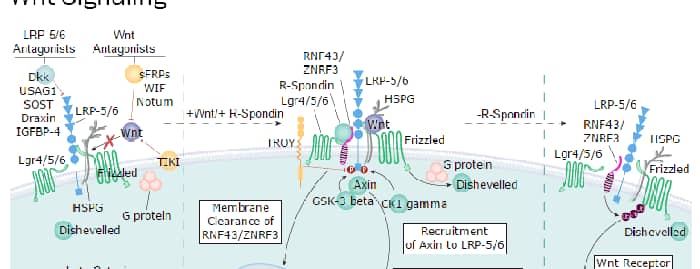
Frizzled-4, designated CD344, is a 7-transmembrane glycoprotein of the Frizzled family within the G-protein coupled receptor superfamily (1, 2). Frizzled proteins function as receptors for Wnt proteins and can activate canonical Wnt/beta-catenin signaling as well as planar cell polarity and calcium flux pathways (1). Frizzled-4 is particularly important in angiogenic Wnt pathway signaling (1, 5). Frizzleds contain a divergent N-terminal signal peptide, a highly conserved ~120 amino acid (aa) cysteine-rich domain (CRD), a variable length linker region, seven transmembrane domains, and a variable-length C-terminal tail (1). The human Frizzled-4 cDNA encodes 537 aa with a 36 aa signal sequence and a 186 aa N-terminal extracellular sequence (4). The portion expressed in this product includes aa 37-180, and shares 93%, 93%, 94%, 95% and 97% identity with the corresponding region of mouse, rat, bovine, canine and equine Frizzled-4, respectively. This portion competes for Wnt binding with endogenous receptors. A human 122 aa soluble form that diverges at aa 95 is proposed to be a positive regulator of Wnt signaling pathways (5). Frizzled-4 is unusual in binding a non-wnt ligand, Norrin, in addition to binding Wnt ligands (1, 3, 6). Norrin binds the Frizzled-4 CRD, activates Wnt signaling pathways and uses LRP5/6 as co-receptors (3, 6). Deletion of either Frizzled-4 or Norrin in mice results in a similar phenotype including malformation of vasculature in the retina, cerebellar degeneration, and loss of hair cells in the inner ear (1, 3, 7). In humans, blindness due to familial exudative vitreoretinopathy (FEVR) is associated with mutations producing loss of function of Frizzled-4 or Norrin, designated EVR1 and EVR2, respectively (1, 3, 8). Frizzled-4 expression has been found in many tissues, including mouse ovary, where it influences corpus luteum vasculogenesis and is necessary for fertility (9).

References

  1. Huang, H-C. and P.S. Klein (2004) Genome Biol. 5:234.
  2. Parmalee, N.L. and J. Kitajewski (2008) Curr. Drug Targets 9:558.
  3. Xu, Q. et al. (2004) Cell 116:883.
  4. Kirikoshi, H. et al. (1999) Biochem. Biophys. Res. Commun. 264:955.
  5. Sagara, N. et al. (2001) Biochem. Biophys. Res. Commun. 282:750.
  6. Smallwood, P.M. et al. (2007) J. Biol. Chem. 282:4057.
  7. Wang, Y. et al. (2001) J. Neurosci. 21:4761.
  8. Robitaille, J. et al. (2002) Nat. Genet. 32:326.
  9. Hsieh, M. et al. (2005) Biol. Reprod. 73:1135.

Alternate Names

CD344, Frizzled4, FZD4

Entrez Gene IDs

8322 (Human); 14366 (Mouse)

Gene Symbol

FZD4

UniProt

Additional Frizzled-4 Products

Product Documents for Recombinant Human Frizzled-4 Protein, CF

Certificate of Analysis

To download a Certificate of Analysis, please enter a lot or batch number in the search box below.

Note: Certificate of Analysis not available for kit components.

Product Specific Notices for Recombinant Human Frizzled-4 Protein, CF

For research use only

Related Research Areas

Citations for Recombinant Human Frizzled-4 Protein, CF

Customer Reviews for Recombinant Human Frizzled-4 Protein, CF

There are currently no reviews for this product. Be the first to review Recombinant Human Frizzled-4 Protein, CF and earn rewards!

Have you used Recombinant Human Frizzled-4 Protein, CF?

Submit a review and receive an Amazon gift card!

$25/€18/£15/$25CAN/¥2500 Yen for a review with an image

$10/€7/£6/$10CAN/¥1110 Yen for a review without an image

Submit a review
Amazon Gift Card

FAQs

No product specific FAQs exist for this product.

View all FAQs for Proteins and Enzymes