
Because N-, O-glycans and glycolipids are frequently fucosylated at terminal sites, fucose is often found to be essential for sugar epitope and lectin ligand generation. Well-known fucose containing structures include Lewis structures and ABO blood group antigens. Lewis structures are key elements involved in leukocyte homing and extravasation process and thus are essential for lymphocyte maturation and natural defense functions. Fucose containing glycans also play essential roles in cell signaling and development. So far, more than 10 fucosyltransferases have been cloned from the human genome (1). FUT1 and FUT2 are
alpha 1-2 fucosyltransferases and are responsible for ABO blood group antigen synthesis. FUT3, FUT4, FUT5, FUT6, FUT7 and FUT9 are responsible for Lewis structure generation through their alpha 1-3 or alpha 1-4 fucosyltransferases activities. FUT3, also known as Lewis blood group fucosyltransferase, is unique by having both strong
alpha 1‑3 and alpha 1‑4 fucosyltransferase activities (2). FUT3 has high homology with FUT5 and FUT6 due to gene duplication. FUT7 is exclusively responsible for biosynthesis of sialyl Lewis X epitope in leukocytes and high endothelial venule cells (3). FUT8 is an alpha 1-6 fucosyltransferase that adds a fucose to the chitobiose core of N‑glycans (4). Predicted as type II transmembrane proteins and Golgi enzymes, some of the fucosyltransferases can also be found in plasma. R&D Systems recombinant human FUTs correspond to the luminal domains. The enzymatic activity of recombinant human FUT3 was determined using a phosphatase‑coupled glycosyltransferase assay (5).
Recombinant Human Fucosyltransferase 3/FUT3 Protein, CF
R&D Systems | Catalog # 4950-GT

Key Product Details
- R&D Systems NS0-derived Recombinant Human Fucosyltransferase 3/FUT3 Protein (4950-GT)
- Quality control testing to verify active proteins with lot specific assays by in-house scientists
- All R&D Systems proteins are covered with a 100% guarantee
Source
Accession Number
Applications
Product Specifications
Source
Arg35-Thr361, with an N-terminal 6-His tag
Purity
Endotoxin Level
N-terminal Sequence Analysis
Predicted Molecular Mass
SDS-PAGE
Activity
The specific activity is >25 pmol/min/µg, as measured under the described conditions.
Scientific Data Images for Recombinant Human Fucosyltransferase 3/FUT3 Protein, CF
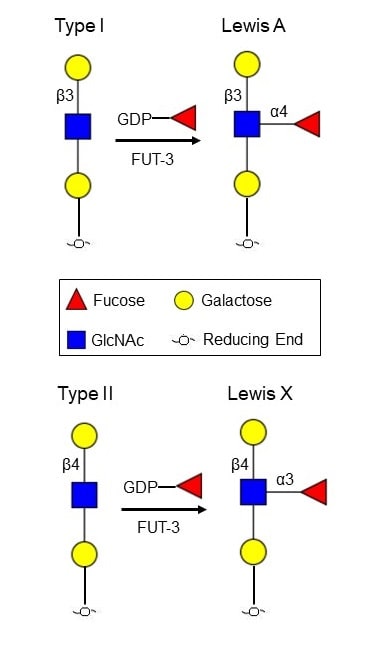
Recombinant Human Fucosyltransferase 3/FUT3 Protein Enzyme Activity Diagram.
Recombinant Human Fucosyltransferase 3/FUT3 Protein, CF (Cat # 4950-GT) creates Lewis A on Type I (Gal beta 3GlcNAc) lactosamine by transferring fucose to GlcNAc. In addition, FUT-3 alpha 1-3-fucosyltransferase activity creates Lewis X on Type II (Gal beta 4GlcNAc) lactosamine.Formulation, Preparation, and Storage
4950-GT
| Formulation | Supplied as a 0.2 μm filtered solution in Tris and NaCl. |
| Shipping | The product is shipped with polar packs. Upon receipt, store it immediately at the temperature recommended below. |
| Stability & Storage | Use a manual defrost freezer and avoid repeated freeze-thaw cycles.
|
Background: Fucosyltransferase 3/FUT3
References
- Becker, D.J. et al. (2003) Glycobiology 13:41R.
- Kukowska-Latallo, J.F. et al. (1990) Genes Dev. 4:1288.
- Blander, J. M. et al. (1999) J. Immunol. 163:3746.
- Lee, S.H. et al. (2006) J. Biochem. 139:391.
- Wu, Z.L. et al. (2011) Glycobiology 21:727.
Alternate Names
Entrez Gene IDs
Gene Symbol
UniProt
Additional Fucosyltransferase 3/FUT3 Products
Product Documents for Recombinant Human Fucosyltransferase 3/FUT3 Protein, CF
Certificate of Analysis
To download a Certificate of Analysis, please enter a lot or batch number in the search box below.
Note: Certificate of Analysis not available for kit components.
Product Specific Notices for Recombinant Human Fucosyltransferase 3/FUT3 Protein, CF
For research use only
Related Research Areas
Citations for Recombinant Human Fucosyltransferase 3/FUT3 Protein, CF
 Powered by Bioz
Customer Reviews for Recombinant Human Fucosyltransferase 3/FUT3 Protein, CF
There are currently no reviews for this product. Be the first to review Recombinant Human Fucosyltransferase 3/FUT3 Protein, CF and earn rewards!
Have you used Recombinant Human Fucosyltransferase 3/FUT3 Protein, CF?
Submit a review and receive an Amazon gift card!
$25/€18/£15/$25CAN/¥2500 for a review with an image
$10/€7/£6/$10CAN/¥1110 for a review without an image
Submit a review
Protocols
View specific protocols for Recombinant Human Fucosyltransferase 3/FUT3 Protein, CF (4950-GT):
- Assay Buffer: 25 mM Tris, 5 mM MnCl2(supplied in kit), pH 7.5
- Recombinant Human Fucosyltransferase 3/FUT3 (rhFUT3) (Catalog # 4950-GT)
- GDP-Fucose (Sigma, Catalog # G4401), 1.6 mM stock in deionized water
- Lactosamine (V-Labs, Catalog # GN204), 50 mM in deionized water
- Glycosyltransferase Activity Kit (Catalog # EA001)
- 96-well Clear Plate (Costar, Catalog # 92592)
- Plate Reader (Model: SpectraMax Plus by Molecular Devices) or equivalent
- Dilute GDP-Fucose to 240 μM in Assay Buffer.
- Dilute Lactosamine to 2.4 mM in Assay Buffer.
- Dilute Coupling Phosphatase 1 to 12 μg/mL in Assay Buffer.
- Prepare reaction mixture by combining equal volumes of diluted GDP-Fucose, Lactosamine, and Coupling Phosphatase 1.
- Dilute rhFUT3 to 40 µg/mL in Assay Buffer.
- Dilute Phosphate Standard by adding 40 µL of the 1 mM Phosphate Standard to 360 µL of deionized water for a 100 µM stock.
- Prepare standard curve by performing seven one-half serial dilutions of the 100 µM Phosphate stock in Assay Buffer. The standard curve has a range of 0.039 to 2.5 nmol per well.
- Load 50 µL of each dilution of the standard curve into a plate. Include a curve blank containing 50 μL of Assay Buffer.
- Load 25 µL of the 40 µg/mL rhFUT3 into the plate. Include a Substrate Blank containing 25 µL of Assay Buffer.
- Add 25 µL of reaction mixture (step 4) to the wells, excluding the standard curve and curve blank.
- Cover the plate with parafilm or a plate sealer and incubate at 37 °C for 20 minutes.
- Add 30 µL of the Malachite Green Reagent A to all wells. Mix briefly.
- Add 100 µL of deionized water to all wells. Mix briefly.
- Add 30 µL of the Malachite Green Reagent B to all wells. Mix and incubate for 20 minutes at room temperature.
- Read plate at 620 nm (absorbance) in endpoint mode.
- Calculate specific activity:
|
Specific Activity (pmol/min/µg) = |
Phosphate released* (nmol) x (1000 pmol/nmol) |
| Incubation time (min) x amount of enzyme (µg) |
*Derived from the phosphate standard curve using linear or 4-parameter fitting and adjusted for Control.
Per Reaction:
- rhFUT3: 1 µg
- Coupling Phosphatase 1: 0.1 µg
- Lactosamine: 400 µM
- GDP-Fucose: 40 µM