Integrin alpha V beta 3 together with alpha IIb beta 3, constitutes the only known beta 3 Integrins (1‑3). The non‑covalent heterodimer of 170 kDa alpha V/CD51 and 93 kDa beta 3/CD61 subunits shows wide expression, notably by endothelial cells and osteoclasts (2‑4). Each subunit has a transmembrane sequence and a short cytoplasmic tail connected to the cytoskeleton. Active cell surface alpha V beta 3 adheres to matrix proteins including vitronectin, fibronectin, fibrinogen and thrombospondin (2, 3). The ligand binding site of alpha V beta 3 is in the N‑terminal head region, formed by interaction of the beta 3 vWFA domain with the alpha V beta‑propeller structure (4). The alpha V subunit contributes a thigh and a calf region, while the beta 3 subunit contains a PSI domain and four cysteine‑rich I‑EGF folds. The alpha V subunit domains termed thigh, calf‑1 and calf‑2 generate a “knee” region that is bent when the alpha V beta 3 is in its constitutively inactive state. Activation, either by “inside out” signaling or by Mg2+ or Mn2+ binding, extends the Integrin to expose its ligand binding site (1, 4). The 962 aa human alpha V ECD(11) shares 92‑95% aa sequence identity with mouse, rat and bovine alpha V while the 685 aa human beta 3 ECD(12) shares 95% aa identity with equine and canine, and 89‑92% aa identity with mouse, rat and porcine beta 3. Two splice variants of beta 3 (b and c) diverge over the last 21 amino acids (aa) and lack cytoplasmic phosphorylation sites (5, 6). Another beta 3 splice variant diverges after the vWFA domain, producing a soluble 60 kDa form in platelets and endothelial cells (7). alpha V beta 3 is essential for the maturation of osteoclasts and their binding and resorption of bone; it also, however, promotes their apoptosis (8, 9). M‑CSF R and alpha V beta 3 share signaling pathways during osteoclastogenesis, and deletion of either molecule causes osteopetrosis (8, 9). alpha V beta 3 is involved in several other signaling pathways by direct interaction with receptor tyrosine kinases and ligands. For example, it cooperates with endothelial cell VEGF R2 in angiogenesis, and with IGF‑1 to promote cancer cell proliferation and invasiveness (13, 14). Also, cell entry of several viruses is mediated by alpha V beta 3 (4, 10).
Recombinant Human Integrin alpha V beta 3 Fc Protein, CF
R&D Systems | Catalog # 11648-AV
Fc Chimera

Loading...
Key Product Details
- R&D Systems HEK293-derived Recombinant Human Integrin alpha V beta 3 Fc Protein (11648-AV)
- Quality control testing to verify active proteins with lot specific assays by in-house scientists
- All R&D Systems proteins are covered with a 100% guarantee
Source
HEK293
Structure / Form
Disulfide linked heterodimer
Applications
Bioactivity
Loading...
Product Specifications
Source
Human embryonic kidney cell, HEK293-derived human Integrin alpha V beta 3 protein
| Human ITGAV (Phe31-Val992) Accession # AAA36808.1 |
IEGR | Human IgG1 (Glu99-Lys330) (with modifications) |
| Human ITGB3 (Gly27-Asp718) Accession # P05106.2 |
HPIEGR | Human IgG1 (Glu99-Lys330) (with modifications) |
| N-terminus | C-terminus |
Purity
>95%, by SDS-PAGE visualized with Silver Staining and quantitative densitometry by Coomassie® Blue Staining.
Endotoxin Level
<0.10 EU per 1 μg of the protein by the LAL method.
N-terminal Sequence Analysis
Phe 31 (Integrin alpha V) & Gly 27 (Integrin Beta 3)
Predicted Molecular Mass
133 kDa (Integrin alpha V) & 103 kDa (Integrin beta 3)
SDS-PAGE
>190 kDa, under non-reducing conditions.
Activity
Measured by its binding ability in a functional ELISA.
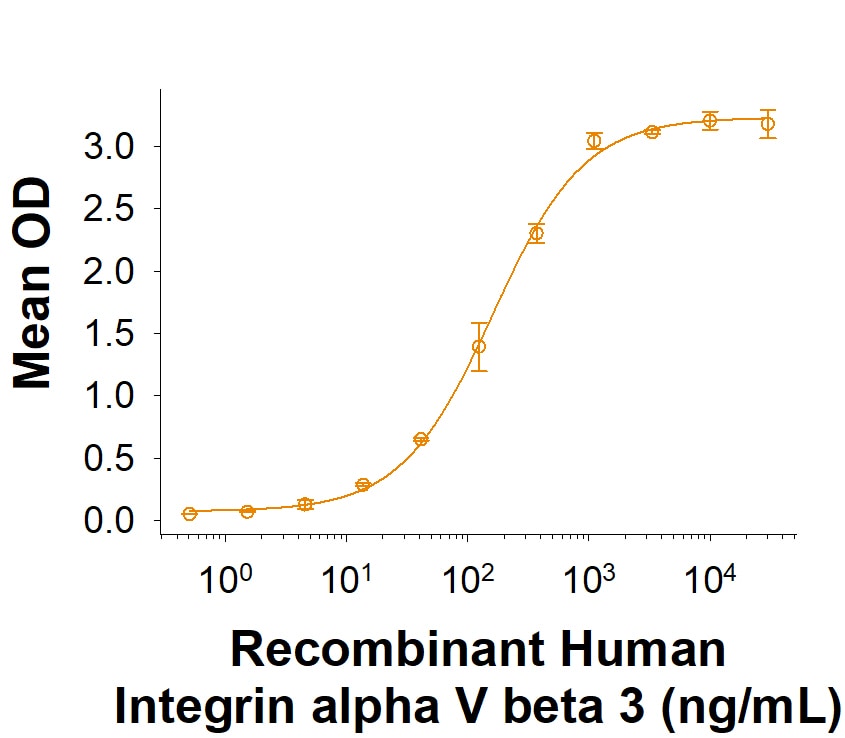
Recombinant Human Integrin alpha V beta 3 Fc Chimera (Catalog # 11648-AV) binds to Recombinant Human Vitronectin (Catalog # 2308-VN) with an ED50 of 60.0-600 ng/mL.
Recombinant Human Integrin alpha V beta 3 Fc Chimera (Catalog # 11648-AV) binds to Recombinant Human Vitronectin (Catalog # 2308-VN) with an ED50 of 60.0-600 ng/mL.
Scientific Data Images for Recombinant Human Integrin alpha V beta 3 Fc Protein, CF
Recombinant Human Integrin alpha V beta 3 Fc Chimera Protein Binding Activity.
In a functional ELISA, Recombinant Human Integrin alpha V beta 3 Fc Chimera Protein (Catalog # 11648-AV) binds to Recombinant Human Vitronectin (2308-VN) with an ED50 of 60.0‑600 ng/mL.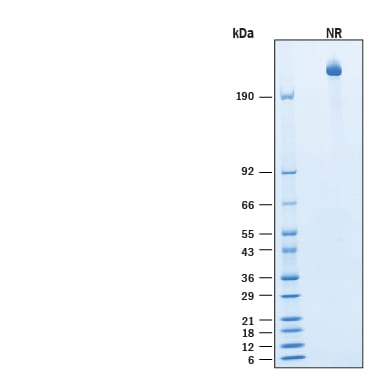
Recombinant Human Integrin alpha V beta 3 Fc Chimera Protein SDS-PAGE.
2 μg/lane of Recombinant Human Integrin alpha V beta 3 Fc Chimera Protein (Catalog # 11648-AV) was resolved with SDS-PAGE under non-reducing (NR) condition and visualized by Coomassie® Blue staining, showing bands at >190 kDa.Formulation, Preparation, and Storage
11648-AV
| Formulation | Lyophilized from a 0.2 μm filtered solution in PBS with Trehalose. |
| Reconstitution | Reconstitute at 250 μg/mL in water. |
| Shipping | The product is shipped at ambient temperature. Upon receipt, store it immediately at the temperature recommended below. |
| Stability & Storage | Use a manual defrost freezer and avoid repeated freeze-thaw cycles.
|
Calculators
Background: Integrin alpha V beta 3
References
- Hynes, R. O. (2002) Cell 110:673.
- Serini, G. et al. (2006) Exp. Cell Res. 312:651.
- Ross, F. P. and S. L. Teitelbaum (2005) Immunol. Rev. 208:88.
- Xiong, J. et al. (2001) Science 294:339.
- Kumar, C. S. et al. (1987) J. Biol. Chem. 272:16390.
- vanKuppevelt, H. et al. (1989) Proc. Natl. Acad. Sci. USA 86:5415.
- Djaffar, I. et al. (1994) Biochem. J. 300:69.
- McHugh, K. P. et al. (2000) J. Clin. Invest. 105:433.
- Faccio, R. et al. (2003) J. Clin. Invest. 111:749.
- Chu, J. J. and M. Ng (2004) J. Biol. Chem. 279:54533.
- Suzuki, S. et al. (1987) J. Biol. Chem. 262:14060.
- Fitzgerald, L. A. et al. (1987) J. Biol. Chem. 262:3936.
- Somanath, P.R. et al. (2009) Angiogenesis 12:177.
- Saegusa, J. et al. (2009) J. Biol. Chem. 284:24106.
Alternate Names
antigen identified by monoclonal L230, CD51, CD51 antigen, integrin alpha-V, integrin, alpha V (vitronectin receptor, alpha polypeptide, antigen CD51), MSK8, Vitronectin receptor subunit alpha, VNRADKFZp686A08142
Entrez Gene IDs
3685 (Human)
Gene Symbol
ITGAV
Additional Integrin alpha V beta 3 Products
Product Documents for Recombinant Human Integrin alpha V beta 3 Fc Protein, CF
Certificate of Analysis
To download a Certificate of Analysis, please enter a lot or batch number in the search box below.
Note: Certificate of Analysis not available for kit components.
Product Specific Notices for Recombinant Human Integrin alpha V beta 3 Fc Protein, CF
For research use only
Customer Reviews for Recombinant Human Integrin alpha V beta 3 Fc Protein, CF
There are currently no reviews for this product. Be the first to review Recombinant Human Integrin alpha V beta 3 Fc Protein, CF and earn rewards!
Have you used Recombinant Human Integrin alpha V beta 3 Fc Protein, CF?
Submit a review and receive an Amazon gift card!
$25/€18/£15/$25CAN/¥2500 for a review with an image
$10/€7/£6/$10CAN/¥1110 for a review without an image
Submit a review