
Human BMP-2 is one of at least 15 structurally and functionally related BMPs, which are members of the transforming growth factor beta (TGF-beta ) superfamily. BMPs were originally identified as protein regulators of cartilage and bone formation. However, they have since been shown to be involved in embryogenesis and morphogenesis of various tissues and organs. BMPs have also been shown to regulate the growth, differentiation, chemotaxis and apoptosis of various cell types, including mesenchymal cells, epithelial cells, hematopoietic cells and neuronal cells. Similarly to other TGF-beta family proteins, BMPs are highly conserved across animal species. At the amino acid sequence level, mature human, mouse and rat BMP-2 are 100% identical. BMP-2 is synthesized as a large precursor protein that is cleaved at the dibasic cleavage site (RXXR) to release the carboxy-terminal domain. Biologically active BMP-2 is a disulfide-linked homodimer of the carboxy-terminal 114 amino acid residues that contains the characteristic seven conserved cysteine residues involved in the formation of the cysteine knot and the single interchain disulfide bond. Cellular responses to BMP-2 have been shown to be mediated by the formation of hetero-oligomeric complexes of type I and type II serine/threonine kinase receptors. One BMP type II and two BMP type I receptors have been identified. In contrast to the TGF-beta type I receptor, which does not bind the ligand in the absence of the TGF-beta receptor type II, both BMP receptor type Is can bind BMP-2 with high-affinity in the absence of BMP receptor type II.
Recombinant Human/Mouse/Rat BMP-2 (E. coli-expressed)
R&D Systems | Catalog # 355-BEC

Key Product Details
- R&D Systems E. coli-derived Recombinant Human/Mouse/Rat BMP-2 (E. coli-expressed) (355-BEC)
- Quality control testing to verify active proteins with lot specific assays by in-house scientists
- All R&D Systems proteins are covered with a 100% guarantee
Source
Accession Number
Structure / Form
Applications
Product Specifications
Source
Ala284-Arg396
This form is not detected using human BMP-2 Quantikine ELISA (Catalog # DBP200).
Purity
Endotoxin Level
N-terminal Sequence Analysis
Predicted Molecular Mass
Activity
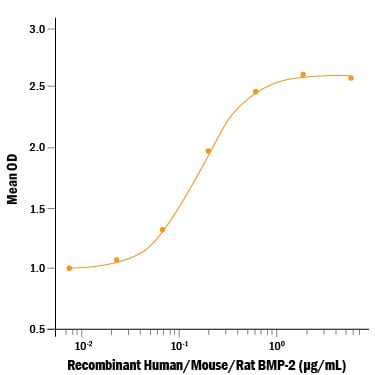
The ED50 for this effect is 0.08-0.48 µg/mL.
Scientific Data Images for Recombinant Human/Mouse/Rat BMP-2 (E. coli-expressed)
Recombinant Human/Mouse/Rat BMP-2 (E. coli-expressed) Bioactivity
Recombinant Human/Mouse/Rat BMP-2 (Catalog # 355-BEC/CF) induces alkaline phosphatase production in the ATDC5 mouse chondrogenic cell line. The ED50 for this effect is 0.08-0.48 μg/mL.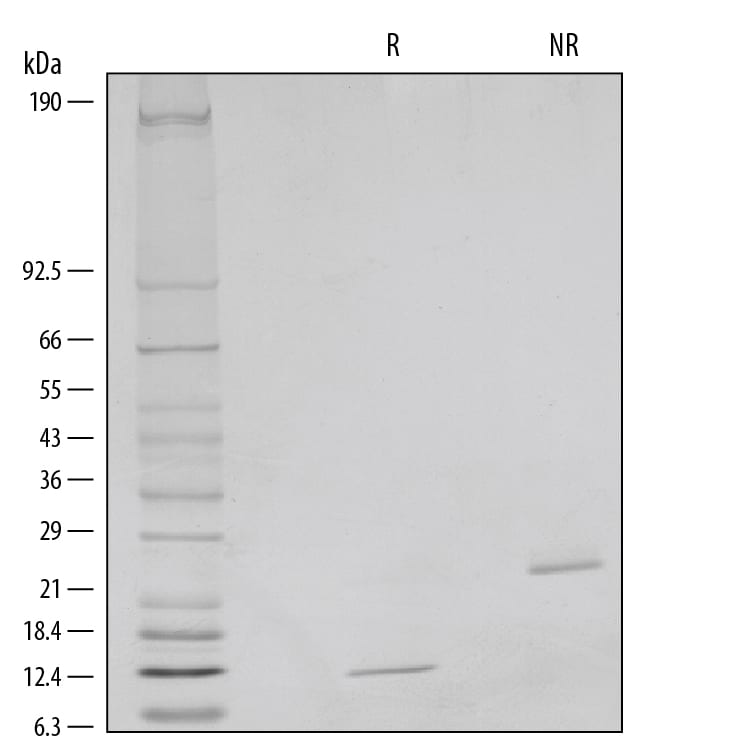
Recombinant Human/Mouse/Rat BMP-2 (E. coli-expressed) SDS-PAGE
1 μg/lane of Recombinant Human/Mouse/Rat BMP-2 was resolved with SDS-PAGE under reducing (R) and non-reducing (NR) conditions and visualized by silver staining, showing single bands at 12 kDa and 24 kDa, respectively.Formulation, Preparation, and Storage
Carrier Free
What does CF mean?CF stands for Carrier Free (CF). We typically add Bovine Serum Albumin (BSA) as a carrier protein to our recombinant proteins. Adding a carrier protein enhances protein stability, increases shelf-life, and allows the recombinant protein to be stored at a more dilute concentration. The carrier free version does not contain BSA.
What formulation is right for me?In general, we advise purchasing the recombinant protein with BSA for use in cell or tissue culture, or as an ELISA standard. In contrast, the carrier free protein is recommended for applications, in which the presence of BSA could interfere.
Carrier: 355-BEC
| Formulation | Lyophilized from a 0.2 μm filtered solution in Acetonitrile and TFA with BSA as a carrier protein. |
| Reconstitution | Reconstitute at 100 μg/mL in sterile 4 mM HCl containing at least 0.1% human or bovine serum albumin. |
| Shipping | The product is shipped at ambient temperature. Upon receipt, store it immediately at the temperature recommended below. |
| Stability & Storage | Use a manual defrost freezer and avoid repeated freeze-thaw cycles.
|
Carrier Free: 355-BEC/CF
| Formulation | Lyophilized from a 0.2 μm filtered solution in Acetonitrile and TFA. |
| Reconstitution | Reconstitute at 100 μg/mL in sterile 4 mM HCl. |
| Shipping | The product is shipped at ambient temperature. Upon receipt, store it immediately at the temperature recommended below. |
| Stability & Storage | Use a manual defrost freezer and avoid repeated freeze-thaw cycles.
|
Calculators
Background: BMP-2
References
- Kawabata, M. et al. (1998) Cytokine and Growth Factor Reviews 9:49
- Ebendal, T. et al. (1998) J. Neurosci. Res. 51:139.
- Reddi, A.H. (1998) Nature Biotechnology 16: 247.
Long Name
Alternate Names
Gene Symbol
UniProt
Additional BMP-2 Products
Product Documents for Recombinant Human/Mouse/Rat BMP-2 (E. coli-expressed)
Certificate of Analysis
To download a Certificate of Analysis, please enter a lot or batch number in the search box below.
Note: Certificate of Analysis not available for kit components.
Product Specific Notices for Recombinant Human/Mouse/Rat BMP-2 (E. coli-expressed)
For research use only
Related Research Areas
Citations for Recombinant Human/Mouse/Rat BMP-2 (E. coli-expressed)
 Powered by Bioz
Customer Reviews for Recombinant Human/Mouse/Rat BMP-2 (E. coli-expressed)
There are currently no reviews for this product. Be the first to review Recombinant Human/Mouse/Rat BMP-2 (E. coli-expressed) and earn rewards!
Have you used Recombinant Human/Mouse/Rat BMP-2 (E. coli-expressed)?
Submit a review and receive an Amazon gift card!
$25/€18/£15/$25CAN/¥2500 for a review with an image
$10/€7/£6/$10CAN/¥1110 for a review without an image
Submit a review
FAQs for Recombinant Human/Mouse/Rat BMP-2 (E. coli-expressed)
-
Q: What is the difference between the two Recombinant Human/Mouse/Rat BMP-2 Proteins (Catalog # 355-BM and 355-BEC)?
A: Catalog # 355-BM is produced in a mammalian system using CHO cells and exhibits better activity in our routine QC bioassay, while Catalog # 355-BEC is produced in an E. coli expression system and is less expensive. Bioactivity of both Human/Mouse/Rat BMP-2 Proteins is measured in an alkaline phosphatase assay using by ATDC5 mouse chondrogenic cells. For 355-BM, the ED50 for this effect is 40-200 ng/mL, while for 355-BEC, the ED50 range is 80-480 ng/mL. We recommend reviewing our list of publications under the Citations tab for both 355-BM and 355-BEC to determine which of the two proteins is most suitable for your experiment.
-
Q: What is the sequence homology between human, mouse and rat BMP-2
A: Mature human BMP-2 shares 100% aa sequence identity with mouse and rat BMP-2.
-
Q: What is the difference between the two Recombinant Human/Mouse/Rat BMP-2 Proteins (Catalog # 355-BM and 355-BEC)?
A: Catalog # 355-BM is produced in a mammalian system using CHO cells and exhibits better activity in our routine QC bioassay, while Catalog # 355-BEC is produced in an E. coli expression system and is less expensive. Bioactivity of both Human/Mouse/Rat BMP-2 Proteins is measured in an alkaline phosphatase assay using by ATDC5 mouse chondrogenic cells. For 355-BM, the ED50 for this effect is 40-200 ng/mL, while for 355-BEC, the ED50 range is 80-480 ng/mL. We recommend reviewing our list of publications under the Citations tab for both 355-BM and 355-BEC to determine which of the two proteins is most suitable for your experiment.
-
Q: What is the sequence homology between human, mouse and rat BMP-2
A: Mature human BMP-2 shares 100% aa sequence identity with mouse and rat BMP-2.

