
Osteopontin (OPN), previously called SPP1 (secreted phosphoprotein 1), Eta-1 (early T lymphocyte activation 1) or BSP (bone sialoprotein), is a secreted molecule in the SIBLING (small integrin-binding ligand N-linked glycoprotein) family of non-collagenous matricellular proteins (1-3). Human OPN is synthesized as a 317 amino acid (aa) precursor protein with a 16 aa signal peptide and a 301 aa mature protein (3). Mature human OPN shares 64% and 62% aa sequence identity with mouse and rat OPN, respectively. OPN is highly acidic and has 26 potential Ser/Thr phosphorylation sites and a C-terminal CD44 binding site (1-4). Depending on
tissue-specific modification by O- and N-glycosylation, sulfation, phosphorylation and transglutamination, OPN can be detected at 45-75 kDa (5, 6). The central region of OPN contains RGD and non-RGD binding sites for multiple integrins (3, 4). Adjacent to the RGD motif is the sequence SVVYGLR (SLAYGLR in mouse) which serves as a cryptic binding site for additional integrins: it is masked in full length OPN but is exposed following OPN cleavage by thrombin in tumors and sites of tissue injury (6-8). OPN can also be cleaved by MMP-3, -7, -9, and -12 within the SVVYGLR motif and at sites closer to the C-terminus (8, 9). OPN is widely expressed and is prominent in mineralized tissues. It inhibits bone mineralization and kidney stone formation, and promotes inflammation and cell adhesion and migration (1, 2, 4, 6). Its expression is up‑regulated during inflammation, obesity, atherosclerosis, cancer, and tissue damage, and contributes to the pathophysiology of these conditions (1, 2, 6, 9, 10).
Recombinant Human Osteopontin (OPN) Protein
R&D Systems | Catalog # 1433-OP

Key Product Details
- R&D Systems NS0-derived Recombinant Human Osteopontin (OPN) Protein (1433-OP)
- Quality control testing to verify active proteins with lot specific assays by in-house scientists
- All R&D Systems proteins are covered with a 100% guarantee
Source
Accession Number
Applications
Product Specifications
Source
Ile17-Asn300, with a C-terminal 6-His tag
Purity
Endotoxin Level
N-terminal Sequence Analysis
Predicted Molecular Mass
SDS-PAGE
Activity
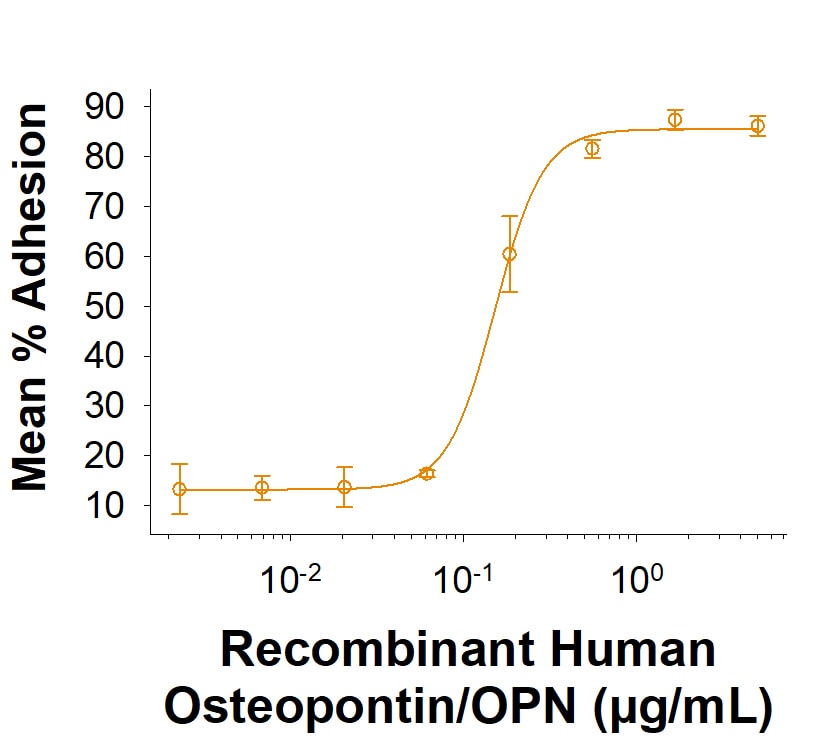
Measured by the ability of the immobilized protein to support the adhesion of HEK293 human embryonic kidney cells. The ED50 for this effect is 0.0600-0.900 µg/mL.
Reviewed Applications
Read 2 reviews rated 4.5 using 1433-OP in the following applications:
Scientific Data Images for Recombinant Human Osteopontin (OPN) Protein
Recombinant Human Osteopontin/OPN Protein Bioactivity.
Recombinant Human Osteopontin/OPN Protein (Catalog # 1433-OP) supports the adhesion of HEK293 human embryonic kidney cells. The ED50 for this effect is 0.0600-0.900 µg/mL.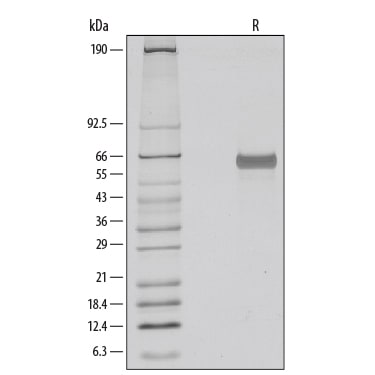
Recombinant Human Osteopontin (OPN) Protein SDS-PAGE
1 μg/lane of Recombinant Human Osteopontin/OPN was resolved with SDS-PAGE under reducing (R) conditions and visualized by silver staining, showing a bands at 60-65 kDa.Formulation, Preparation, and Storage
Carrier Free
What does CF mean?CF stands for Carrier Free (CF). We typically add Bovine Serum Albumin (BSA) as a carrier protein to our recombinant proteins. Adding a carrier protein enhances protein stability, increases shelf-life, and allows the recombinant protein to be stored at a more dilute concentration. The carrier free version does not contain BSA.
What formulation is right for me?In general, we advise purchasing the recombinant protein with BSA for use in cell or tissue culture, or as an ELISA standard. In contrast, the carrier free protein is recommended for applications, in which the presence of BSA could interfere.
Carrier: 1433-OP
| Formulation | Lyophilized from a 0.2 μm filtered solution in PBS with BSA as a carrier protein. |
| Reconstitution | Reconstitute at 100 μg/mL in sterile PBS containing at least 0.1% human or bovine serum albumin. |
| Shipping | The product is shipped at ambient temperature. Upon receipt, store it immediately at the temperature recommended below. |
| Stability & Storage | Use a manual defrost freezer and avoid repeated freeze-thaw cycles.
|
Carrier Free: 1433-OP/CF
| Formulation | Lyophilized from a 0.2 μm filtered solution in PBS. |
| Reconstitution | Reconstitute at 100 μg/mL in sterile PBS. |
| Shipping | The product is shipped at ambient temperature. Upon receipt, store it immediately at the temperature recommended below. |
| Stability & Storage | Use a manual defrost freezer and avoid repeated freeze-thaw cycles.
|
Calculators
Background: Osteopontin/OPN
References
- Scatena, M. et al. (2007) Arterioscler. Thromb. Vasc. Biol. 27:2302.
- Rangaswami, H. et al. (2006) Trends Cell Biol. 16:79.
- Young, M.F. et al. (1990) Genomics 7:491.
- Weber, G.F. et al. (2002) J. Leukoc. Biol. 72:752.
- Keykhosravani, M. et al. (2005) Biochemistry 44:6990.
- Kazanecki, C.C. et al. (2007) J. Cell. Biochem. 102:912.
- Senger, D.R. et al. (1994) Mol. Biol. Cell 5:565.
- Yokosaki, Y. et al. (2005) Matrix Biol. 24:418.
- Takafuji, V. et al. (2007) Oncogene 26:6361.
- Kiefer, F.W. et al. (2010) Diabetes 59:935.
Long Name
Alternate Names
Gene Symbol
UniProt
Additional Osteopontin/OPN Products
Product Documents for Recombinant Human Osteopontin (OPN) Protein
Certificate of Analysis
To download a Certificate of Analysis, please enter a lot or batch number in the search box below.
Note: Certificate of Analysis not available for kit components.
Product Specific Notices for Recombinant Human Osteopontin (OPN) Protein
For research use only
Citations for Recombinant Human Osteopontin (OPN) Protein
 Powered by Bioz
Customer Reviews for Recombinant Human Osteopontin (OPN) Protein (2)
Have you used Recombinant Human Osteopontin (OPN) Protein?
Submit a review and receive an Amazon gift card!
$25/€18/£15/$25CAN/¥2500 for a review with an image
$10/€7/£6/$10CAN/¥1110 for a review without an image
Submit a review
-
Application: Immunoassay StandardVerified Customer | Posted 05/15/2024
-
Application: In vitro bioactivity in cell cultureVerified Customer | Posted 08/21/2019
There are no reviews that match your criteria.
Associated Pathways
