
PRELP (Proline aRginine-rich End Leucine-rich repeat Protein; also Prolargin) is a 55-62 kDa secreted glycoprotein that belongs to the small leucine-rich proteoglycan (SLRG) superfamily of extracellular matrix (ECM) molecules (1-4). Within this family, it is considered a class II member, implying that it is unlikely to form dimeric structures (3). PRELP is synthesized as a 382 amino acid (aa) precursor that contains a 20 aa signal sequence plus a 362 aa mature region (1, 5). Like other SLRPs, PRELP contains an N-terminal extension (aa 72-107) coupled to multiple Leu-rich repeats (LRRs) (aa 95-382) (6). Unlike other SLRPs, PRELP does not contain any proteoglycan chains, and its N‑terminal extension is highly basic in charge. The N-terminus reportedly binds to negatively-charged heparin/heparin-sulfate, chondroitin sulfate, and Gram- bacterial cell walls, while the LRR region participates in protein-protein interactions (7-9). Although PRELP is known to be synthesized by only a few cell types, including osteoblasts, skeletal muscle and chondrocytes, its expression is likely to be more widespread, given its presence in the basement membrane (BM) of Bowman’s capsule, epididymal epithelium and the stratified squamous epithelium of the skin (1, 10, 11). The dual binding profile of PRELP is key to its function. In cartilage, PRELP likely links chondrocyte cell membrane heparin sulfate (HS) chains to endogenous type II collagen. Within the context of the BM, PRELP likely plays an anchoring role. The BM is composed of type IV collagen and laminin, linked together by nidogen. BM Perlecan reinforces this linkage by binding to all three components. PRELP, on the edge of the BM, can bind to free perlecan HS chains (via its N-terminus), and to underlying type I collagen (via its LRRs), thus forming an anchor for the BM (11). Notably, the N-terminus appears to do more than simply provide part of a linkage mechanism. In bone, osteoblast secreted PRELP is hypothesized to undergo proteolysis by enzymes such as LysC and glutamyl endopeptidase. This will generate 40‑75 aa N‑terminal fragments that can bind to chondroitin sulfate adducts that exist on the surface of prefusion osteoclast precursors. Following binding, PRELP is internalized, complexed to annexin-II, and translocated to the nucleus, where it interacts with NF kappa Bp65 to block osteoclast maturation (8). In addition, PRELP interacts with connective tissue extracellular matrix, part of which is Aggrecan (11). Aggrecan G3 domain contains CRP repeat, which is involved in regulation of complement activity, is found synovial fluid. PRELP inhibits the formation of the complement membrane attack complex through interaction with different components of complement system in synovial fluid (12). In tissue, PRELP may also undergo proteolytic processing during inflammation to release an N‑terminal fragment containing aa 21‑42 of the precursor (7). This sequence has been shown to possess potent antimicrobial activity by creating pores in bacterial cell walls. Mature human PRELP shares 91% aa identity with mouse PRELP (10).
Recombinant Human PRELP Protein, CF
R&D Systems | Catalog # 6447-PR

Loading...
Key Product Details
- R&D Systems CHO-derived Recombinant Human PRELP Protein (6447-PR)
- Quality control testing to verify active proteins with lot specific assays by in-house scientists
- All R&D Systems proteins are covered with a 100% guarantee
Source
CHO
Accession Number
Applications
Bioactivity
Loading...
Product Specifications
Source
Chinese Hamster Ovary cell line, CHO-derived human PRELP protein
Gln21-Ile382, with an N-terminal 6-His tag
Gln21-Ile382, with an N-terminal 6-His tag
Purity
>95%, by SDS-PAGE visualized with Silver Staining and quantitative densitometry by Coomassie® Blue Staining.
Endotoxin Level
<0.10 EU per 1 μg of the protein by the LAL method.
N-terminal Sequence Analysis
His
Predicted Molecular Mass
42.5 kDa
SDS-PAGE
55-65 kDa, reducing conditions
Activity
Measured by its binding ability in a functional ELISA.
Recombinant Human PRELP (Catalog # 6447-PR) binds Recombinant Human Aggrecan with an ED50 of 10.0-120 ng/mL.
Recombinant Human PRELP (Catalog # 6447-PR) binds Recombinant Human Aggrecan with an ED50 of 10.0-120 ng/mL.
Reviewed Applications
Read 1 review rated 4 using 6447-PR in the following applications:
Formulation, Preparation, and Storage
6447-PR
| Formulation | Supplied as a 0.2 μm filtered solution in PBS. |
| Reconstitution |
Loading...
|
| Shipping | The product is shipped with dry ice or equivalent. Upon receipt, store it immediately at the temperature recommended below. |
| Stability & Storage | Use a manual defrost freezer and avoid repeated freeze-thaw cycles.
|
Background: PRELP
References
- Bengtsson, E. et al. (1995) J. Biol. Chem. 270:25639.
- Merline, R. et al. (2009) J. Cell Commun. Signal. 3:323.
- McEwan, P.A. et al. (2006) J. Struct. Biol. 155:294.
- Neame, P.J. et al. (1999) Cell. Mol. Life Sci. 55:1327.
- Grover, J. et al. (1996) Genomics 38:109.
- SwissProt # P51888.
- Bengtsson, E. et al. (2000) J. Biol. Chem. 275:40695.
- Rucci, N. et. al. (2009) J. Cell Biol. 187:669.
- Malmsten, M. et al. (2006) Matrix Biol. 25:294.
- Grover, J. & P.J. Roughley (2001) Matrix Biol. 20:555.
- Bengtsson, E. et al. (2002) J. Biol. Chem. 277:15061.
- Happonen, KE. (2012) J Biol Chem. 287:8092-8100.
Long Name
Proline-arginine-Rich End Leucine-rich repeat Protein
Alternate Names
MST161, MSTP161, Prolargin, SLRR2A
Entrez Gene IDs
5549 (Human)
Gene Symbol
PRELP
UniProt
Additional PRELP Products
Product Documents for Recombinant Human PRELP Protein, CF
Certificate of Analysis
To download a Certificate of Analysis, please enter a lot or batch number in the search box below.
Note: Certificate of Analysis not available for kit components.
Product Specific Notices for Recombinant Human PRELP Protein, CF
For research use only
Related Research Areas
Citations for Recombinant Human PRELP Protein, CF
 Powered by Bioz
Customer Reviews for Recombinant Human PRELP Protein, CF (1)
4 out of 5
1 Customer Rating
Have you used Recombinant Human PRELP Protein, CF?
Submit a review and receive an Amazon gift card!
$25/€18/£15/$25CAN/¥2500 for a review with an image
$10/€7/£6/$10CAN/¥1110 for a review without an image
Submit a review
Customer Images
Showing
1
-
1 of
1 review
Showing All
Filter By:
-
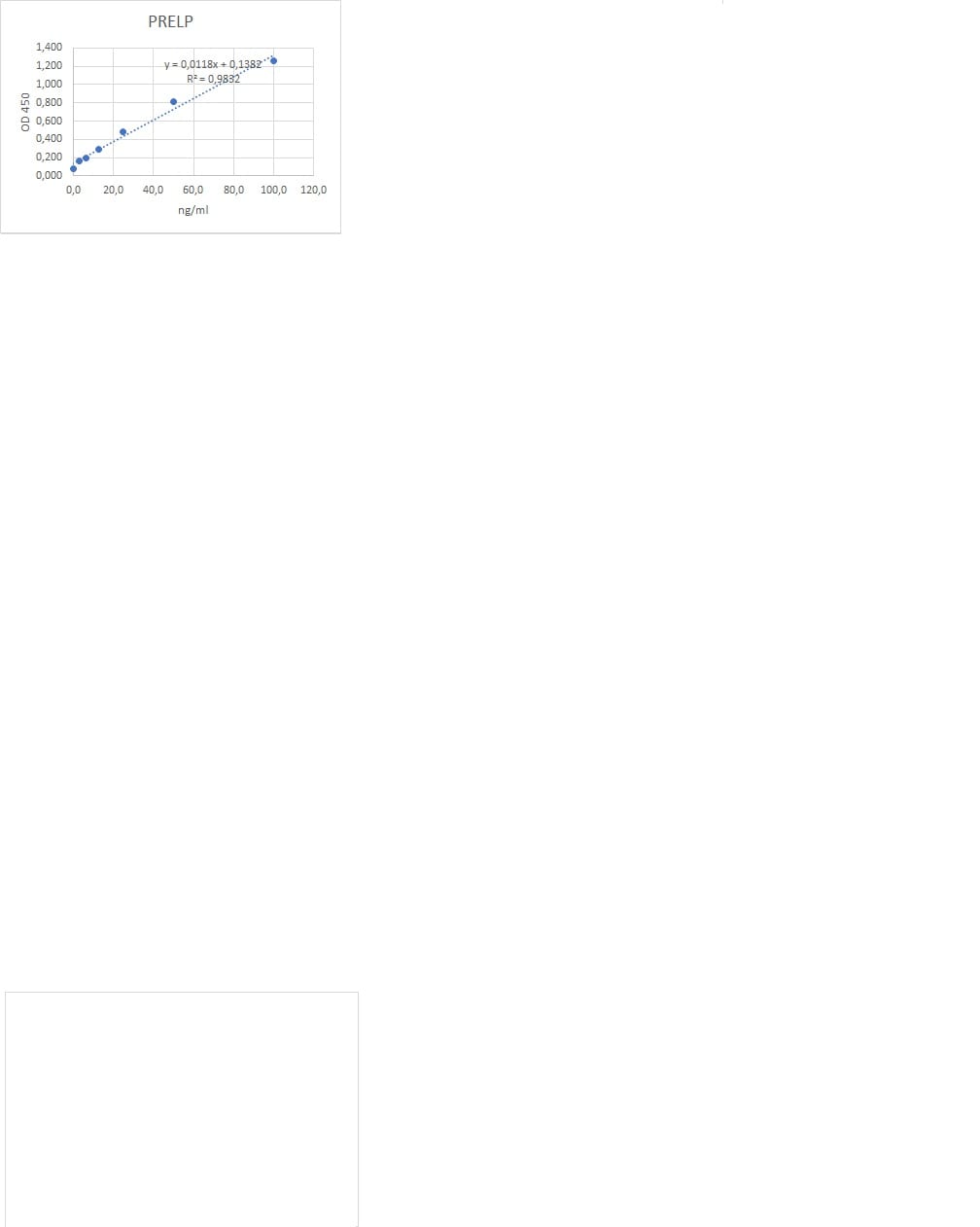
Application: Immunoassay StandardVerified Customer | Posted 07/05/2022good standard for ELISA

There are no reviews that match your criteria.
Loading...
Associated Pathways
