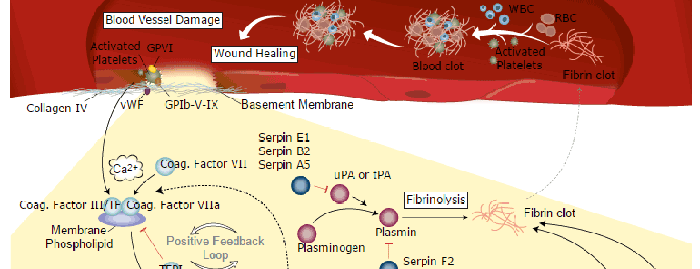
Serpin C1 is a member of the Serpin superfamily of the serine protease inhibitors (1). It is the principal plasma Serpin of blood clotting proteases and inhibits thrombin as well as several factors such as Xa (2). Similar to Serpins A5 and D1, its thrombin inhibitory activity is enhanced by heparin. Hereditary and acquired Serpin C1 deficiency is the cause of an increased thrombotic tendency in many cases (3). For example, acquired Serpin C1 deficiency is a common condition in sepsis, after major trauma or surgery (4).
Recombinant Human Serpin C1/Antithrombin-III Protein, CF
R&D Systems | Catalog # 1267-PI


Loading...
Key Product Details
- R&D Systems NS0-derived Recombinant Human Serpin C1/Antithrombin-III Protein (1267-PI)
- Quality control testing to verify active proteins with lot specific assays by in-house scientists
- All R&D Systems proteins are covered with a 100% guarantee
Source
NS0
Accession Number
Applications
Inhibition Activity
Loading...
Product Specifications
Source
Mouse myeloma cell line, NS0-derived human Serpin C1/Antithrombin-III protein
His33-Lys464, with a C-terminal 10-His tag
His33-Lys464, with a C-terminal 10-His tag
Purity
>95%, by SDS-PAGE visualized with Silver Staining and quantitative densitometry by Coomassie® Blue Staining.
Endotoxin Level
<1.0 EU per 1 μg of the protein by the LAL method.
N-terminal Sequence Analysis
His33
Predicted Molecular Mass
50 kDa
SDS-PAGE
55-65 kDa, reducing conditions
Formulation, Preparation, and Storage
1267-PI
| Formulation | Lyophilized from a 0.2 μm filtered solution in MES and NaCl. |
| Reconstitution | Reconstitute at 100 μg/mL in sterile 25 mM MES, 150 mM NaCl, pH 6.5. |
| Shipping | The product is shipped at ambient temperature. Upon receipt, store it immediately at the temperature recommended below. |
| Stability & Storage | Use a manual defrost freezer and avoid repeated freeze-thaw cycles.
|
Calculators
Background: Serpin C1/Antithrombin-III
References
- Silverman, G.A. et al. (2001) J. Biol. Chem. 276:33293.
- Chuang, Y.-J. et al. (2001) Biochemistry 40:6670.
- Vinazzer, H. (1999) Semin. Thromb. Hemost. 25:257.
- Risberg, B. (1998) Blood Coagul. Fibrinolysis Suppl. 3:S3.
Alternate Names
Antithrombin-III, ATIII
Gene Symbol
SERPINC1
UniProt
Additional Serpin C1/Antithrombin-III Products
Product Documents for Recombinant Human Serpin C1/Antithrombin-III Protein, CF
Certificate of Analysis
To download a Certificate of Analysis, please enter a lot or batch number in the search box below.
Note: Certificate of Analysis not available for kit components.
Product Specific Notices for Recombinant Human Serpin C1/Antithrombin-III Protein, CF
For research use only
Related Research Areas
Citations for Recombinant Human Serpin C1/Antithrombin-III Protein, CF
 Powered by Bioz
Customer Reviews for Recombinant Human Serpin C1/Antithrombin-III Protein, CF
There are currently no reviews for this product. Be the first to review Recombinant Human Serpin C1/Antithrombin-III Protein, CF and earn rewards!
Have you used Recombinant Human Serpin C1/Antithrombin-III Protein, CF?
Submit a review and receive an Amazon gift card!
$25/€18/£15/$25CAN/¥2500 for a review with an image
$10/€7/£6/$10CAN/¥1110 for a review without an image
Submit a review
Protocols
View specific protocols for Recombinant Human Serpin C1/Antithrombin-III Protein, CF (1267-PI):
Materials
- Assay Buffer: 50 mM Tris, 10 mM CaCl2, 150 mM NaCl, 0.05% (w/v) Brij-35, pH 7.5 (TCNB)
- Recombinant Human Serpin C1/Antithrombin-III (rhSerpin C1) (Catalog # 1267-PI)
- Recombinant Human Coagulation Factor II/Thrombin (Catalog # 1473-SE)
- Heparin (Sigma, Catalog # H3393), 20 mg/mL stock in deionized water
- Substrate: BOC-Val-Pro-Arg-AMC (Catalog # ES011), 10 mM stock in DMSO
- F16 Black Maxisorp Plate (Nunc, Catalog # 475515)
- Fluorescent Plate Reader (Model: SpectraMax Gemini EM by Molecular Devices) or equivalent
- Dilute Thrombin to 1 µg/mL with Heparin at 48.6 µg/mL in Assay Buffer.
- Prepare a curve of rhSerpin C1 (MW: 50,378 Da) in Assay Buffer. Make the following serial dilutions: 1000, 500, 250, 125, 62.5, 41.7, 27.8, 13.9, 6.94, and 2.31 nM.
- Mix equal volumes of rhSerpin C1 curve dilutions and Thrombin/Heparin mixture. Include a control (in duplicate) containing equal volumes of Assay Buffer and Thrombin/Heparin mixture.
- Incubate reaction mixtures at room temperature for 30 minutes.
- After incubation, dilute reaction mixtures by 1/5 in Assay Buffer.
- Dilute Substrate to 200 µM in Assay Buffer.
- In a plate load 50 µL of the diluted reaction mixtures to wells, and start the reaction by adding 50 µL of 200 µM Substrate.
- Read at excitation and emission wavelengths of 380 nm and 460 nm (top read), respectively, in kinetic mode for 5 minutes.
- Derive the 50% inhibition concentration (IC50) for rhSerpin C1 by plotting RFU/min (or specific activity) vs. concentration with 4-PL fitting.
- Calculate specific activity for Thrombin at each point using the following formula (if needed):
|
Specific Activity (pmol/min/µg) = |
Adjusted Vmax* (RFU/min) x Conversion Factor** (pmol/RFU) |
| amount of enzyme (µg) |
*Adjusted for Substrate Blank
**Derived using calibration standard 7-amino, 4-Methyl Coumarin (Sigma, Catalog # A-9891)
Per Well:
- Thrombin: 0.005 µg (1.0 nM)
- rhSerpin C1: 50, 25, 12.5, 6.25, 3.13, 2.09, 1.39, 0.695, 0.347, and 0.116 nM
- Substrate: 100 µM
Loading...
Associated Pathways