
SPARC, an acronym for “secreted protein, acidic and rich in cysteine”, is also known as osteonectin or BM-40 (1-5). It is the founding member of a family of secreted matricellular proteins with similar domain structure. The 286 amino acid (aa), 43 kDa protein contains an N-terminal acidic region that binds calcium, a follistatin domain that contains Kazal-like sequences, and a C-terminal extracellular calcium (EC) binding domain with two EF-hand motifs (1-5). Crystal structure modeling shows that residues implicated in cell binding, inhibition of cell spreading, and disassembly of focal adhesions cluster on one face of SPARC, while a collagen binding epitope and an N-glycosylation site are opposite this face (6). SPARC is produced by fibroblasts, capillary endothelial cells, platelets and macrophages, especially in areas of tissue morphogenesis and remodeling (3, 7). SPARC shows context-specific effects, but generally inhibits adhesion, spreading and proliferation, and promotes collagen matrix formation (3-5). For endothelial cells, SPARC disrupts focal adhesions and binds and sequesters PDGF and VEGF (3-5). SPARC is abundantly expressed in bone, where it promotes osteoblast differentiation and inhibits adipogenesis (5, 8). SPARC is potentially cleaved by metalloproteinases, producing an angiogenic peptide that includes the copper-binding sequence KGHK (7). Paradoxically, SPARC is highly expressed in many tumor types undergoing an endothelial to mesenchymal transistion; its expression, however, mainly decreases the likelihood of metastasis and confers sensitivity to chemotherapy and radiation (4, 9-11). Stabilin-1, which is expressed on alternately activated macrophages, is the first SPARC receptor to be identified. It binds the SPARC EC domain and mediates endocytosis for degradation (12). Mature human SPARC shows 92%, 92%, 97%, 99%, 96% and 85% aa identity with mouse, rat, canine, bovine, porcine and chick SPARC, respectively.
Recombinant Human SPARC Protein, CF
R&D Systems | Catalog # 941-SP


Loading...
Key Product Details
- R&D Systems NS0-derived Recombinant Human SPARC Protein (941-SP)
- Quality control testing to verify active proteins with lot specific assays by in-house scientists
- All R&D Systems proteins are covered with a 100% guarantee
Source
NS0
Accession Number
Applications
Bioactivity
Loading...
Product Specifications
Source
Mouse myeloma cell line, NS0-derived human SPARC protein
Ala18-Ile303, with a C-terminal 10-His tag
Ala18-Ile303, with a C-terminal 10-His tag
Purity
>95%, by SDS-PAGE visualized with Silver Staining and quantitative densitometry by Coomassie® Blue Staining.
Endotoxin Level
<0.10 EU per 1 μg of the protein by the LAL method.
N-terminal Sequence Analysis
Ala18
Predicted Molecular Mass
34 kDa
SDS-PAGE
40-50 kDa, reducing conditions
Activity
Measured by its ability to inhibit the cell growth of Mv1Lu mink lung epithelial cells. Schiemann, B.J. et al. (2003) Mol. Biol. Cell. 14:3977.
The ED50 for this effect is 0.75-3.0 µg/mL.
The ED50 for this effect is 0.75-3.0 µg/mL.
Reviewed Applications
Read 2 reviews rated 4.5 using 941-SP in the following applications:
Formulation, Preparation, and Storage
941-SP
| Formulation | Lyophilized from a 0.2 μm filtered solution in PBS. |
| Reconstitution | Reconstitute at 100 μg/mL in sterile PBS.
Loading...
|
| Shipping | The product is shipped at ambient temperature. Upon receipt, store it immediately at the temperature recommended below. |
| Stability & Storage | Use a manual defrost freezer and avoid repeated freeze-thaw cycles.
|
Calculators
Background: SPARC
References
- Lankat-Buttgereit, B. et al. (1988) FEBS Lett. 236:352.
- Sweetwyne, M. T. et al. (2004) J. Histochem. Cytochem. 52:723.
- Sage, H. et al. (1989) J. Cell Biol. 109:341.
- Framson, P. E. and E. H. Sage (2004) J. Cell. Biochem. 92:679.
- Alford, A. I. and K. D. Hankenson (2006) Bone 38:749.
- Hohenester, E et al. (1997) EMBO J. 16:3778.
- Sage, E. H. et al. (2003) J. Biol. Chem. 278:37849.
- Delany, A. M. et al. (2003) Endocrinology 144:2588.
- Robert, G. et al. (2006) Cancer Res. 66:7516.
- Koblinski, J. E. et al. (2005) Cancer Res. 65:7370.
- Tai, I. T. et al. (2005) J. Clin. Invest. 115:1492.
- Kzhyshkowska, J. et al. (2006) J. Immunol. 176:5825.
Long Name
Secreted Protein Acidic and Rich in Cysteine
Alternate Names
BM-40, Osteonectin
Gene Symbol
SPARC
UniProt
Additional SPARC Products
Product Documents for Recombinant Human SPARC Protein, CF
Certificate of Analysis
To download a Certificate of Analysis, please enter a lot or batch number in the search box below.
Note: Certificate of Analysis not available for kit components.
Product Specific Notices for Recombinant Human SPARC Protein, CF
For research use only
Citations for Recombinant Human SPARC Protein, CF
 Powered by Bioz
Customer Reviews for Recombinant Human SPARC Protein, CF (2)
4.5 out of 5
2 Customer Ratings
Have you used Recombinant Human SPARC Protein, CF?
Submit a review and receive an Amazon gift card!
$25/€18/£15/$25CAN/¥2500 for a review with an image
$10/€7/£6/$10CAN/¥1110 for a review without an image
Submit a review
Customer Images
Showing
1
-
2 of
2 reviews
Showing All
Filter By:
-
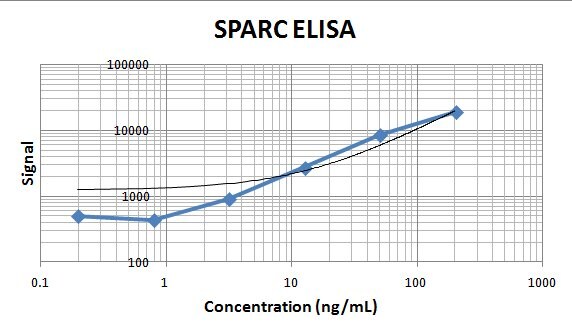
Application: Immunoassay StandardVerified Customer | Posted 11/08/2019Used in an ELISA with MAB941 and AF941. The assay had good parallelism with human serum and plasma samples.

-
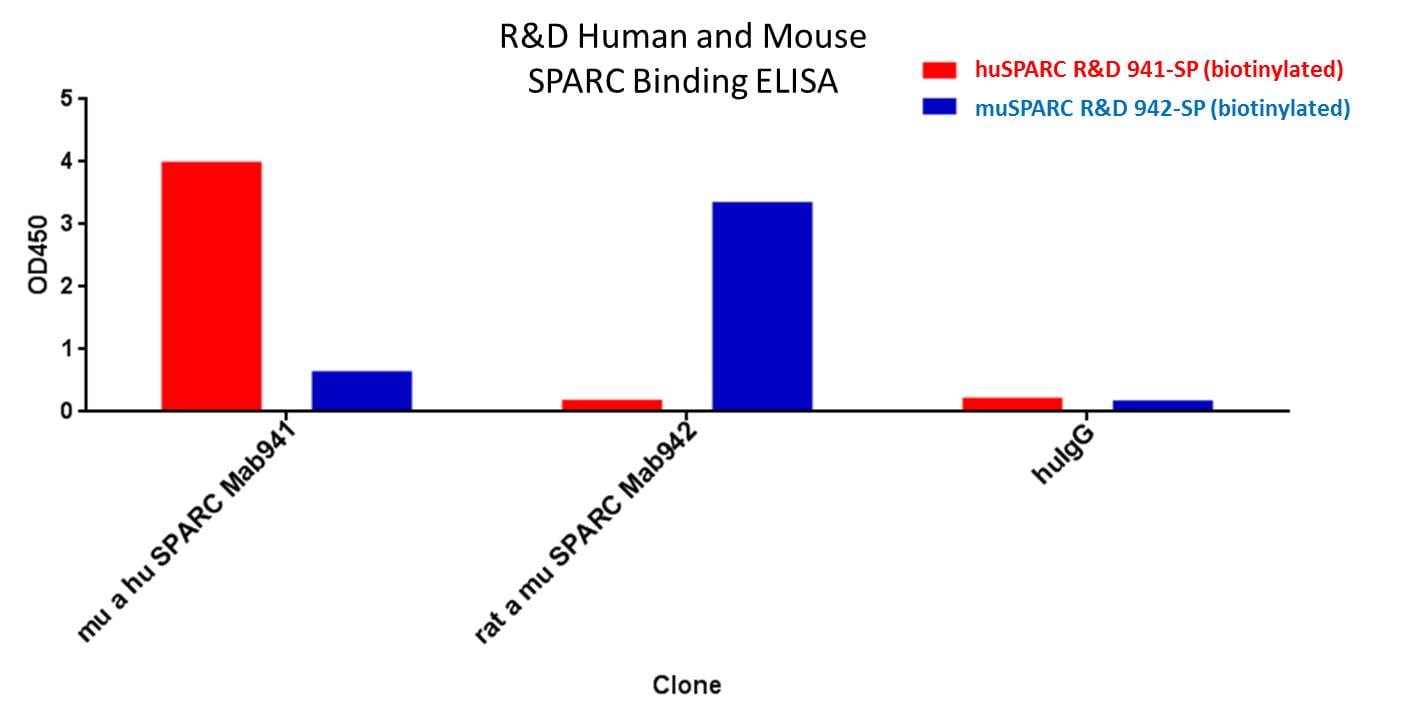
Application: Binding assay/Protein-protein interactionVerified Customer | Posted 01/09/2018MAB941 binds human SPARC, MAB942 does not bind human SPARC.
There are no reviews that match your criteria.
Loading...
Associated Pathways
