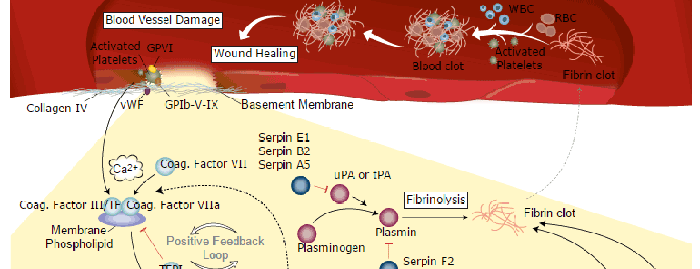
Human Tissue Factor Pathway Inhibitor 2 (TFPI-2), also known as placental protein 5 (PP5) and retinal pigment epithelial cell factor 1 (REF-1), is a secreted protein with a N-terminal acidic region, three Kunitz (K) domains (residues 36 to 86, 96 to 149 and 158 to 208) separated with by two linker regions, and a C‑terminal basic region (1-3). Expression of TFPI-2 is down-regulated in several cancers, which may contribute to tumor progression in these cancers (4). The purified rhTFPI-2 ends at residue 213 and does not contain the last 22 residues (residues 214 to 235) in the C-terminal region. It inhibits the activity of Recombinant Human Coagulation Factor VII (Catalog # http://www.rndsystems.com/product_results.aspx?k=2338-SE">2338-SE) in the presence of Recombinant Human Coagulation Factor III/Tissue Factor (Catalog # http://www.rndsystems.com/product_results.aspx?k=2339-PA">2339-PA).
Recombinant Human TFPI-2 Protein, CF
R&D Systems | Catalog # 2545-PI

Loading...
Key Product Details
- R&D Systems NS0-derived Recombinant Human TFPI-2 Protein (2545-PI)
- Quality control testing to verify active proteins with lot specific assays by in-house scientists
- All R&D Systems proteins are covered with a 100% guarantee
Source
NS0
Accession Number
Applications
Inhibition Activity
Loading...
Product Specifications
Source
Mouse myeloma cell line, NS0-derived human TFPI-2 protein
Asp23-Lys213, with a C-terminal 10-His tag
Asp23-Lys213, with a C-terminal 10-His tag
Purity
>95%, by SDS-PAGE visualized with Silver Staining and quantitative densitometry by Coomassie® Blue Staining.
Endotoxin Level
<1.0 EU per 1 μg of the protein by the LAL method.
N-terminal Sequence Analysis
Asp23
Predicted Molecular Mass
23 kDa
SDS-PAGE
28-35 kDa, reducing conditions
Activity
Measured by its ability to inhibit trypsin cleavage of a fluorogenic peptide substrate, Mca-RPKPVE-Nval-WRK(Dnp)-NH2 (Catalog # ES002).
The IC50 value is <5 nM, as measured under the described conditions.
The IC50 value is <5 nM, as measured under the described conditions.
Formulation, Preparation, and Storage
2545-PI
| Formulation | Lyophilized from a 0.2 μm filtered solution in Tris, NaCl and Brij-35. |
| Reconstitution | Reconstitute at 100 μg/mL in sterile 25 mM Tris and 150 mM NaCl, pH 7.5. |
| Shipping | The product is shipped at ambient temperature. Upon receipt, store it immediately at the temperature recommended below. |
| Stability & Storage | Use a manual defrost freezer and avoid repeated freeze-thaw cycles.
|
Calculators
Background: TFPI-2
References
- Miyagi, Y. et al. (1994) J. Biochem. 116:939.
- Sprecher, C.A. et al. (1994) Proc. Natl. Acad. Sci. USA 91:3353.
- Tanaka, Y. et al. (2004) Invest. Ophthalmol. Vis. Sci. 45:245.
- Rollin, J. et al. (2005) Br, J. Cancer 92:775.
Long Name
Tissue Factor Pathway Inhibitor 2
Alternate Names
PP5, REF-1, TFPI2
Entrez Gene IDs
7980 (Human)
Gene Symbol
TFPI2
UniProt
Additional TFPI-2 Products
Product Documents for Recombinant Human TFPI-2 Protein, CF
Certificate of Analysis
To download a Certificate of Analysis, please enter a lot or batch number in the search box below.
Note: Certificate of Analysis not available for kit components.
Product Specific Notices for Recombinant Human TFPI-2 Protein, CF
For research use only
Related Research Areas
Citations for Recombinant Human TFPI-2 Protein, CF
 Powered by Bioz
Customer Reviews for Recombinant Human TFPI-2 Protein, CF
There are currently no reviews for this product. Be the first to review Recombinant Human TFPI-2 Protein, CF and earn rewards!
Have you used Recombinant Human TFPI-2 Protein, CF?
Submit a review and receive an Amazon gift card!
$25/€18/£15/$25CAN/¥2500 for a review with an image
$10/€7/£6/$10CAN/¥1110 for a review without an image
Submit a review
Protocols
View specific protocols for Recombinant Human TFPI-2 Protein, CF (2545-PI):
Materials
- Assay Buffer: 50 mM Tris, 10 mM CaCl2, 150 mM NaCl, 0.05% (w/v) Brij-35, pH 7.5 (TCNB)
- Recombinant Human TFPI‑2 (rhTFPI-2) (Catalog # 2545-PI)
- Trypsin (Sigma, Catalog # T-1426)
- Substrate: MCA-Arg-Pro-Lys-Pro-Val-Glu-NVAL-Trp-Arg-Lys(DNP)-NH2 (Catalog # ES002)
- F16 Black Maxisorp Plate (Nunc, Catalog # 475515)
- Fluorescent Plate Reader (Model: SpectraMax Gemini EM by Molecular Devices) or equivalent
- Dilute Trypsin to 0.25 µg/mL in Assay Buffer.
- Prepare a curve of rhTFPI-2 (MW: 23,197 Da) in Assay Buffer. Make the following serial dilutions: 4000, 800, 400, 200, 100, 50, 25, 12.5, 6.25, and 1.25 nM.
- Combine equal volumes of diluted Trypsin and rhTFPI-2 at each concentration of the curve. Include two controls containing equal volumes of Assay Buffer and diluted Trypsin without any rhTFPI-2.
- Incubate mixtures at 37 °C for 15 minutes.
- Dilute reaction mixtures five fold in Assay Buffer.
- Dilute Substrate to 20 µM in Assay Buffer.
- Load 50 µL of the incubated mixtures in a plate, and start the reaction by adding 50 µL of 20 µM Substrate.
- Read at excitation and emission wavelengths of 320 nm and 405 nm (top read), respectively in kinetic mode for 5 minutes.
- Derive the 50% inhibiting concentration (IC50) for rhTFPI-2 by plotting RFU/min (or specific activity) vs. concentration with 4-PL fitting.
- The specific activity for trypsin at each point may be determined using the following formula (if needed):
|
Specific Activity (pmol/min/µg) = |
Adjusted Vmax* (RFU/min) x Conversion Factor** (pmol/RFU) |
| amount of enzyme (µg) |
*Adjusted for Substrate Blank
**Derived using calibration standard MCA-Pro-Leu-OH (Bachem, Catalog # M-1975).
Per Well:
- Trypsin: 0.00125 µg
- rhTFPI-2: 200, 40, 20, 10, 5, 2.5, 1.25, 0.625, 0.3125, and 0.0625 nM.
- Substrate: 10 µM
Loading...
Associated Pathways