
Thrombopoietin (Tpo), is a key regulator of megakaryocytopoiesis and thrombopoiesis. It is principally produced in the liver and is bound and internalized by the receptor Tpo R/c‑mpl. Defects in the Tpo‑Tpo R signaling pathway are associated with a variety of platelet disorders (1‑3). The 353 amino acid (aa) human Tpo precursor is cleaved to yield the 332 aa mature protein. Mature human Tpo shares approximately 70% aa sequence homology with mouse and rat Tpo. It is an 80‑85 kDa protein that consists of an N‑terminal domain with homology to Erythropoietin (Epo) and a C‑terminal domain that contains multiple N‑linked and O‑linked glycosylation sites (4, 5). Tissue specific alternate splicing of human Tpo generates multiple isoforms with internal deletions, insertions, and/or C‑terminal substitutions (6). Tpo promotes the differentiation, proliferation, and maturation of MK and their progenitors (4, 5, 7). Several other cytokines can promote these functions as well but only in cooperation with Tpo (8, 9). Notably, IL‑3 independently induces MK development, although its effects are restricted to early in the MK lineage (8, 9). Tpo additionally promotes platelet production, aggregation, ECM adhesion, and activation (10, 13). It is cleaved by platelet‑derived thrombin following Arg191 within the C‑terminal domain and subsequently at other sites upon extended digestion (14). Full length Tpo and shorter forms circulate in the plasma (4, 5). The C‑terminal domain is not required for binding to Tpo R or inducing MK growth and differentiation (5). Aside from its hematopoietic effects, Tpo is expressed in the brain where it promotes the apoptosis of hypoxia‑sensitized neurons and inhibits neuronal differentiation by blocking NGF induced signaling (15, 16).
Recombinant Human Thrombopoietin Protein
R&D Systems | Catalog # 288-TP

NEW VERSION AVAILABLE! Combing R&D Systems quality with scalability, try our new version of Human Recombinant Thrombopoietin/TPO (Catalog # BT-TPO).
Key Product Details
- R&D Systems Sf 21 (baculovirus)-derived Recombinant Human Thrombopoietin Protein (288-TP)
- Quality control testing to verify active proteins with lot specific assays by in-house scientists
- All R&D Systems proteins are covered with a 100% guarantee
Source
Accession Number
Applications
Product Specifications
Source
Ser22-Gly353
Purity
Endotoxin Level
N-terminal Sequence Analysis
Predicted Molecular Mass
SDS-PAGE
Activity
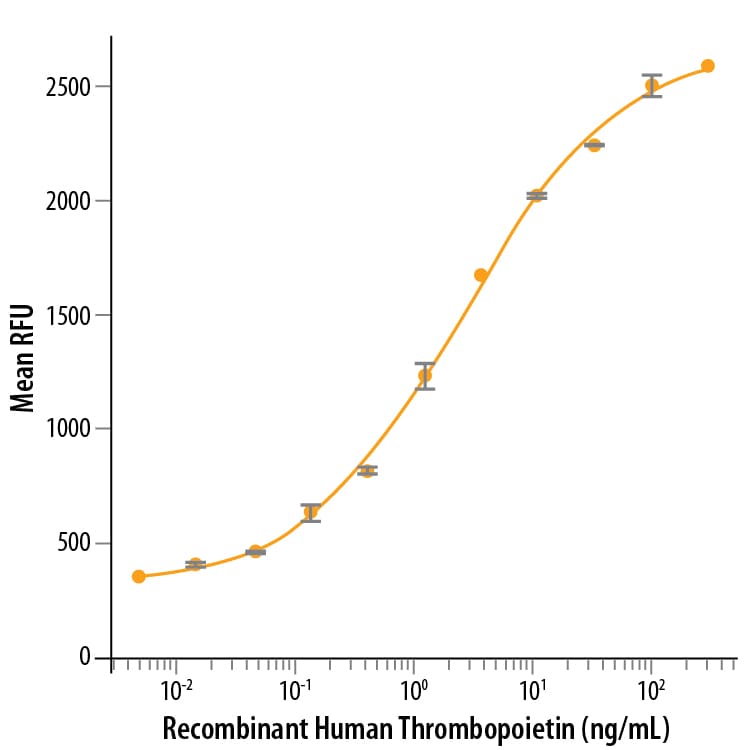
The ED50 for this effect is 0.3-3 ng/mL.
Scientific Data Images for Recombinant Human Thrombopoietin Protein
Recombinant Human Thrombopoietin Protein Bioactivity
Recombinant Human Thrombopoietin/Tpo (Catalog # 288-TP) stimulates proliferation in the MO7e human megakaryocytic leukemic cell line. The ED50 for this effect is 0.3-3 ng/mL.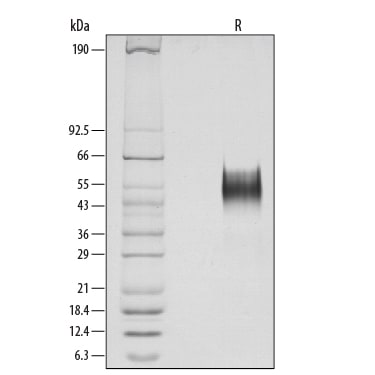
Recombinant Human Thrombopoietin Protein SDS-PAGE
1 µg/lane of Recombinant Human Thrombopoietin was resolved with SDS-PAGE under reducing (R) conditions and visualized by silver staining, showing major bands at 43-60 kDa. Multiple bands in gel are due to variable glycosylation.Formulation, Preparation, and Storage
Carrier Free
What does CF mean?CF stands for Carrier Free (CF). We typically add Bovine Serum Albumin (BSA) as a carrier protein to our recombinant proteins. Adding a carrier protein enhances protein stability, increases shelf-life, and allows the recombinant protein to be stored at a more dilute concentration. The carrier free version does not contain BSA.
What formulation is right for me?In general, we advise purchasing the recombinant protein with BSA for use in cell or tissue culture, or as an ELISA standard. In contrast, the carrier free protein is recommended for applications, in which the presence of BSA could interfere.
Carrier: 288-TP
| Formulation | Lyophilized from a 0.2 μm filtered solution in Acetonitrile and TFA with BSA as a carrier protein. |
| Reconstitution | Reconstitute at 50-200 μg/mL in sterile 4 mM HCl containing at least 0.1% human or bovine serum albumin. |
| Shipping | The product is shipped at ambient temperature. Upon receipt, store it immediately at the temperature recommended below. |
| Stability & Storage | Use a manual defrost freezer and avoid repeated freeze-thaw cycles.
|
Carrier Free: 288-TP/CF
| Formulation | Lyophilized from a 0.2 μm filtered solution in Acetonitrile and TFA. |
| Reconstitution | Reconstitute at 50-200 µg/mL in sterile 4 mM HCl. |
| Shipping | The product is shipped at ambient temperature. Upon receipt, store it immediately at the temperature recommended below. |
| Stability & Storage | Use a manual defrost freezer and avoid repeated freeze-thaw cycles.
|
Calculators
Background: Thrombopoietin/Tpo
References
- Deutsch, V.R. and A. Tomer (2006) Br. J. Haematol. 134:453.
- Kaushansky, K. (2005) J. Clin. Invest. 115:3339.
- Li, J. et al. (1999) Br. J. Haematol. 106:345.
- Bartley, T.D. et al. (1994) Cell 77:1117.
- de Sauvage, F.J. et al. (1994) Nature 369:533.
- Marcucci, R. and M. Romano (2008) Biochim. Biophys. Acta 1782:427.
- Kaushansky, K. et al. (1994) Nature 369:568.
- Kaushansky, K. et al. (1995) Proc. Natl. Acad. Sci. 92:3234.
- Broudy, V.C. et al. (1995), Blood 85:1719.
- Lok, S.I. et al. (1994) Nature 369:565.
- Chen, J. et al. (1995) Blood 86:4054.
- Oda, A. et al. (1996) Blood 87:4664.
- Van Os, E. et al. (2003) Br. J. Haematol. 121:482.
- Kato, T. et al. (1997) Proc. Natl. Acad. Sci. 94:4669.
- Ehrenreich, H. et al. (2005) Proc. Natl. Acad. Sci. 102:862.
- Samoylenko, A. et al. (2008) Cell. Signal. 20:154.
Alternate Names
Gene Symbol
UniProt
Additional Thrombopoietin/Tpo Products
Product Documents for Recombinant Human Thrombopoietin Protein
Certificate of Analysis
To download a Certificate of Analysis, please enter a lot or batch number in the search box below.
Note: Certificate of Analysis not available for kit components.
Product Specific Notices for Recombinant Human Thrombopoietin Protein
For research use only
Related Research Areas
Citations for Recombinant Human Thrombopoietin Protein
 Powered by Bioz
Customer Reviews for Recombinant Human Thrombopoietin Protein
There are currently no reviews for this product. Be the first to review Recombinant Human Thrombopoietin Protein and earn rewards!
Have you used Recombinant Human Thrombopoietin Protein?
Submit a review and receive an Amazon gift card!
$25/€18/£15/$25CAN/¥2500 for a review with an image
$10/€7/£6/$10CAN/¥1110 for a review without an image
Submit a review
FAQs for Recombinant Human Thrombopoietin Protein
-
Q: What are the differences between the Recombinant Human Thrombopoietin/Tpo Proteins (Catalog #s 288-TP, 288-TPN, and 288-TPE)?
A: Each of these proteins is produced using a different expression system. 288-TP is Spodoptera frugiperda, Sf21 baculovirus-derived; 288-TPN is mouse myeloma cell line, NS0-derived; and 288-TPE is E. coli-derived.
Additionally, the sequence length also varies. 288-TP and 288-TPN begin at Ser22 and end at Gly353. 288-TPE also begins at Ser22 but is truncated at the C-terminus, ending at Leu195. Truncation of the C-terminus has been shown to enhance the biological activity of Tpo. -
Q: Why do you sell Thrombopoietin protein from two different expression systems? Under what circumstances would it be preferred to use the NS0-expressed protein?
A: The NS0-expressed protein is necessary for the serum-free megakaryocyte colony stimulating assay (Nadine Weich, Genetics Insititute). In all other assays, it works the same as the Sf-21 derived protein.
-
Q: What are the differences between the Recombinant Human Thrombopoietin/Tpo Proteins (Catalog #s 288-TP, 288-TPN, and 288-TPE)?
A: Each of these proteins is produced using a different expression system. 288-TP is Spodoptera frugiperda, Sf21 baculovirus-derived; 288-TPN is mouse myeloma cell line, NS0-derived; and 288-TPE is E. coli-derived.
Additionally, the sequence length also varies. 288-TP and 288-TPN begin at Ser22 and end at Gly353. 288-TPE also begins at Ser22 but is truncated at the C-terminus, ending at Leu195. Truncation of the C-terminus has been shown to enhance the biological activity of Tpo. -
Q: Why do you sell Thrombopoietin protein from two different expression systems? Under what circumstances would it be preferred to use the NS0-expressed protein?
A: The NS0-expressed protein is necessary for the serum-free megakaryocyte colony stimulating assay (Nadine Weich, Genetics Insititute). In all other assays, it works the same as the Sf-21 derived protein.


