
RANK Ligand (receptor activator of NF-kappa B ligand [RANKL], also called TNF-related activation-induced cytokines (TRANCE), osteoprotegerin ligand [OPGL], and osteoclast differentiation factor [ODF]), is a member of the tumor necrosis factor (TNF) family. RANK Ligand was originally identified as an immediate early gene up‑regulated by T cell receptor stimulation. The human RANK Ligand cDNA encodes a type II transmembrane protein of 317 amino acids with a predicted cytoplasmic domain of 47 amino acids, a 21 amino acids transmembrane region, and an extracellular domain of 249 amino acids. The extracellular domain contains two potential N‑linked glycosylation sites. Mouse and human RANK Ligand share 85% amino acid identity. RANK Ligand is primarily expressed in T cells and T cell rich organs, such as thymus and lymph nodes. The multi-functions of RANK Ligand include induction of activation of the c-jun N‑terminal kinase, enhancement of T cell growth and dendritic cell function, induction of osteoclastogenesis, and lymph node organogenesis. RANK is the cell surface signaling receptor of RANK Ligand. RANK has been shown to undergo receptor clustering during signal transduction. Osteoprotegerin, a soluble member of the TNF receptor family which binds RANK Ligand, is a naturally occurring decoy receptor that counterbalances the effects of RANK Ligand.
Recombinant Human TRANCE/RANK L/TNFSF11 Protein
R&D Systems | Catalog # 390-TN

Key Product Details
- Recombinant Human TRANCE/RANK L/TNFSF11 protein is a key regulator of osteoclast differentiation, bone remodeling, and immune function
- Applications include cell and tissue culture, differentiation of human pluripotent stem cells, growth and maintenance of organoids, and used as a control in immunoassays
- Recombinant Human TRANCE/RANK L/TNFSF11 protein has been demonstrated to play a critical role in maintaining pluripotency, supporting tissue regeneration, and enabling the investigation of complex cellular processes
- Quality control testing to verify active proteins with lot specific assays by in-house scientists
- All R&D Systems proteins are covered with a 100% guarantee
Source
Accession Number
Applications
Product Specifications
Source
| MHHHHHHHHHH | GGGSGGGSGGGS | IEGR | Human TRANCE (Gly64-Asp245) Accession # AAC51762 |
| N-terminus | C-terminus | ||
Purity
Endotoxin Level
N-terminal Sequence Analysis
Predicted Molecular Mass
SDS-PAGE
Activity
The ED50 for this effect is 1.5-7.5 ng/mL in the presence of 2.5 µg/mL of a cross-linking antibody, Mouse Anti-polyHistidine Monoclonal Antibody (Catalog # MAB050).
Reviewed Applications
Read 8 reviews rated 4.8 using 390-TN in the following applications:
Scientific Data Images for Recombinant Human TRANCE/RANK L/TNFSF11 Protein
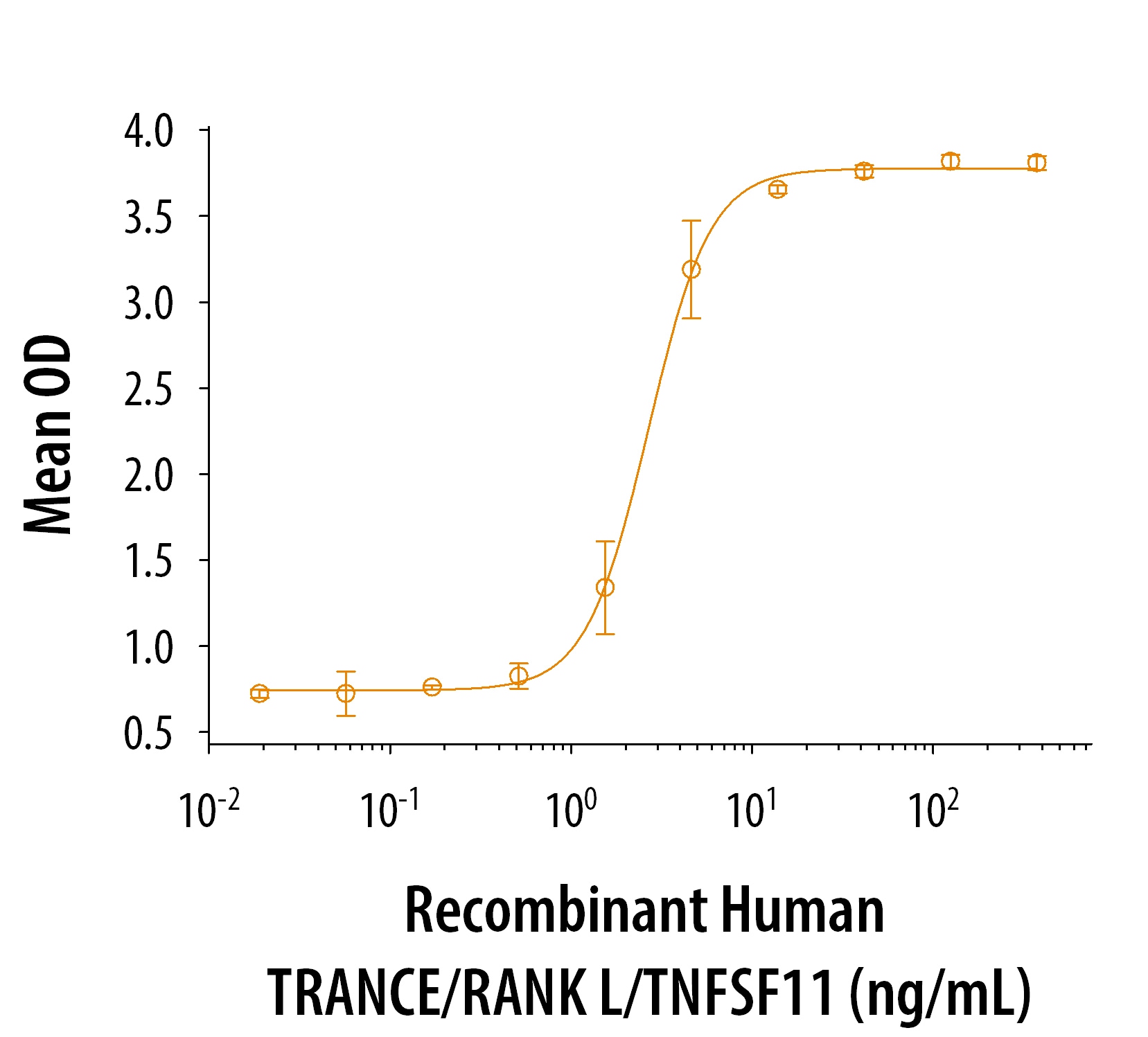
Bioactivity of Human TRANCE / RANK L / TNFSF11 Protein
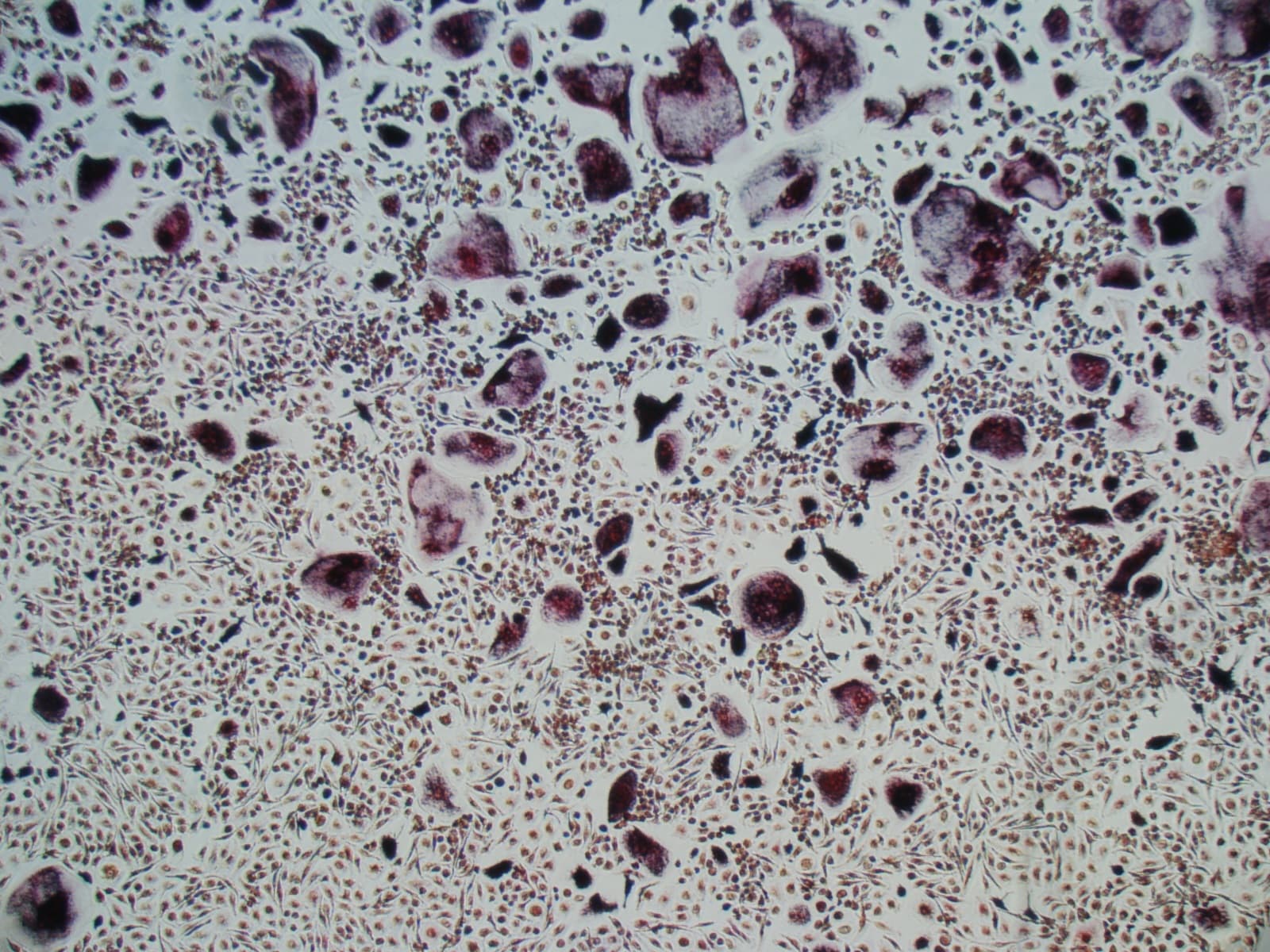
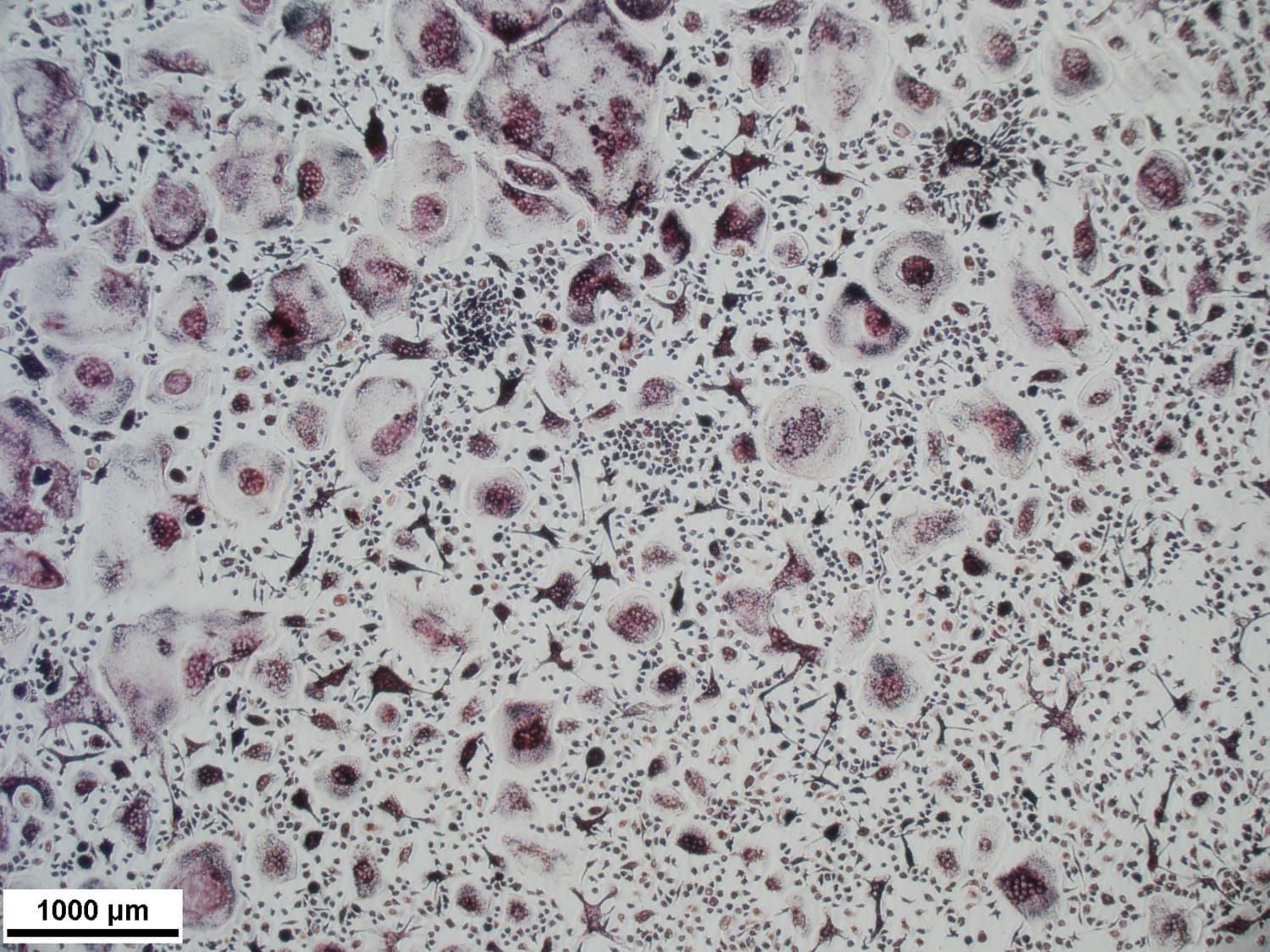
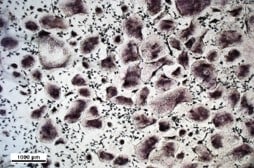
Recombinant human TRANCE / RANK L / TNFSF11 (390-TN) induces osteoclast differentiation of the RAW264.7 mouse monocyte/macrophage cell line. The ED50 for this effect is 1.5-7.5 ng/mL in the presence of 2.5 µg/mL of a cross-linking antibody, Mouse Anti-polyHistidine.Formulation, Preparation, and Storage
Carrier Free
What does CF mean?CF stands for Carrier Free (CF). We typically add Bovine Serum Albumin (BSA) as a carrier protein to our recombinant proteins. Adding a carrier protein enhances protein stability, increases shelf-life, and allows the recombinant protein to be stored at a more dilute concentration. The carrier free version does not contain BSA.
What formulation is right for me?In general, we advise purchasing the recombinant protein with BSA for use in cell or tissue culture, or as an ELISA standard. In contrast, the carrier free protein is recommended for applications, in which the presence of BSA could interfere.
Carrier: 390-TN
| Formulation | Lyophilized from a 0.2 μm filtered solution in MOPS and NaCl withTrehalose and BSA as a carrier protein. |
| Reconstitution | Reconstitute at 100 μg/mL in sterile PBS containing at least 0.1% human or bovine serum albumin. |
| Shipping | The product is shipped at ambient temperature. Upon receipt, store it immediately at the temperature recommended below. |
| Stability & Storage | Use a manual defrost freezer and avoid repeated freeze-thaw cycles.
|
Carrier Free: 390-TN/CF
| Formulation | Lyophilized from a 0.2 μm filtered solution in MOPS and NaCl with Trehalose. |
| Reconstitution | Reconstitute at 100 μg/mL in sterile PBS. |
| Shipping | The product is shipped at ambient temperature. Upon receipt, store it immediately at the temperature recommended below. |
| Stability & Storage | Use a manual defrost freezer and avoid repeated freeze-thaw cycles.
|
Calculators
Background: TRANCE/TNFSF11/RANK L
References
- Wong, B.R. et al. (1997) J. Biol. Chem. 272:25190.
- Anderson, D.M. et al. (1997) Nature 390:175.
- Nakagawa, N. et al. (1998) Biochem. Biophys. Res. Commun. 245:382.
- Kong, Y-Y. et al. (1999) Nature 397:315.
Long Name
Alternate Names
Gene Symbol
UniProt
Additional TRANCE/TNFSF11/RANK L Products
Product Documents for Recombinant Human TRANCE/RANK L/TNFSF11 Protein
Certificate of Analysis
To download a Certificate of Analysis, please enter a lot or batch number in the search box below.
Note: Certificate of Analysis not available for kit components.
Product Specific Notices for Recombinant Human TRANCE/RANK L/TNFSF11 Protein
For research use only
Related Research Areas
Citations for Recombinant Human TRANCE/RANK L/TNFSF11 Protein
 Powered by Bioz
Customer Reviews for Recombinant Human TRANCE/RANK L/TNFSF11 Protein (8)
Have you used Recombinant Human TRANCE/RANK L/TNFSF11 Protein?
Submit a review and receive an Amazon gift card!
$25/€18/£15/$25CAN/¥2500 for a review with an image
$10/€7/£6/$10CAN/¥1110 for a review without an image
Submit a review
Customer Images
-
Application: In vitro bioactivity in cell cultureVerified Customer | Posted 05/17/2022

-
Application: In vitro bioactivity in cell cultureVerified Customer | Posted 12/31/2021
-
Application: In vitro bioactivity in cell cultureVerified Customer | Posted 03/20/2021
-
Application: In vitro bioactivity in cell cultureVerified Customer | Posted 01/18/2021
-
Application: Cell ProliferationVerified Customer | Posted 02/06/2019
-
Application: Characterization by MSVerified Customer | Posted 01/05/2018
-
Verified Customer | Posted 05/16/2017
-
Application: Cell ProliferationVerified Customer | Posted 05/18/2016
There are no reviews that match your criteria.
FAQs for Recombinant Human TRANCE/RANK L/TNFSF11 Protein
-
Q: Is this protein provided in trimeric form or monomer form?
A: We do not define this protein as being exclusively a monomer, but we know that the protein is not fully associated into trimers because we need to use a cross-linking antibody for our in-house activity testing to cause multiple subunits of this protein to associate. This product has been shown to be biologically active in such testing when a cross-linking antibody is used. Therefore, we would expect for this protein to perform its expected biological function.
-
Q:
This protein datasheet indicates I need to use a cross-linking antibody, Catalog # MAB050, for biological activity. What is this antibody and is it really necessary?
A: The antibody is directed against a 6x histidine repeat and is recommended for use as a cross-linker of proteins with 6x his-tag. Crosslinking is often used for proteins that require receptor trimerization and can result greater biological activity. R&D Systems Quality Control tests the performance of these proteins in the presence of the cross-linking antibody. Therefore, it is necessary to use this antibody when trying to achieve the same level of specific activity described in the datasheet.
-
Q: What are the differences between the Recombinant Human TRANCE/RANK L/TNFSF11 Protein (Catalog # 390-TN) and the Recombinant Human TRANCE/RANK L/TNFSF11 (Catalog # 6449-TEC)?
A: 6449-TEC is the truncated version of 390-TN, and it contains a 10-His tag in the N-terminus. The bioactivity of 390-TN and 6449-TEC are measured in the same assay described in the datasheet, "Measured by its ability to induce osteoclast differentiation of RAW 264.7 mouse monocyte/macrophage cells." However, 390-TN utilizes a cross-linking antibody, MAB050, as it requires receptor trimerization which results in higher bioactivity. The ED50 for 390-TN is 1.5-7.5 ng/mL in the presence of MAB050, while the ED50 for 6449-TEC is 2-12 ng/mL.
-
Q: Is this protein provided in trimeric form or monomer form?
A: We do not define this protein as being exclusively a monomer, but we know that the protein is not fully associated into trimers because we need to use a cross-linking antibody for our in-house activity testing to cause multiple subunits of this protein to associate. This product has been shown to be biologically active in such testing when a cross-linking antibody is used. Therefore, we would expect for this protein to perform its expected biological function.
-
Q:
This protein datasheet indicates I need to use a cross-linking antibody, Catalog # MAB050, for biological activity. What is this antibody and is it really necessary?
A: The antibody is directed against a 6x histidine repeat and is recommended for use as a cross-linker of proteins with 6x his-tag. Crosslinking is often used for proteins that require receptor trimerization and can result greater biological activity. R&D Systems Quality Control tests the performance of these proteins in the presence of the cross-linking antibody. Therefore, it is necessary to use this antibody when trying to achieve the same level of specific activity described in the datasheet.
-
Q: What are the differences between the Recombinant Human TRANCE/RANK L/TNFSF11 Protein (Catalog # 390-TN) and the Recombinant Human TRANCE/RANK L/TNFSF11 (Catalog # 6449-TEC)?
A: 6449-TEC is the truncated version of 390-TN, and it contains a 10-His tag in the N-terminus. The bioactivity of 390-TN and 6449-TEC are measured in the same assay described in the datasheet, "Measured by its ability to induce osteoclast differentiation of RAW 264.7 mouse monocyte/macrophage cells." However, 390-TN utilizes a cross-linking antibody, MAB050, as it requires receptor trimerization which results in higher bioactivity. The ED50 for 390-TN is 1.5-7.5 ng/mL in the presence of MAB050, while the ED50 for 6449-TEC is 2-12 ng/mL.
-
Q: Is this protein provided in trimeric form or monomer form?
A: We do not define this protein as being exclusively a monomer, but we know that the protein is not fully associated into trimers because we need to use a cross-linking antibody for our in-house activity testing to cause multiple subunits of this protein to associate. This product has been shown to be biologically active in such testing when a cross-linking antibody is used. Therefore, we would expect for this protein to perform its expected biological function.
-
Q:
This protein datasheet indicates I need to use a cross-linking antibody, Catalog # MAB050, for biological activity. What is this antibody and is it really necessary?
A: The antibody is directed against a 6x histidine repeat and is recommended for use as a cross-linker of proteins with 6x his-tag. Crosslinking is often used for proteins that require receptor trimerization and can result greater biological activity. R&D Systems Quality Control tests the performance of these proteins in the presence of the cross-linking antibody. Therefore, it is necessary to use this antibody when trying to achieve the same level of specific activity described in the datasheet.
-
Q: What are the differences between the Recombinant Human TRANCE/RANK L/TNFSF11 Protein (Catalog # 390-TN) and the Recombinant Human TRANCE/RANK L/TNFSF11 (Catalog # 6449-TEC)?
A: 6449-TEC is the truncated version of 390-TN, and it contains a 10-His tag in the N-terminus. The bioactivity of 390-TN and 6449-TEC are measured in the same assay described in the datasheet, "Measured by its ability to induce osteoclast differentiation of RAW 264.7 mouse monocyte/macrophage cells." However, 390-TN utilizes a cross-linking antibody, MAB050, as it requires receptor trimerization which results in higher bioactivity. The ED50 for 390-TN is 1.5-7.5 ng/mL in the presence of MAB050, while the ED50 for 6449-TEC is 2-12 ng/mL.
Associated Pathways
