
Recombinant Human VEGF 165, ACFP Protein
R&D Systems | Catalog # ACFP293

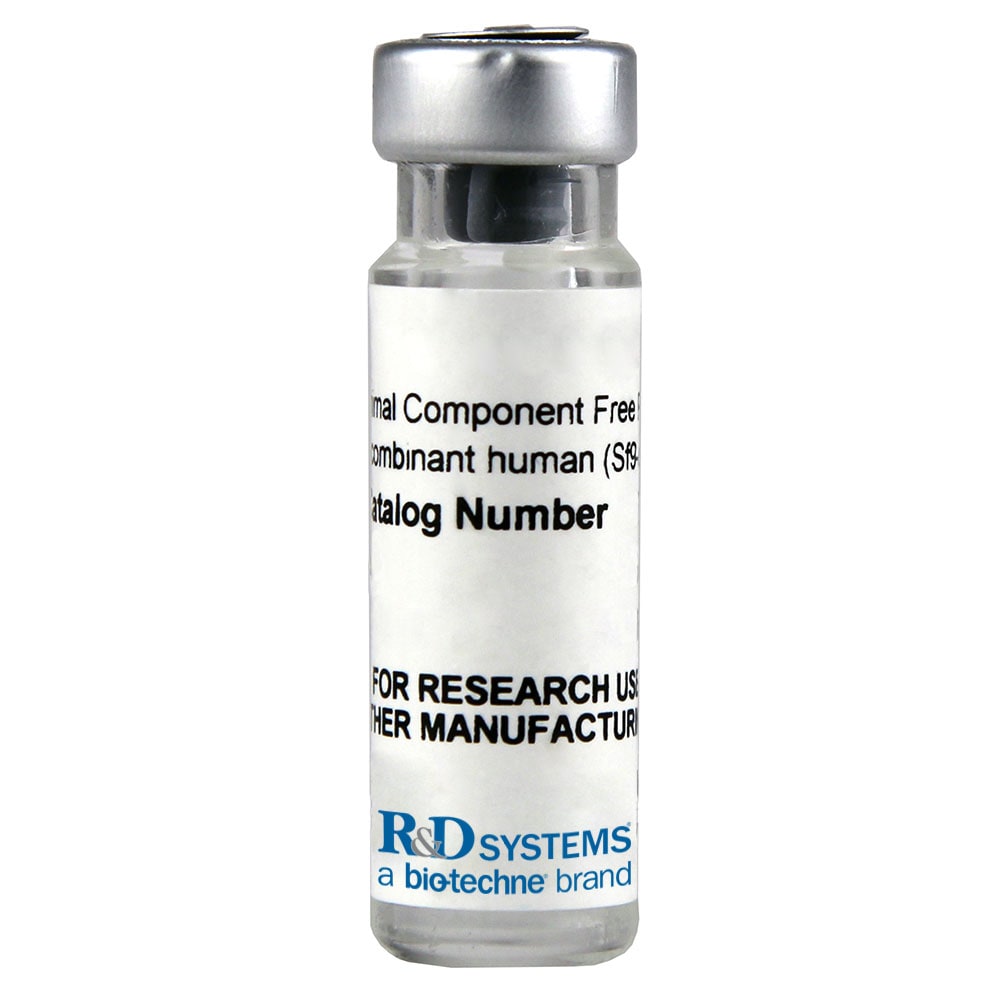
Discontinued Product
ACFP293 has been discontinued.
An alternative/replacement product is available:
BT-VEGF-AFL. View all VEGF products.
Key Product Details
Source
Sf 9 (baculovirus)
Accession Number
Structure / Form
Disulfide-linked homodimer
Applications
Bioactivity
Loading...
Product Specifications
Source
Spodoptera frugiperda, Sf 9 (baculovirus)-derived human VEGF protein
Met1-Arg191
Produced in an animal component free process (ACFP).
Met1-Arg191
Produced in an animal component free process (ACFP).
Purity
>97%, by SDS-PAGE under reducing conditions and visualized by silver stain.
Endotoxin Level
<0.01 EU per 1 μg of the protein by the LAL method.
N-terminal Sequence Analysis
Ala27
Predicted Molecular Mass
19.2 kDa (monomer)
SDS-PAGE
19-21 kDa, reducing conditions
Activity
Measured in a cell proliferation assay using HUVEC human umbilical vein endothelial cells. Conn, G. et al. (1990) Proc. Natl. Acad. Sci. USA 87:1323.
The ED50 for this effect is 1-6 ng/mL.
The specific activity of recombinant human VEGF is approximately 1.7 x 10³ U/μg, which is calibrated against recombinant human VEGF 165 WHO Standard (NIBSC code: 02/286).
The ED50 for this effect is 1-6 ng/mL.
The specific activity of recombinant human VEGF is approximately 1.7 x 10³ U/μg, which is calibrated against recombinant human VEGF 165 WHO Standard (NIBSC code: 02/286).
Formulation, Preparation, and Storage
ACFP293
| Formulation | Lyophilized from a 0.2 μm filtered solution in HCl. |
| Reconstitution | Reconstitute at 100 μg/mL in sterile PBS. Alternatively, reconstitute at 100-500 μg/mL in sterile 4 mM HCl. |
| Shipping | The product is shipped at ambient temperature. Upon receipt, store it immediately at the temperature recommended below. |
| Stability & Storage | Use a manual defrost freezer and avoid repeated freeze-thaw cycles.
|
Calculators
Background: VEGF
References
- Leung, D.W. et al. (1989) Science 246:1306.
- Keck, P.J. et al. (1989) Science 246:1309.
- Byrne, A.M. et al. (2005) J. Cell. Mol. Med. 9:777.
- Robinson, C.J. and Stringer, S.E. (2001) J. Cell. Sci. 114:853.
- Pan, Q. et al. (2007) J. Biol. Chem. 282:24049.
- Weis, S.M. and D.A. Cheresh (2005) Nature 437:497.
- Thurston, G. (2002) J. Anat. 200:575.
- Carvalho, J.F. et al. (2007) J. Clin. Immunol. 27:246.
- Angelo, L.S. and R. Kurzrock (2007) Clin. Cancer Res. 13:2825.
Long Name
Vascular Endothelial Growth Factor
Alternate Names
MVCD1, VAS, Vasculotropin, VEGF-A, VEGFA, VPF
Entrez Gene IDs
Gene Symbol
VEGFA
UniProt
Additional VEGF Products
Product Documents for Recombinant Human VEGF 165, ACFP Protein
Certificate of Analysis
To download a Certificate of Analysis, please enter a lot or batch number in the search box below.
Note: Certificate of Analysis not available for kit components.
Manufacturing Specifications
Animal Component-Free Process (ACFP) Manufacturing ConditionsR&D Systems Animal Component-Free Process (ACFP) recombinant proteins are expressed in an animal-free certified Sf 9 insect cell line using dedicated animal-free raw materials and labware. Production and purification procedures use equipment and media that are confirmed animal-free but performed outside our dedicated animal-free laboratories. Every stage of the manufacturing process follows R&D Systems' stringent Standard Operating Procedures (SOPs). The certified Sf 9 insect cell bank has undergone extensive testing to certify the lack of cytopathogens by screening for various viruses, Mycoplasma, and Spiroplasmas using both in vitro and in vivo testing methods. For ex vivo research or bioproduction, additional documentation can be provided.
Please read our complete ACFP Statement
Product Specific Notices for Recombinant Human VEGF 165, ACFP Protein
For research use or further manufacturing only
Customer Reviews for Recombinant Human VEGF 165, ACFP Protein
There are currently no reviews for this product. Be the first to review Recombinant Human VEGF 165, ACFP Protein and earn rewards!
Have you used Recombinant Human VEGF 165, ACFP Protein?
Submit a review and receive an Amazon gift card!
$25/€18/£15/$25CAN/¥2500 for a review with an image
$10/€7/£6/$10CAN/¥1110 for a review without an image
Submit a review
Loading...
Associated Pathways


