>97%, by SDS-PAGE visualized with Silver Staining and quantitative densitometry by Coomassie® Blue Staining.
Endotoxin Level
<0.01 EU per 1 μg of the protein by the LAL method.
N-terminal Sequence Analysis
Met & Pro28
Predicted Molecular Mass
19.2 kDa (monomer)
SDS-PAGE
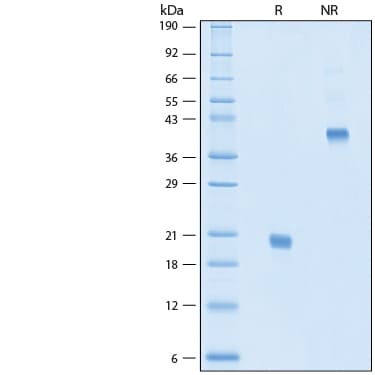
19-21 kDa, under reducing conditions.
Activity
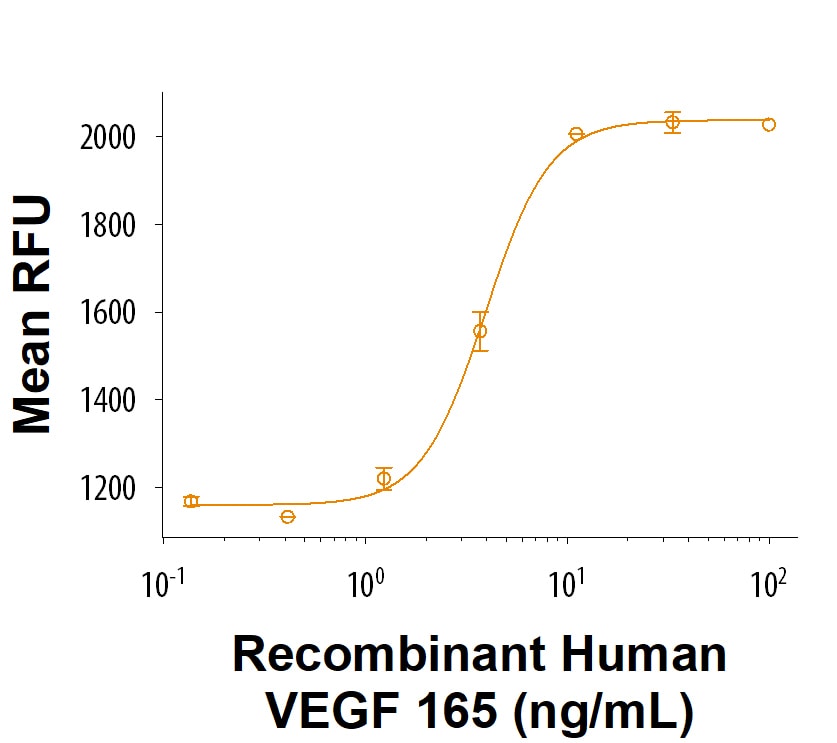
Measured in a cell proliferation assay using HUVEC human umbilical vein endothelial cells. Conn, G. et al. (1990) Proc. Natl. Acad. Sci. USA 87:1323. The
ED50 for this effect is 1.50-12.0 ng/mL.
Reviewed Applications
Read 1 review rated 4 using BT-VEGF in the following applications:
Scientific Data Images for Recombinant Human VEGF 165 Protein, CF
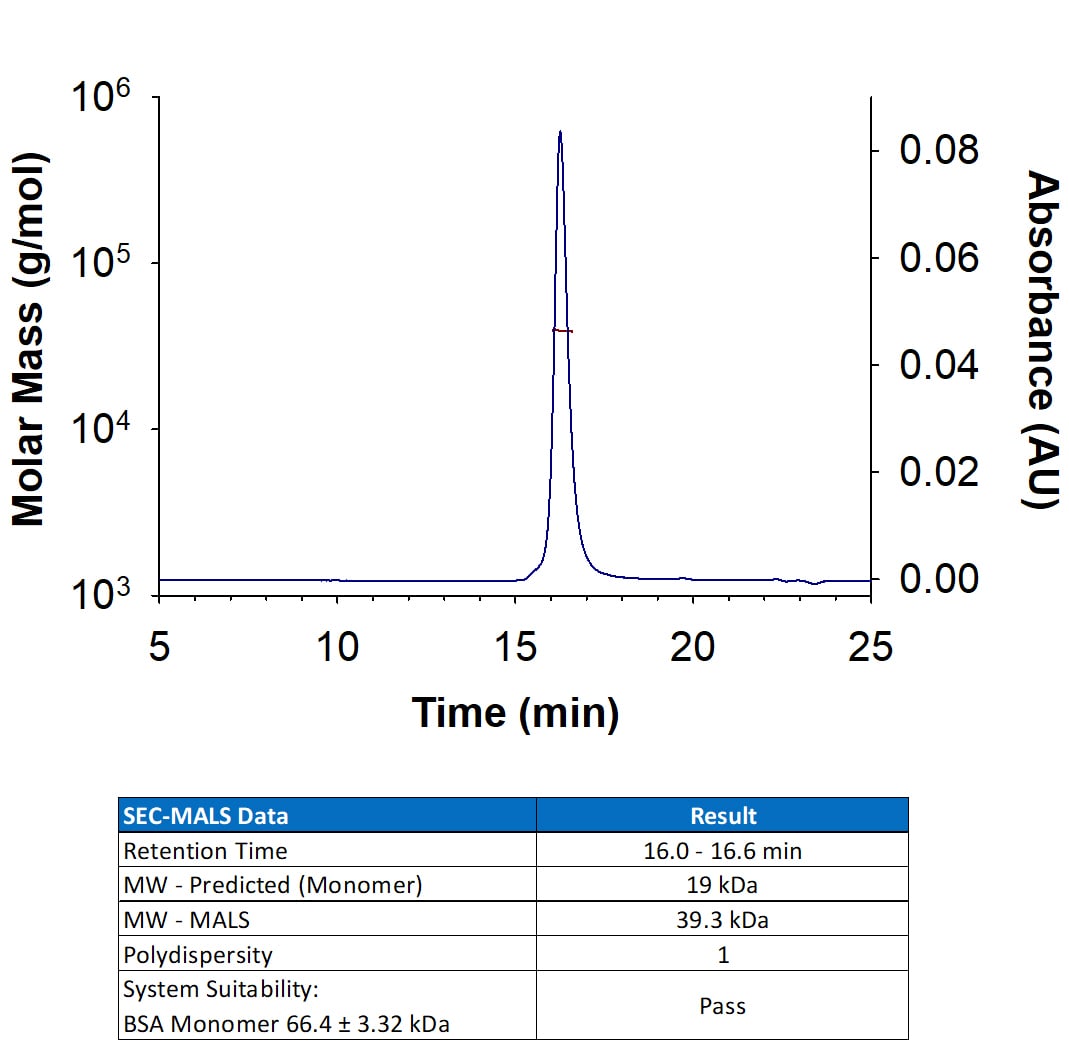
Recombinant Human VEGF 165 Protein SEC-MALS.
Recombinant Human VEGF 165 (Catalog # BT-VEGF) has a molecular weight (MW) of 39.3 kDa as analyzed by SEC-MALS in non-reducing conditions, suggesting that this protein is a disulfide-linked homodimer. MW may differ from predicted MW due to post-translational modifications (PTMs) present (i.e. Glycosylation).
Recombinant Human VEGF 165 Protein Bioactivity.
Recombinant Human VEGF 165 Protein (Catalog # BT-VEGF) stimulates proliferation in HUVEC human umbilical vein endothelial cells. The ED50 for this effect is 1.50-12.0 ng/mL.
Recombinant Human VEGF 165 Protein SDS-PAGE.
2 μg/lane of Recombinant Human VEGF 165 Protein (Catalog # BT-VEGF) was resolved with SDS-PAGE under reducing (R) and non-reducing (NR) conditions and visualized by Coomassie® Blue staining, showing bands at 19-21 kDa.
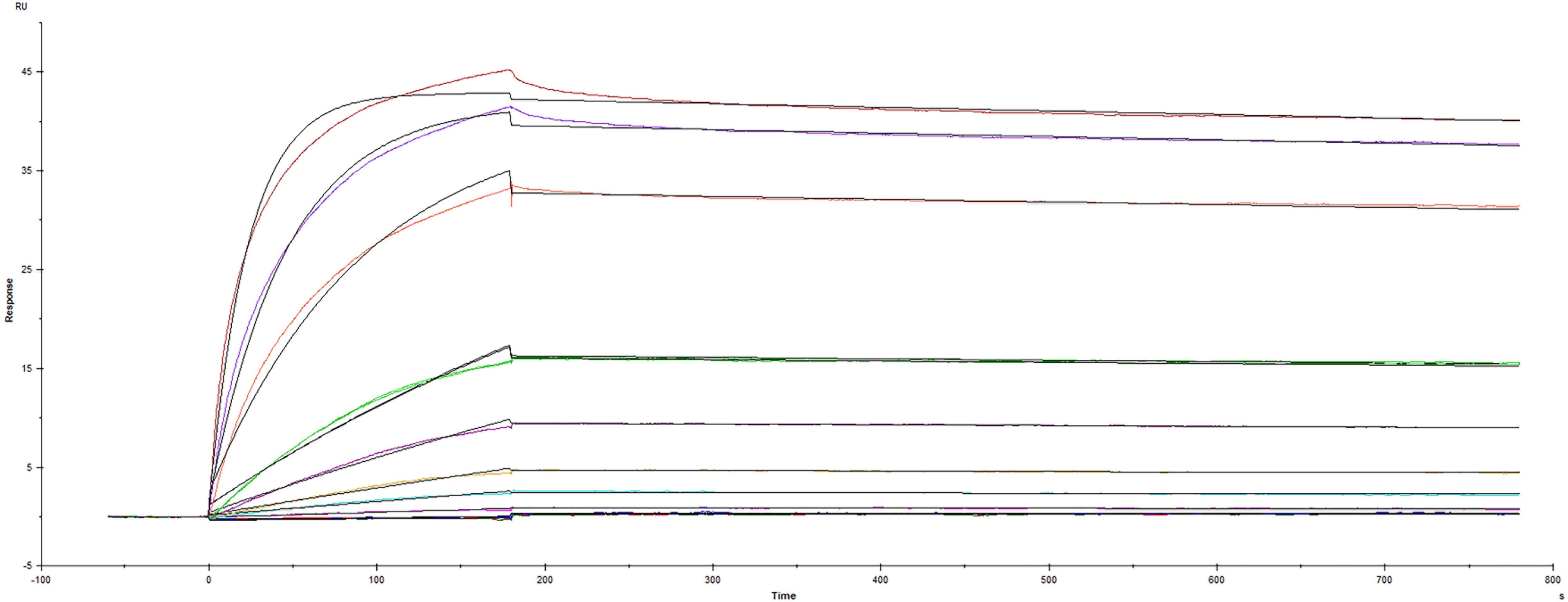
Recombinant Human VEGF 165 Protein Surface Plasmon Resonance
Recombinant Human VEGFR1/Flt-1 Fc Chimera (Catalog # 3516-FL) was captured on Biacore Sensor Chip CM5 via Recombinant Protein A/G/L (Catalog # NBP2-34985), and binding to Recombinant Human VEGF 165 (Catalog # BT-VEGF) was measured at a concentration range between 0.000488 nM and 1 nM. The double-referenced sensorgram was fit to a 1:1 binding model to determine the binding kinetics and affinity, with an affinity constant of KD=1.65 pM. (Biacore T200).
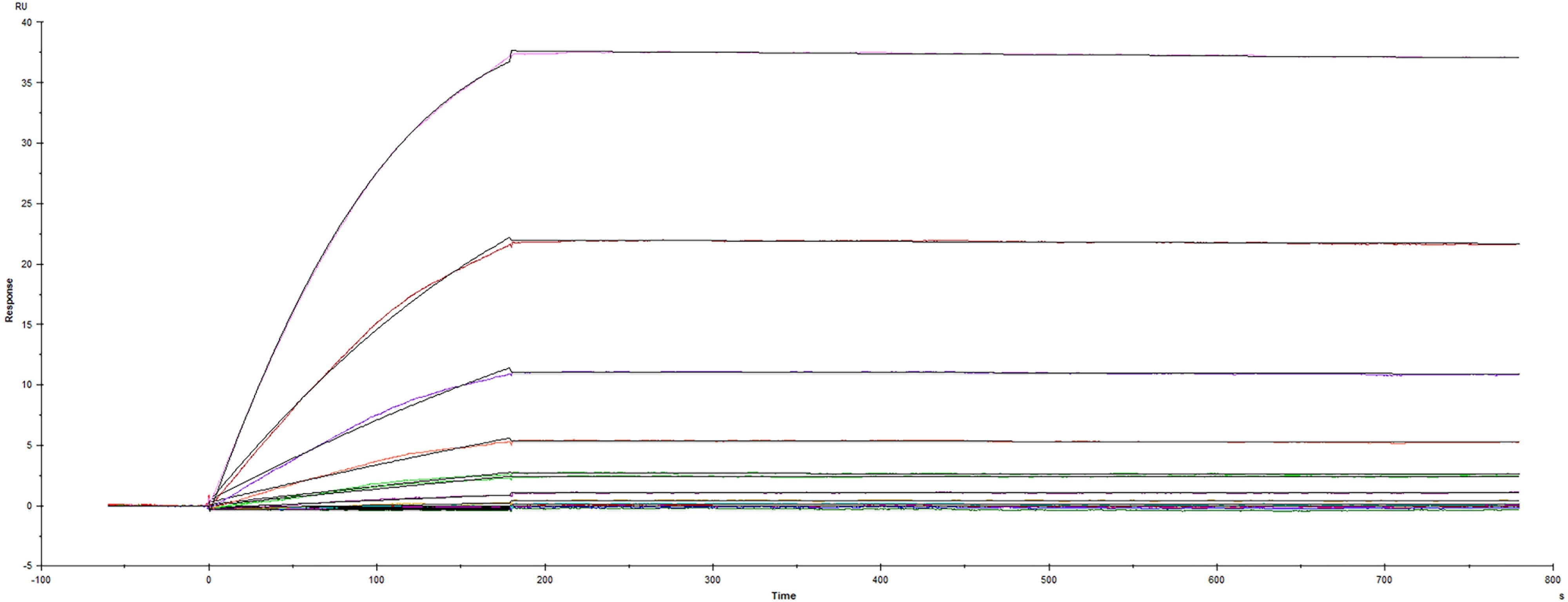
Recombinant Human VEGF 165 Protein Surface Plasmon Resonance
Recombinant Human VEGFR2/KDR/Flk-1Fc Chimera (Catalog # 357-KD) was captured on Biacore Sensor Chip CM5 via Recombinant Protein A/G/L (Catalog # NBP2-34985), and binding to Recombinant Human VEGF 165 (Catalog # BT-VEGF) was measured at a concentration range between 0.00488 nM and 10 nM. The double-referenced sensorgram was fit to a 1:1 binding model to determine the binding kinetics and affinity, with an affinity constant of KD=20.5 pM. (Biacore T200).
Lyophilized from a 0.2 μm filtered solution in Sodium Acetate.
Reconstitution
Reconstitute the 20 μg size at 200 μg/mL in sterile deionized water. Reconstitute all other sizes at 500 μg/mL in sterile deionized water.
Shipping
The product is shipped at ambient temperature. Upon receipt, store it immediately at the temperature recommended below.
Stability & Storage
Use a manual defrost freezer and avoid repeated freeze-thaw cycles.
12 months from date of receipt, -20 to -70 °C as supplied.
1 month, 2 to 8 °C under sterile conditions after reconstitution.
3 months, -20 to -70 °C under sterile conditions after reconstitution.
Calculators
Background: VEGF
Vascular endothelial growth factor (VEGF or VEGF-A), also known as vascular permeability factor (VPF), is a potent mediator of both angiogenesis and vasculogenesis in the fetus and adult (1-3). It is a member of the PDGF family that is characterized by the presence of eight conserved cysteine residues and a cystine knot structure (4). Humans express alternately spliced isoforms of 121, 145, 165, 183, 189, and 206 amino acids (aa) in length (4). VEGF165 appears to be the most abundant and potent isoform, followed by VEGF121 and VEGF189 (3, 4). Isoforms other than VEGF121 contain basic heparin-binding regions and are not freely diffusible (4). Human VEGF165 shares 88% aa sequence identity with corresponding regions of mouse and rat, 96% with porcine, 95% with canine, and 93% with feline, equine and bovine VEGF, respectively. VEGF binds the type I transmembrane receptor tyrosine kinases VEGF R1 (also called Flt-1) and VEGF R2 (Flk-1/KDR) on endothelial cells (4). Although VEGF affinity is highest for binding to VEGF R1, VEGF R2 appears to be the primary mediator of VEGF angiogenic activity (3, 4). VEGF165 binds the semaphorin receptor, Neuropilin-1 and promotes complex formation with VEGF R2 (5). VEGF is required during embryogenesis to regulate the proliferation, migration, and survival of endothelial cells (3, 4). In adults, VEGF functions mainly in wound healing and the female reproductive cycle (3). Pathologically, it is involved in tumor angiogenesis and vascular leakage (6, 7). Circulating VEGF levels correlate with disease activity in autoimmune diseases such as rheumatoid arthritis, multiple sclerosis and systemic lupus erythematosus (8). VEGF is induced by hypoxia and cytokines such as IL-1, IL-6, IL-8, oncostatin M and TNF-alpha (3, 4, 9).
Due to its role in angiogenesis of blood vessels, tumor and
stroma cells use VEGF to stimulate formation of blood vessels and the
proliferation and survival of endothelial cells. Specific immunotherapies
targeting the VEGF signaling pathway include the recombinant antibody against
VEGF (Bevacizumab), antibodies targeting the main VEGF receptor (VEGFR2), and
small molecule inhibitors against VEGF receptor tyrosine kinases (10). Immune
checkpoint inhibitors are an important tool in cancer therapies as tumor cells can
hijack immune checkpoint signals to evade detection by immune cells. In
addition to stimulating the formation of tumor blood vessels, VEGF has
immunosuppressive effects by acting on dendritic cells to block their antigen-presenting
and T cell stimulatory functions. Targeting VEGF in combination with other
immune checkpoint ligands or receptors may prove more effective in
immunotherapy approaches to certain cancer types (11). Because of its role in
the formation of blood vessels, VEGF is also an important factor in skeletal
development where blood supply and vascularization are crucial. This has made
VEGF an important molecule in regenerative studies for bone repair as sustained
release of VEGF has been shown to improve the efficiency of bone regeneration
(12).
In differentiation protocols for stems cells, VEGF is a
commonly added growth factor for the transformation of induced pluripotent stem
cells into hematopoietic progenitor cells used to make Natural Killer cells (13, 14).
VEGF has also been used to transform intermediate mesoderm into kidney glomerular
podocytes or stem cell-derived liver spheres (15, 16). VEGF may also be used in
assistance of stem cell transplantations by supporting angiogenesis at sites of
stem cell transplants or as a honing tool for adipose-derived mesenchymal stem
cells or bone marrow stem cells to migrate to (17, 18).
References
Leung, D.W. et al. (1989) Science 246:1306.
Keck, P.J. et al. (1989) Science 246:1309.
Byrne, A.M. et al. (2005) J. Cell. Mol. Med. 9:777.
Robinson, C.J. and S.E. Stringer (2001) J. Cell. Sci. 114:853.
Pan, Q. et al. (2007) J. Biol. Chem. 282:24049.
Weis, S.M. and D.A. Cheresh (2005) Nature 437:497.
Thurston, G. (2002) J. Anat. 200:575.
Carvalho, J.F. et al. (2007) J. Clin. Immunol. 27:246.
Angelo, L.S. and R. Kurzrock (2007) Clin. Cancer Res. 13:2825.
Apte, R.S. et al. (2019) Cell 176:1248.
Sangro, B. et al. (2021) Nature 18:525.
Hu, K. & Olsen, B.R. (2016) Bone 91:30.
Zhou, Y. et al. (2022) Cancers 14:2266.
Li, Y. et al. (2018) Cell Stem Cell. 23:181.
Musah, S. et al. (2018) Nat. Protoc. 13:1662.
Meseguer-Ripolles, J. et al. (2021) STAR Protoc. 2:100502.
Hutchings, G. et al. (2020) Int. J. Mol. Sci. 21:3790.
Monday, October 16, 2023
Biosimilar antibodies are becoming crucial tools in the fight against cancer, offering new hope for patients battling this deadly disease. Learn more!


 Powered by Bioz



