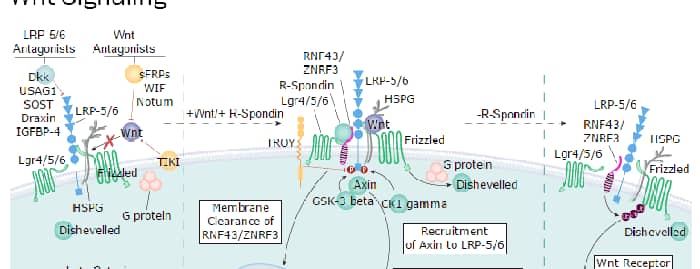
Human Wnt-7a is one of about 19 vertebrate members of the Wingless-type MMTV integration site (Wnt) family of highly conserved cysteine-rich secreted glycoproteins important for normal developmental processes (1). Wnts bind to receptors of the Frizzled family in conjunction with low-density lipoprotein receptor-related proteins (LRPs). Downstream effects of Wnt signaling occur through activation of one of three different intracellular pathways: the canonical Wnt pathway, Wnt/Ca2+ pathway, and planar cell polarity. The highly transforming Wnts, including Wnt-1, -3, -3a, -7a and -8 activate the canonical pathway, which regulates beta ‑catenin-mediated gene expression (1, 2). Human Wnt-7a is a 48 kDa secreted glycoprotein containing 24 cysteine residues that is expressed by epithelial and epithelially-derived cells of the placenta, kidney, testis, uterus, fetal lung and fetal and adult brain (3, 4). Palmitate modification of a cysteine residue has been shown for Wnt-3a; this site is conserved on all Wnts and is Cys73 on Wnt7a (5). When modified, increased hydrophobicity and activity is expected. Human Wnt-7a shows 97% aa identity with mouse, rat and dog Wnt-7a and 92% aa identity with chicken Wnt-7a. During development, Wnt7a is expressed by the dorsal ectoderm and drives expression of homeodomain transcription factors that control effectors important in patterning and cell fates in adjacent mesenchyme (6 - 10). When Wnt-7a is deleted, mice show disruption of dorsalization and anterior/posterior patterning during limb development and abnormalities in the reproductive tract (6 - 10). Wnt-7a is frequently downregulated in leukemia and lung cancers, potentially affecting homeobox (HOX) gene expression, differentiation state and growth control (11, 12). Roles for Wnt-7a have also been shown during formation of neural synapses, response of the uterus to estrogen and inflammatory cartilage destruction (10, 13, 14).
Recombinant Human Wnt-7a Protein
R&D Systems | Catalog # 3008-WN


Discontinued Product
3008-WN has been discontinued.
View all Wnt-7a products.
Key Product Details
Source
CHO
Accession Number
Applications
Bioactivity
Loading...
Product Specifications
Source
Chinese Hamster Ovary cell line, CHO-derived human Wnt-7a protein
Leu32-Lys349
Leu32-Lys349
Purity
>70%, by SDS-PAGE under reducing conditions and visualized by silver stain.
Endotoxin Level
<0.10 EU per 1 μg of the protein by the LAL method.
N-terminal Sequence Analysis
Leu32
Predicted Molecular Mass
35.5 kDa
SDS-PAGE
40-65 kDa, reducing conditions
Activity
Measured by its ability to inhibit Wnt-3a-induced alkaline phosphatase production by MC3T3‑E1 mouse preosteoblast cells.
The ED50 for this effect is 1-3 µg/mL in the presence of 5 ng/mL recombinant mouse Wnt-3a.
Optimal dilutions should be determined by each laboratory for each application.
The ED50 for this effect is 1-3 µg/mL in the presence of 5 ng/mL recombinant mouse Wnt-3a.
Optimal dilutions should be determined by each laboratory for each application.
Formulation, Preparation, and Storage
3008-WN
| Formulation | Lyophilized from a 0.2 μm filtered solution in PBS, EDTA and CHAPS with BSA as a carrier protein. |
| Reconstitution | Reconstitute at 10 μg/mL in sterile PBS containing at least 0.1% human or bovine serum albumin. |
| Shipping | The product is shipped at ambient temperature. Upon receipt, store it immediately at the temperature recommended below. |
| Stability & Storage | Use a manual defrost freezer and avoid repeated freeze-thaw cycles.
|
Calculators
Background: Wnt-7a
References
- Logan, C. Y. and R. Nusse (2004) Annu. Rev. Cell Dev. Biol. 20:781.
- Wong, G. T. et al. (1994) Mol. Cell. Biol. 14:6278.
- http://www.stanford.edu/~rnusse/wntwindow.html
- Bui, T. D. et al. (1997) Gene 189:25.
- Willert, K. et al. (2003) Nature 423:448.
- Parr, B. A. and A.P. McMahon (1995) Nature 374:350.
- Cygan, J. A. et al. (1997) Development 124:5021.
- Parr, B.A. and A.P. McMahon (1998) Nature 395:707.
- Miller, C. and D. Sassoon (1998) Development 125:3201.
- Carta, L. and D. Sassoon (2004) Biol. Reprod. 71:444.
- Calvo, R. et al. (2000) Proc. Natl. Acad. Sci. USA 97:12776.
- Winn, R.A. et al. (2005) J. Biol Chem. 280:19625.
- Hall, A.C. et al. (2000) Cell 100:525.
- Hwang, S.-G. et al. (2004) J. Biol. Chem 279:26597.
Long Name
Wingless-type MMTV Integration Site Family, Member 7a
Alternate Names
Wnt7a
Entrez Gene IDs
7476 (Human)
Gene Symbol
WNT7A
UniProt
Additional Wnt-7a Products
Product Documents for Recombinant Human Wnt-7a Protein
Certificate of Analysis
To download a Certificate of Analysis, please enter a lot or batch number in the search box below.
Note: Certificate of Analysis not available for kit components.
Product Specific Notices for Recombinant Human Wnt-7a Protein
For research use only
Related Research Areas
Citations for Recombinant Human Wnt-7a Protein
 Powered by Bioz
Customer Reviews for Recombinant Human Wnt-7a Protein
There are currently no reviews for this product. Be the first to review Recombinant Human Wnt-7a Protein and earn rewards!
Have you used Recombinant Human Wnt-7a Protein?
Submit a review and receive an Amazon gift card!
$25/€18/£15/$25CAN/¥2500 for a review with an image
$10/€7/£6/$10CAN/¥1110 for a review without an image
Submit a review
Loading...
Associated Pathways