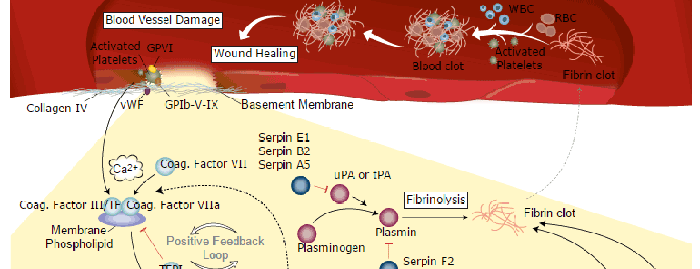
Coagulation factors XI and XIa refer to the pro and active forms of the same protease, respectively (1). Factor XI is synthesized in the liver and circulates in the plasma as a disulfide bond-linked dimer complexed with high molecular weight kininogen. Factor XI is converted into XIa via either the contact phase of blood coagulation or thrombin-mediated activation on the platelet surface. The resulting XIa converts factor IX into IXa, which subsequently activates factor X into Xa. Factor Xa in turn activates factor II/thrombin to complete the coagulation cascade. Patients with factor XI deficiency are prone to excessive bleeding after hemostatic challenge. There are two alternative splicing forms. Isoform 1 corresponds to the circulating plasma factor XI and isoform 2 is produced by platelets and megakaryocytes but absent from other blood cells (2). The 624 amino acid precursor of isoform 1 consists of a signal peptide (residues 1 to 18) and the mature chain (residues 19 to 624). The mature chain (XI) can be further processed into the heavy chain (residues 19 to 389) and the light chain (residues 390 to 624) (XIa). The purified rmFactor XI corresponds to isoform 1 (residues 19 to 624), which can be activated by treatment with thermolysin under the conditions described in the Activity Assay Protocol.
Recombinant Mouse Coagulation Factor XI Protein, CF
R&D Systems | Catalog # 4556-SE


Key Product Details
- R&D Systems NS0-derived Recombinant Mouse Coagulation Factor XI Protein (4556-SE)
- Quality control testing to verify active proteins with lot specific assays by in-house scientists
- All R&D Systems proteins are covered with a 100% guarantee
Source
Accession Number
Structure / Form
Applications
Product Specifications
Source
Glu19-Val624, with a C-terminal 10-His tag
Purity
Endotoxin Level
N-terminal Sequence Analysis
Predicted Molecular Mass
SDS-PAGE
Activity
The specific activity is >100 pmol/min/µg, as measured under the described conditions.
Formulation, Preparation, and Storage
4556-SE
| Formulation | Supplied as a 0.2 μm filtered solution in HEPES and NaCl. |
| Shipping | The product is shipped with dry ice or equivalent. Upon receipt, store it immediately at the temperature recommended below. |
| Stability & Storage | Use a manual defrost freezer and avoid repeated freeze-thaw cycles.
|
Background: Coagulation Factor XI
References
- Wash, P.N. (2004) in Handbook of Proteolytic Enzymes, Barrett, A.J. et al. eds. p. 1651.
- Hsu, T.C. et al. (1998) J. Biol. Chem. 273:13787.
Alternate Names
Gene Symbol
UniProt
Additional Coagulation Factor XI Products
Product Documents for Recombinant Mouse Coagulation Factor XI Protein, CF
Certificate of Analysis
To download a Certificate of Analysis, please enter a lot or batch number in the search box below.
Note: Certificate of Analysis not available for kit components.
Product Specific Notices for Recombinant Mouse Coagulation Factor XI Protein, CF
For research use only
Related Research Areas
Citations for Recombinant Mouse Coagulation Factor XI Protein, CF
 Powered by Bioz
Customer Reviews for Recombinant Mouse Coagulation Factor XI Protein, CF
There are currently no reviews for this product. Be the first to review Recombinant Mouse Coagulation Factor XI Protein, CF and earn rewards!
Have you used Recombinant Mouse Coagulation Factor XI Protein, CF?
Submit a review and receive an Amazon gift card!
$25/€18/£15/$25CAN/¥2500 for a review with an image
$10/€7/£6/$10CAN/¥1110 for a review without an image
Submit a review
Protocols
View specific protocols for Recombinant Mouse Coagulation Factor XI Protein, CF (4556-SE):
- Activation Buffer: 50 mM Tris, 10 mM CaCl2, 150 mM NaCl, 0.05% (w/v) Brij-35, pH 7.5 (TCNB)
- Assay Buffer: 50 mM Tris, 1 mM EDTA, pH 7.5
- Recombinant Mouse Coagulation Factor XI (rmFactor XI) (Catalog # 4556-SE)
- Bacterial Thermolysin (Thermolysin) (Catalog # 3097-ZN)
- EDTA, pH 8.0 (Sigma, Catalog # E-4884), 0.5 M stock in deionized water
- Substrate: BOC-Ile-Glu-Gly-Arg-AMC (Bachem, Catalog # I-1100), 10 mM stock in DMSO
- F16 Black Maxisorp Plate (Nunc, Catalog # 475515)
- Fluorescent Plate Reader (Model: SpectraMax Gemini EM by Molecular Devices) or equivalent
- Dilute rmFactor XI to 100 µg/mL in Activation Buffer containing 10 µg/mL of Thermolysin.
- Incubate at 37 °C for 1 hour.
- Stop reaction with EDTA at a final concentration of 40 mM.
- Dilute incubated rmFactor XI to 2 ng/µL in Assay Buffer.
- Dilute Substrate to 200 µM in Assay Buffer.
- Load 50 µL of 2 ng/µL rmFactor XI into a plate, and start the reaction by adding 50 µL of 200 µM Substrate. Include a Substrate Blank containing 50 µL Assay Buffer and 50 µL of 200 µM Substrate.
- Read at excitation and emission wavelengths of 380 nm and 460 nm (top read), respectively, in kinetic mode for 5 minutes.
- Calculate specific activity:
|
Specific Activity (pmol/min/µg) = |
Adjusted Vmax* (RFU/min) x Conversion Factor** (pmol/RFU) |
| amount of enzyme (µg) |
*Adjusted for Substrate Blank
**Derived using calibration standard 7-amino, 4-Methyl Coumarin (AMC) (Sigma, Catalog # A-9891).
Per Well:
- rmFactor XI: 0.100 µg
- Thermolysin: 0.010 µg
- Substrate: 100 µM
Associated Pathways