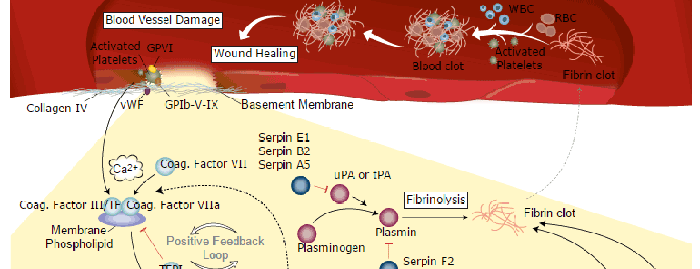
Protein C is a vitamin K-dependent serine protease synthesized in the liver as a single-chain precursor, which is then proteolytically processed to two disulfide-linked chains (1). The light chain consists of a Gla (gamma-carboxy-glutamate) domain and two EGF-like domains. The heavy chain consists of an activation peptide (aa 199‑212) and serine protease domain (aa 213‑449). Physiologically, Protein C is converted to the active form by thrombin, which releases the activation peptide. Protein C plays a key role in anticoagulation, cleaving factors VIIIa and Va to inactivate them. This anticoagulation activity can be enhanced by a presence of a cofactor such as protein S. In hereditary thrombophilia, Protein C deficiency is caused by a genetic mutation that affects Protein C activity. A severe recessive form may result in massive thrombosis fatal to patient.
Recombinant Mouse Coagulation Factor XIV/Protein C, CF
R&D Systems | Catalog # 4885-SE

Key Product Details
- R&D Systems CHO-derived Recombinant Mouse Coagulation Factor XIV/Protein C (4885-SE)
- Quality control testing to verify active proteins with lot specific assays by in-house scientists
- All R&D Systems proteins are covered with a 100% guarantee
Source
Accession Number
Structure / Form
Applications
Product Specifications
Source
Ile19-Leu460 (pro) & Ala42-Leu460 (mature), both with a C-terminal 10-His tag
Purity
Endotoxin Level
N-terminal Sequence Analysis
Predicted Molecular Mass
SDS-PAGE
Activity
The specific activity is >125 pmol/min/µg, as measured under the described conditions.
Formulation, Preparation, and Storage
4885-SE
| Formulation | Supplied as a 0.2 μm filtered solution in Sodium Acetate and NaCl. |
| Shipping | The product is shipped with polar packs. Upon receipt, store it immediately at the temperature recommended below. |
| Stability & Storage | Use a manual defrost freezer and avoid repeated freeze-thaw cycles.
|
Background: Coagulation Factor XIV/Protein C
References
- Shen, L. and Dahlbäck, B. (2004) in Handbook of Proteolytic Enzymes, Barrett, A.J. et al. eds. pp. 1673.
Long Name
Alternate Names
Gene Symbol
UniProt
Additional Coagulation Factor XIV/Protein C Products
Product Documents for Recombinant Mouse Coagulation Factor XIV/Protein C, CF
Certificate of Analysis
To download a Certificate of Analysis, please enter a lot or batch number in the search box below.
Note: Certificate of Analysis not available for kit components.
Product Specific Notices for Recombinant Mouse Coagulation Factor XIV/Protein C, CF
For research use only
Related Research Areas
Customer Reviews for Recombinant Mouse Coagulation Factor XIV/Protein C, CF
There are currently no reviews for this product. Be the first to review Recombinant Mouse Coagulation Factor XIV/Protein C, CF and earn rewards!
Have you used Recombinant Mouse Coagulation Factor XIV/Protein C, CF?
Submit a review and receive an Amazon gift card!
$25/€18/£15/$25CAN/¥2500 for a review with an image
$10/€7/£6/$10CAN/¥1110 for a review without an image
Submit a review
Protocols
View specific protocols for Recombinant Mouse Coagulation Factor XIV/Protein C, CF (4885-SE):
- Activation Buffer: 50 mM Tris, 10 mM CaCl2, 150 mM NaCl, 0.05% (w/v) Brij-35, pH 7.5 (TCNB)
- Assay Buffer: 50 mM Tris, 10 mM CaCl2, 150 mM NaCl, 0.01% (w/v) Brij-35, pH 8.5
- Recombinant Mouse Coagulation Factor XIV/Protein C (rmPROC) (Catalog # 4885-SE)
- Bacterial Thermolysin (Thermolysin) (Catalog # 3097-ZN)
- 1,10 phenanthroline (Sigma, Catalog # 320056), 0.6 M stock in DMSO
- Substrate: BOC-beta -benzyl-Asp-Pro-Arg-AMC (Bachem, Catalog # I-1560), 10 mM in DMSO
- F16 Black Maxisorp Plate (Nunc, Catalog # 475515)
- Fluorescent Plate Reader (Model: SpectraMax Gemini EM by Molecular Devices) or equivalent
- Dilute rmPROC to 200 µg/mL in Activation Buffer.
- Dilute Thermolysin to 10 µg/mL in Activation Buffer.
- Combine 25 µL of the diluted rmPROC and 25 µL of the diluted Thermolysin.
- Incubate at 37 °C for 2 hours.
- Dilute 1,10 phenanthroline to 5 mM in Assay Buffer.
- Add 200 µL of 5 mM 1,10 phenanthroline to the reaction mixtures to stop the Thermolysin activation.
- Dilute rmPROC to 2 µg/mL in Assay Buffer.
- Dilute Substrate to 200 µM in Assay Buffer.
- Load 50 µL of 2 µg/mL rmPROC into a plate, and start the reaction by adding 50 µL of 200 µM Substrate.
- Include a Substrate Blank containing 50 µL Assay Buffer and 50 µL of 200 µM Substrate.
- Read at excitation and emission wavelengths of 380 nm and 460 nm (top read), respectively, in kinetic mode for 5 minutes.
- Calculate specific activity:
|
Specific Activity (pmol/min/µg) = |
Adjusted Vmax* (RFU/min) x Conversion Factor** (pmol/RFU) |
| amount of enzyme (µg) |
*Adjusted for Substrate Blank
**Derived using calibration standard 7-Amino, 4-Methyl Coumarin (AMC) (Sigma, Catalog # A-9891).
Per Well:
- rmPROC: 0.100 µg
- Substrate: 100 µM
Associated Pathways