
CTLA-4 (cytotoxic T-lymphocyte-4, designated CD152), is a type I transmembrane T cell inhibitory molecule that is a member of the Ig superfamily (1, 2). Human or mouse CTLA-4 cDNA encodes 223 amino acids (aa) including a 35 aa signal sequence, a 126 aa extracellular domain (ECD) with one Ig-like V-type domain, a 21 aa transmembrane (TM) sequence, and a 41 aa cytoplasmic sequence. It is found as a covalent homodimer of 41 ‑ 43 kDa (2) Within the ECD, mouse CTLA-4 shares 94% and 68 ‑ 71% aa sequence identity with rat and human/porcine/bovine/rabbit/feline/canine CTLA-4, respectively. A 174 aa form that lacks TM and cytoplasmic sequences (sCTLA-4) is possibly secreted (3 ‑ 5). Isoforms of 56 ‑ 79 aa that mainly contain parts of the cytoplasmic domain are reported. In mouse, an isoform lacking the Ig-like domain has ligand-independent inhibitory activity and is termed liCTLA-4 (6). CD28, which is structurally related to CTLA-4, is constitutively expressed on naïve T cells and promotes T cell activation when engaged by B7-2 on antigen-presenting cells (APC) within the immunological synapse (IS) (1, 7, 8). In contrast, CTLA-4 is recruited from intracellular vesicles to the IS beginning 1-2 days after T cell activation (2, 7, 8). It forms a linear lattice with B7-1 on APC, inducing negative regulatory signals and ending T cell activation (9). Abatacept, a therapeutic human CTLA-4-Ig fusion protein (trade name Orencia), competes with CD28 for B7-1 and B7-2 binding and has been used to antagonize T cell activation in autoimmune conditions and to enhance transplant survival (10). Mice deleted for CTLA-4 show no abnormalities until after birth, but then develop lethal autoimmune reactions due to continued T cell activation and poor control by regulatory T cells, which constitutively express CTLA-4 in wild-type mice and humans (11 ‑ 13).
Recombinant Mouse CTLA-4 Fc Chimera Protein
R&D Systems | Catalog # 434-CT

Key Product Details
- Recombinant Mouse CTLA-4 Protein supports immune checkpoint inhibitor development by enabling ligand interaction and blocking assays. Suitable for antibody screening and T cell activation studies, this protein is widely used in immuno-oncology therapeutic research.
- R&D Systems NS0-derived Recombinant Mouse CTLA-4 Fc Chimera Protein (434-CT)
- Quality control testing to verify active proteins with lot specific assays by in-house scientists
- All R&D Systems proteins are covered with a 100% guarantee
Source
Accession Number
Structure / Form
Applications
Product Specifications
Source
| Mouse CTLA-4 (Ala37-Phe162) Accession #Q6GTR6 |
IEGRMD | Human IgG1 (Pro100-Lys330) |
6-His tag |
| N-terminus | C-terminus | ||
Purity
Endotoxin Level
N-terminal Sequence Analysis
Predicted Molecular Mass
SDS-PAGE
Activity
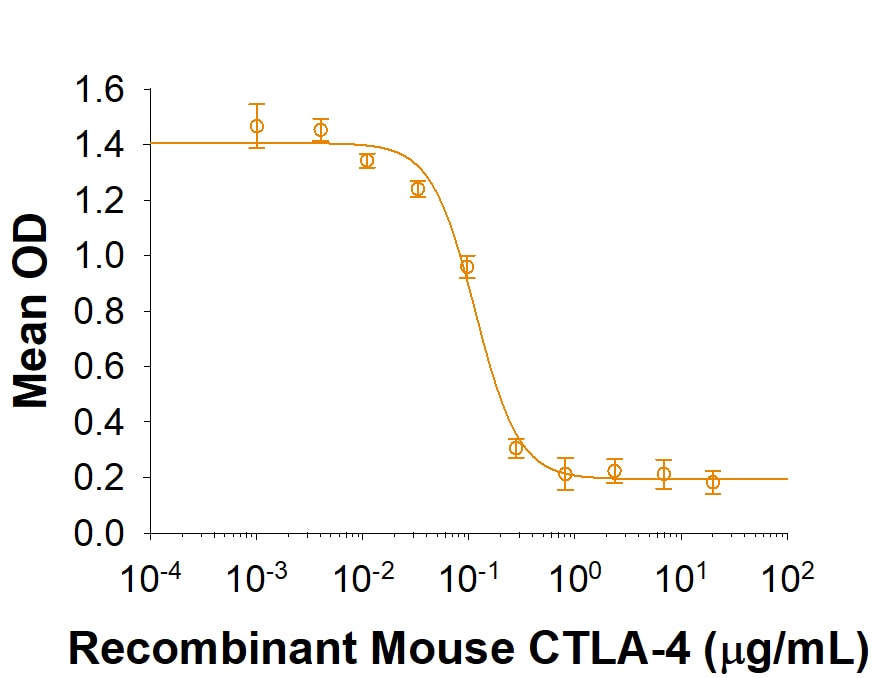
The ED50 for this effect is 0.1-0.4 µg/mL when stimulated with 1 µg/mL Recombinant Human B7‑1/CD80 Fc Chimera (Catalog # 140-B1) in the presence of PHA.
Reviewed Applications
Read 1 review rated 5 using 434-CT in the following applications:
Scientific Data Images for Recombinant Mouse CTLA-4 Fc Chimera Protein
Recombinant Mouse CTLA-4 Fc Chimera Protein Bioactivity
Recombinant Mouse CTLA-4 Fc Chimera inhibits IL-2 secretion by stimulated Jurkat human acute T cell leukemia cells. The ED50 for this effect is 0.03-0.15 µg/mL when stimulated with 1 µg/mL Recombinant Human B7-1/CD80 Fc Chimera (Catalog # 140-B1).Formulation, Preparation, and Storage
Carrier Free
What does CF mean?CF stands for Carrier Free (CF). We typically add Bovine Serum Albumin (BSA) as a carrier protein to our recombinant proteins. Adding a carrier protein enhances protein stability, increases shelf-life, and allows the recombinant protein to be stored at a more dilute concentration. The carrier free version does not contain BSA.
What formulation is right for me?In general, we advise purchasing the recombinant protein with BSA for use in cell or tissue culture, or as an ELISA standard. In contrast, the carrier free protein is recommended for applications, in which the presence of BSA could interfere.
Carrier: 434-CT
| Formulation | Lyophilized from a 0.2 μm filtered solution in PBS with BSA as a carrier protein. |
| Reconstitution | Reconstitute at 200 μg/mL in sterile PBS containing at least 0.1% human or bovine serum albumin. |
| Shipping | The product is shipped at ambient temperature. Upon receipt, store it immediately at the temperature recommended below. |
| Stability & Storage | Use a manual defrost freezer and avoid repeated freeze-thaw cycles.
|
Carrier Free: 434-CT/CF
| Formulation | Lyophilized from a 0.2 μm filtered solution in PBS. |
| Reconstitution | Reconstitute at 200 μg/mL in sterile PBS. |
| Shipping | The product is shipped at ambient temperature. Upon receipt, store it immediately at the temperature recommended below. |
| Stability & Storage | Use a manual defrost freezer and avoid repeated freeze-thaw cycles.
|
Calculators
Background: CTLA-4
References
- Harper, K. et al. (1991) J. Immunol. 147:1037.
- Teft, W.A. et al. (2006) Annu. Rev. Immunol. 24:65.
- Magistrelli, G. et al. (1999) Eur. J. Immunol. 29:3596.
- Tector, M. et al. (2009) BMC Immunol. 10:51.
- Oaks, M.K. and K.M. Hallett (2000) J. Immunol. 164:5015.
- Vijayakrishnan, L. et al. (2004) Immunity 20:563.
- Pentcheva-Hoang, T. et al. (2004) Immunity 21:401.
- Jansson, A. et al. (2005) J. Immunol 175:1575.
- Darlington, P.J. et al. (2005) J. Immunol. 175:996.
- Platt, A.M. et al. (2010) J. Immunol. 185:1558.
- Wing, K. et al. (2008) Science 322:271.
- Friedline, R.H. et al. (2009) J. Exp. Med. 206:421.
- Jain, N. et al. (2010) Proc. Natl. Acad. Sci. USA 107:1524.
Long Name
Alternate Names
Gene Symbol
UniProt
Additional CTLA-4 Products
Product Documents for Recombinant Mouse CTLA-4 Fc Chimera Protein
Certificate of Analysis
To download a Certificate of Analysis, please enter a lot or batch number in the search box below.
Note: Certificate of Analysis not available for kit components.
Product Specific Notices for Recombinant Mouse CTLA-4 Fc Chimera Protein
For research use only
Citations for Recombinant Mouse CTLA-4 Fc Chimera Protein
 Powered by Bioz
Customer Reviews for Recombinant Mouse CTLA-4 Fc Chimera Protein (1)
Have you used Recombinant Mouse CTLA-4 Fc Chimera Protein?
Submit a review and receive an Amazon gift card!
$25/€18/£15/$25CAN/¥2500 for a review with an image
$10/€7/£6/$10CAN/¥1110 for a review without an image
Submit a review
-
Application: Binding assay/Protein-protein interactionVerified Customer | Posted 03/24/2018
There are no reviews that match your criteria.
FAQs for Recombinant Mouse CTLA-4 Fc Chimera Protein
-
Q: Can Recombinant Mouse CTLA-4 Fc Chimera Protein (Catalog # 434-CT) be used with human cell lines or any other species?
A:
The activity of Recombinant Mouse CTLA-4 Fc Chimera Protein (Catalog # 434-CT) is measured by its ability to inhibit IL-2 secretion by stimulated Jurkat human acute T cell leukemia cells. The ED50 for this effect is 0.1-0.4 µg/mL when stimulated with 1 µg/mL Recombinant Human B7‑1/CD80 Fc Chimera (Catalog # 140-B1) in the presence of PHA. The product shows activity on the human Jurkat cell line. For human assay systems, please also consider Recombinant Human CTLA-4 Fc Chimera His-tag Protein (Catalog # 325-CT) or Recombinant Human CTLA-4 Fc Chimera (Catalog #7268-CT). Please refer the Citations tab to find publications reporting the use of the protein on other species. Filter the results based on species and sample type for a more relevant search to your target species.