
Fas Ligand (FasL), also known as CD178, CD95L, or TNFSF6, is a 40 kDa type II transmembrane member of the TNF superfamily of proteins. Its ability to induce apoptosis in target cells plays an important role in the development, homeostasis, and function of the immune system (1). Mature mouse Fas Ligand consists of a 179 amino acid (aa) extracellular domain (ECD), a 22 aa transmembrane segment, and a 78 aa cytoplasmic domain (2). Within the ECD, mouse Fas Ligand shares 81% and 93% aa sequence identity with human and rat Fas Ligand, respectively. Alternate splicing generates a 16 kDa isoform that corresponds to the C-terminal 69 amino acids of the ECD (3). Both mouse and human Fas Ligand are active on mouse and human cells (4, 5). Fas Ligand is expressed as a nondisulfide-linked homotrimer on activated CD4+ Th1 cells, CD8+ cytotoxic T cells, and NK cells (1). Fas Ligand binding to Fas/CD95 on an adjacent cell triggers apoptosis in the Fas‑expressing cell (2, 4). Fas Ligand also binds DcR3 which is a soluble decoy receptor that interferes with Fas Ligand-induced apoptosis (6). Fas Ligand can be released from the cell surface by metalloproteinases as a 26 kDa soluble molecule which remains trimeric (7, 8). Shed Fas Ligand retains the ability to bind Fas, although its ability to trigger apoptosis is dramatically reduced (7, 8). In the absence of TGF‑ beta, however, Fas Ligand/Fas interactions instead promote neutrophil-mediated inflammatory responses (5, 9). Fas Ligand itself transmits reverse signals that costimulate the proliferation of freshly antigen-stimulated T cells (10). Fas Ligand‑induced apoptosis plays a central role in the development of immune tolerance and the maintance of immune privileged sites (11). This function is exploited by tumor cells which evade immune surveillance by upregulating Fas Ligand to kill tumor infiltrating lymphocytes (9, 12). In gld mice, a Fas Ligand point mutation is the cause of severe lymphoproliferation and systemic autoimmunity (13, 14).
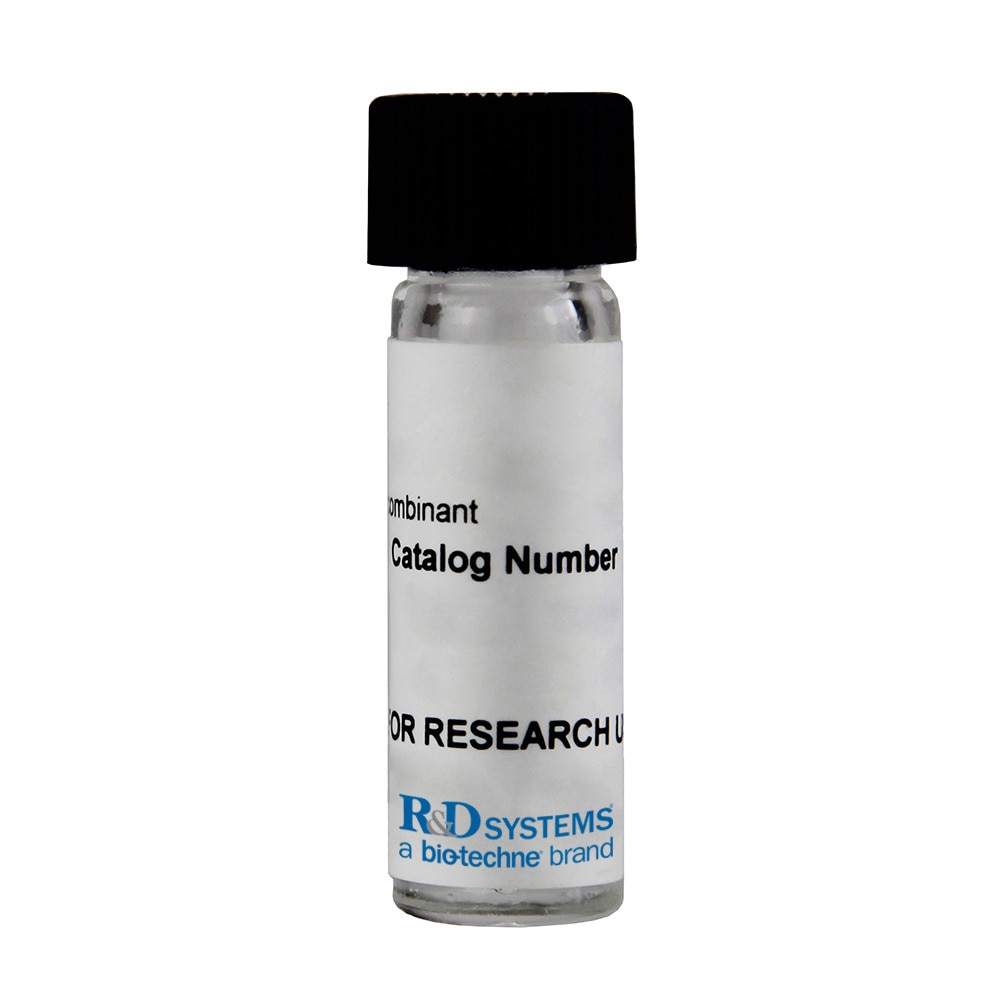
Recombinant Mouse Fas Ligand/TNFSF6 Protein
R&D Systems | Catalog # 6128-SA

Key Product Details
- R&D Systems CHO-derived Recombinant Mouse Fas Ligand/TNFSF6 Protein (6128-SA)
- Quality control testing to verify active proteins with lot specific assays by in-house scientists
- All R&D Systems proteins are covered with a 100% guarantee
Source
Accession Number
Applications
Product Specifications
Source
| Hemagglutinin Tag (YPYDVPDYA) |
GCN4-IZ |
(GGGS)3 | Mouse Fas Ligand (Gln101-Leu279) Accession # P41047 |
| N-terminus | C-terminus | ||
Purity
Endotoxin Level
N-terminal Sequence Analysis
Predicted Molecular Mass
SDS-PAGE
Activity
The ED50 for this effect is 1-8 ng/mL in the presence of 2.5 µg/mL of a cross-linking antibody, Mouse Anti-Hemagglutinin/HA Peptide Monoclonal Antibody (Catalog # MAB060).
Reviewed Applications
Read 1 review rated 5 using 6128-SA in the following applications:
Formulation, Preparation, and Storage
Carrier Free
What does CF mean?CF stands for Carrier Free (CF). We typically add Bovine Serum Albumin (BSA) as a carrier protein to our recombinant proteins. Adding a carrier protein enhances protein stability, increases shelf-life, and allows the recombinant protein to be stored at a more dilute concentration. The carrier free version does not contain BSA.
What formulation is right for me?In general, we advise purchasing the recombinant protein with BSA for use in cell or tissue culture, or as an ELISA standard. In contrast, the carrier free protein is recommended for applications, in which the presence of BSA could interfere.
Carrier: 6128-SA
| Formulation | Lyophilized from a 0.2 μm filtered solution in PBS with BSA as a carrier protein. |
| Reconstitution | Reconstitute at 100 μg/mL in PBS containing at least 0.1% human or bovine serum albumin. |
| Shipping | The product is shipped at ambient temperature. Upon receipt, store it immediately at the temperature recommended below. |
| Stability & Storage | Use a manual defrost freezer and avoid repeated freeze-thaw cycles.
|
Carrier Free: 6128-SA/CF
| Formulation | Lyophilized from a 0.2 μm filtered solution in PBS. |
| Reconstitution | Reconstitute at 100 μg/mL in PBS. |
| Shipping | The product is shipped at ambient temperature. Upon receipt, store it immediately at the temperature recommended below. |
| Stability & Storage | Use a manual defrost freezer and avoid repeated freeze-thaw cycles.
|
Calculators
Background: Fas Ligand/TNFSF6
References
- Lettau, M. et al. (2008) Curr. Med. Chem. 15:1684.
- Suda, T. et al. (1993) Cell 75:1169.
- Ayroldi, E. et al. (1999) Blood 94:3456.
- Takahashi, T. et al. (1994) Int. Immunol. 6:1567.
- Seino, K-I. et al. (1998) J. Immunol. 161:4484.
- Pitti, R.M. et al. (1998) Nature 396:699.
- Schneider, P. et al. (1998) J. Exp. Med. 187:1205.
- Tanaka, M. et al. (1998) Nature Med. 4:31.
- Chen, J.-J. et al. (1998) Science 282:1714.
- Suzuki, I. and P.J. Fink (2000) Proc. Natl. Acad. Sci. 97:1707.
- Ferguson, T.A. and T.S. Griffith (2006) Immunol. Rev. 213:228.
- Ryan, A.E. et al. (2005) Cancer Res. 65:9817.
- Takahashi, T. et al. (1994) Cell 76:969.
- Lynch, D.H. et al. (1994) Immunity 1:131.
Alternate Names
Gene Symbol
UniProt
Additional Fas Ligand/TNFSF6 Products
Product Documents for Recombinant Mouse Fas Ligand/TNFSF6 Protein
Certificate of Analysis
To download a Certificate of Analysis, please enter a lot or batch number in the search box below.
Note: Certificate of Analysis not available for kit components.
Product Specific Notices for Recombinant Mouse Fas Ligand/TNFSF6 Protein
For research use only
Citations for Recombinant Mouse Fas Ligand/TNFSF6 Protein
 Powered by Bioz
Customer Reviews for Recombinant Mouse Fas Ligand/TNFSF6 Protein (1)
Have you used Recombinant Mouse Fas Ligand/TNFSF6 Protein?
Submit a review and receive an Amazon gift card!
$25/€18/£15/$25CAN/¥2500 for a review with an image
$10/€7/£6/$10CAN/¥1110 for a review without an image
Submit a review
Customer Images
-
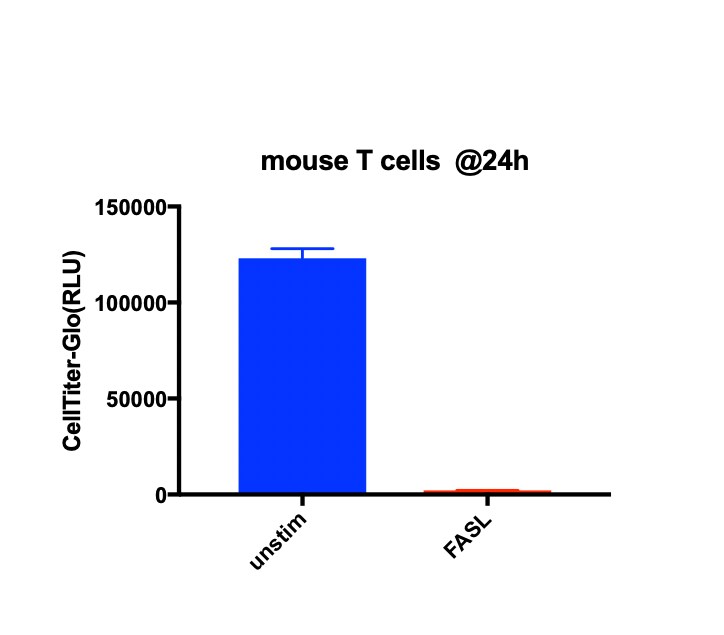
Application: Apoptosis assayVerified Customer | Posted 12/16/2019

There are no reviews that match your criteria.
FAQs for Recombinant Mouse Fas Ligand/TNFSF6 Protein
-
Q: Is the Recombinant Mouse Fas Ligand/TNFSF6 Protein (Catalog # 6128-SA) a trimer in solution?
A: We expect the 6128-SA protein to be a trimer in solution. This protein contains a trimerization domain and amino acids 101-279 of the FasL protein. This extra region of FasL, in combination with the trimerization domain, allows for more stable formation of the homotrimer and increased activity.
Associated Pathways


