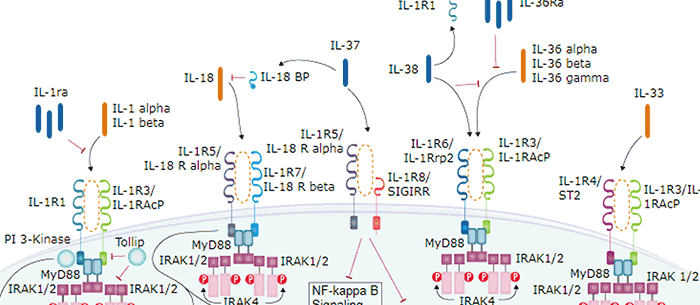
Interleukin 1 alpha (IL-1 alpha ), IL-1 beta, and IL-1 receptor antagonist (IL-1ra) are members of the IL-1 family. IL-1 alpha and IL-1 beta are agonists that bind the functional IL-1 receptor I (IL-1 RI), which then recruits the IL-1 receptor accessory protein (IL-1 R AcP/IL-1 R3) and initiates signal transduction pathways that include the NF-kappa B. JNK/AP-1, and p38 MAP kinase pathways. Both IL-1 alpha and IL-1 beta also bind the non‑signaling IL-1 RII that functions as a decoy receptor. IL-1ra is a receptor antagonist that binds both IL-1 RI and II with equal affinity as the IL-1 alpha and beta. Binding of IL-1ra to IL-1 RI does not initiate signal transduction pathways. IL-1 alpha and beta are pro‑inflammatory cytokines that play an important role in host defense. The imbalance between IL-1 ( alpha and beta ) and IL-1ra can influence the development of various pathologic conditions associated with chronic inflammation and tissue destruction. Pre‑clinical and clinical studies have indicated that IL-1ra may have therapeutic potential for the treatment of sepsis, rheumatoid arthritis and chronic myelogenous leukemia (1, 2).
Rat IL-1ra cDNA encodes a 178 amino acid (aa) residues secreted protein with a 26 aa signal peptide. Although intracellular isoforms of human IL-1ra that are transcribed from the same gene using different promotors have been described, analogous rat isoforms have not been reported. Rat IL-1ra shares 89% and 73% aa sequence homology with mouse and human IL-1ra, respectively. Secreted IL-1ra has been shown to be expressed by monocytes, macrophages, neutrophils, fibroblasts and hepatocytes (1, 2).
 Powered by Bioz