
IL-1 Family Signaling Pathways
IL-1 beta
IL-36 beta
IL-36 gamma
IL-1RAcP
IL-18 R alpha
IL-18 R beta
IL-18 R alpha
SIGIRR
IL-1R1
IL-1Rrp2
IL-1RAcP
ST2
Signaling
Signaling
Signaling
Signaling
(Inactive)
(Inactive)
(Inactive)
Proliferation
Homodimer
Factor
MAP3K3
Response
(Inactive)
(Inactive)
Proliferation
IL-1 beta
IL-1RAcP
IL-1 beta
SIGIRR
IL-1 beta
IL-1R3/IL-1RAcP
IL-1 beta
IL-1RAcP
IL-1 beta
IL-1 beta
IL-18 R alpha
IL-18 R alpha
IL-18 R beta
IL-36 beta
IL-36 gamma
IL-1RAcP
IL-1Rrp2
IL-18 R beta
IL-1 Inhibitors
IL-1raAn IL-1 family cytokine that acts as an IL-1 receptor antagonist by preventing IL-1 alpha or IL-1 beta from binding to IL-1 RI; Binding of IL-1ra to IL-1 RI inhibits recruitment of IL-1R3/IL-1RAcP and downstream signaling
IL-1R2/IL-1RII
An IL-1 decoy receptor with a short cytoplasmic domain that is incapable of transducing an IL-1 signal; May also be capable of binding to pro-IL-1 alpha intracellularly and inhibiting its maturation
IL-1R8/SIGIRR
Single immunoglobulin domain containing IL-1 receptor-related (SIGIRR) molecule; A subtype of the IL-1R family that contains a single extracellular immunoglobulin-like domain and may inhibit signaling by IL-1 family cytokines in a context-dependent manner by competing with activated receptor complexes for association with intracellular regulators of IL-1 family signaling such as MyD88, IRAK, or TRAF-6; Also suggested to act as a co-receptor for IL-37-mediated anti-inflammatory signaling
Soluble IL-1R3/IL-1RAcP
A soluble receptor that can bind to IL-1 - IL-1R1 but is incapable of propagating a signal; Enhances IL-1 binding to soluble IL-1R2/IL-1RII
Soluble IL-1R1/IL-1RI or IL-1R2/IL-1RII
Soluble receptors that can bind to IL-1 and IL-1R3/IL-1RAcP, but are incapable of propagating a signal
IL-1 Inhibitor
IL-1raAn IL-1 family cytokine that acts as an IL-1 receptor antagonist by preventing IL-1 alpha or IL-1 beta from binding to IL-1R1; Binding of IL-1ra to IL-1R1 inhibits recruitment of IL-1R3/IL-1RAcP and downstream signaling
IL-18 Inhibitors
Soluble IL-1R5/IL-18 R alphaA soluble receptor that can bind to IL-18 but is incapable of propagating a signal; A weak inhibitor compared to IL-18 BP
IL-1R8/SIGIRR
Single immunoglobulin domain containing IL-1 receptor-related (SIGIRR) molecule; A subtype of the IL-1 R family that contains a single extracellular immunoglobulin-like domain and may inhibit signaling by IL-1 family cytokines in a context-dependent manner by competing with activated receptor complexes for association with intracellular regulators of IL-1 family signaling such as MyD88, IRAK, or TRAF-6; Also suggested to act as a co-receptor for IL-37-mediated anti-inflammatory signaling
IL-18 BP
IL-18 binding protein (IL-18 BP); A soluble protein with a single immunoglobulin-like domain that binds to IL-18 with higher affinity than either the cell bound or soluble forms of IL-18 R and prevents
IL-18 signaling
IL-37
Both the precursor and mature forms of the longest isoform of IL-37, IL-37b, are secreted and bind to IL-18 BP, enhancing its ability to inhibit IL-18 activity; IL-37-IL-18 BP-IL-1R7/IL-18 R beta have also been suggested to form an inactive tripartite complex that prevents the formation of an active
IL-18 receptor complex; Pro- and mature IL-37b also bind to IL-1R5/IL-18 R alpha but do not act as direct agonists or antagonists of the IL-18 receptor complex
IL-33 Inhibitors
IL-1R8/SIGIRRSingle immunoglobulin domain containing IL-1 receptor-related (SIGIRR) molecule; A subtype of the IL-1R family that contains a single extracellular immunoglobulin-like domain and may inhibit signaling by IL-1 family cytokines in a context-dependent manner by competing with activated receptor complexes for association with intracellular regulators of IL-1 family signaling such as MyD88, IRAK, or TRAF-6; Also suggested to act as a co-receptor for IL-37-mediated anti-inflammatory signaling
Soluble IL-1R4/ST2
A soluble receptor that can bind to IL-33 but is incapable of propagating a signal
IL-36 Inhibitors
IL-36RaAn IL-1 family cytokine that acts as a partial IL-36 receptor antagonist by preventing IL-36 alpha, IL-36 beta, or IL-36 gamma from binding to IL-1R6/IL-1Rrp2 at low concentrations; Binding of IL-36Ra to IL-1R6/IL-1Rrp2 inhibits recruitment of IL-1R3/IL-1RAcP and downstream signaling
IL-38
Similar to IL-36Ra, IL-38 binds to IL-1R6/IL-1Rrp2 and prevents IL-36 alpha, IL-36 beta, or IL-36 gamma from binding to its receptor; Binding of IL-38 to IL-1R6/IL-1Rrp2 inhibits recruitment of IL-1R3/IL-1RAcp and downstream signaling; Due to its activity as a partial IL-1R6/IL-1Rrp2 receptor antagonist, IL-38 has anti-inflammatory effects although it has been suggested that it may act as an agonist at higher concentrations
IL-1R8/SIGIRR
Single immunoglobulin domain containing IL-1 receptor-related (SIGIRR) molecule; A subtype of the IL-1R family that contains a single extracellular immunoglobulin-like domain and may inhibit signaling by IL-1 family cytokines in a context-dependent manner by competing with activated receptor complexes for association with intracellular regulators of IL-1 family signaling such as MyD88, IRAK, or TRAF-6; Also suggested to act as a co-receptor for IL-37-mediated anti-inflammatory signaling
IL-36 Inhibitor
IL-36RaAn IL-1 family cytokine that acts as a partial IL-36 receptor antagonist by preventing IL-36 alpha, IL-36 beta, or IL-36 gamma from binding to IL-1R6/IL-1Rrp2 at low concentrations; Binding of IL-36Ra to IL-1R6/IL-1Rrp2 inhibits recruitment of IL-1R3/IL-1RAcP and downstream signaling
Effects of IL-37
• Five different splice variants of IL-37 (IL-37a-e) have been identified• IL-37b is the longest isoform, the most abundant, and the most extensively studied to date
• IL-37b is expressed at low levels in human cells and tissues but is upregulated by inflammatory stimuli
• Following Caspase-1-mediated cleavage, IL-37b translocates to the nucleus, where it suppresses the expression of pro-inflammatory genes
• Both the precursor and mature forms of IL-37b are also secreted and bind to IL-18 BP, enhancing its ability to inhibit IL-18 activity
• IL-37-IL-18 BP-IL-1R7/IL-18 R beta have been suggested to form an inactive tripartite complex that prevents the formation of an active IL-18 receptor complex
• Pro- and mature IL-37b also bind to IL-1R5/IL-18 R alpha but do not act as direct agonists or antagonists of the IL-18 receptor complex; Rather, the IL-37-IL-1R5 complex recruits IL-1R8/SIGIRR as a co-receptor, and this tripartite complex inhibits the kinase signaling pathways required for the production of pro-inflammatory mediators and activates anti-inflammatory signaling pathways
• A mouse homologue of human IL-37 has not been identified
Effects of IL-38
• Similar to IL-36Ra, IL-38 binds to IL-1R6/IL-1Rrp2 and prevents IL-36 alpha, IL-36 beta, or IL-36 gamma from binding to its receptor• Binding of IL-38 to IL-1R6/IL-1Rrp2 inhibits recruitment of IL-1R3/IL-1RAcp and downstream signaling
• Due to its activity as a partial IL-1R6/IL-1Rrp2 receptor antagonist, IL-38 has anti-inflammatory effects, although it has been suggested that it may act as an agonist at higher concentrations

Featured Literature
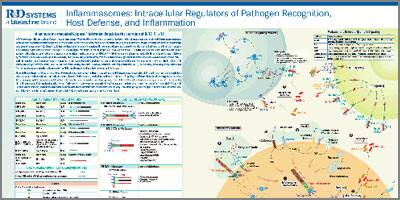
Inflammasomes: Intracellular Regulators of Pathogen Recognition, Host Defense, and Inflammation Poster

Overview of the IL-1 Family Signaling Pathway
The IL-1 cytokine family consists of eleven members that play important roles in regulating inflammation. Members include IL-1 alpha, IL-1 beta, IL-1ra, IL-18, IL-33, IL-36Ra, IL-36 alpha, IL-36 beta, IL-36 gamma, IL-37, and IL-38. While most of these cytokines are biologically active as full-length molecules, activation and secretion of IL-1 beta and IL-18 requires inflammasome/Caspase-1-dependent processing. Other IL-1 family cytokines do not require Caspase-1 cleavage for activation but may undergo some form of protease processing since more potent forms of many of these cytokines can be generated by trimming amino acids at their N-terminal ends.
IL-1 family cytokines mediate their effects by binding to a primary IL-1 family receptor subunit, such as IL-1 RI, IL-18 R alpha, IL-1 Rrp2, or ST2, which subsequently recruits an accessory receptor, IL-1 RAcP or IL-18 R beta, to activate downstream signaling. IL-1 alpha, IL-1 beta, IL-18, IL-33, IL-36 alpha, IL-36 beta, and IL-36 gamma trigger intracellular signaling cascades that induce the NF-kappa B- and AP-1-dependent expression of pro-inflammatory cytokines, chemokines, and secondary mediators of the inflammatory response. In addition, unprocessed forms of IL-1 alpha and IL-33 and the mature form of IL-37b can translocate to the nucleus where they may act as transcriptional regulators. In contrast to the pro-inflammatory members of the IL-1 family, IL-1ra, IL-36Ra, IL-37, and IL-38 have anti-inflammatory effects. IL-1ra antagonizes IL-1 activity by binding to IL-1 RI. This prevents IL-1 alpha and IL-1 beta from interacting with their primary receptor subunit and inhibits recruitment of IL-1 RAcP. Similarly, IL-36Ra binds to IL-1 Rrp2 and inhibits IL-36 signaling. Less is known about IL-37 and IL-38, but both have also been suggested to have anti-inflammatory effects. Five splice variants of IL-37 (IL-37a-e) exist with four containing a putative Caspase-1 cleavage site. Both the immature and mature forms of the longest isoform, IL-37b, bind to IL-18 binding protein (IL-18 BP) and enhance its ability to inhibit IL-18 activity. IL-38 binds to the IL-36 receptor, IL-1 Rrp2, and soluble IL-1 RI. Initial data suggests that the interaction between IL-38 and IL-1 Rrp2 has anti-inflammatory effects similar to those induced by IL-36Ra.
In addition to IL-1ra and IL-36Ra, the pro-inflammatory effects of IL-1, IL-18, IL-33, and IL-36 are regulated by several other endogenous inhibitors. IL-I RII is an IL-1 family receptor that, unlike other receptors in this family, lacks a TIR domain. It can bind to IL-1 alpha and IL-1 beta and recruit IL-1 RAcP, but it is incapable of transducing a signal. As a result, it acts as an IL-1 decoy receptor. Soluble IL-1 RI and IL-I RII can also bind to IL-1 alpha and IL-1 beta and recruit IL-1 RAcP but cannot activate intracellular signaling. Similarly, soluble ST-2/IL-1 R4 and soluble IL-18 R alpha have been shown to negatively regulate IL-33 and IL-18 signaling, respectively. IL-18 signaling is also regulated by IL-18 BP. IL-18 BP is a soluble protein that binds to IL-18 with higher affinity than either the cell-bound or soluble forms of IL-18 R and prevents IL-18 signaling. Single immunoglobulin domain containing IL-1 receptor-related (SIGIRR) molecule is another potential endogenous inhibitor of IL-1, IL-18, IL-33, and IL-36 signaling. SIGIRR is a transmembrane protein with one extracellular Ig-like domain that has been shown to bind to several IL-1 family cytokines and inhibit signaling in a context-dependent manner.
To learn more, please visit our IL-1 Family Research Area.
| IL-1 Family Cytokines - Products by Molecule | |||||
| IL-1 alpha/IL-1F1 | IL-1 beta/IL-1F2 | IL-1ra/IL-1F3 | IL-18/IL-1F4 | IL-33 | IL-36 alpha/IL-1F6 |
| IL-36 beta/IL-1F8 | IL-36 gamma/IL-1F9 | IL-36Ra/IL-1F5 | IL-37/IL-1F7 | IL-37b/IL-1F7b | IL-38/IL-1F10 |
| IL-1 Family Receptors - Products by Molecule | |||||
| IL-1 RI | IL-1 RII | IL-1 RAcP/IL-1 R3 | IL-18 R alpha/IL-1 R5 | IL-18 R beta/IL-1 R7 | IL-1 Rrp2/IL-1 R6 |
| IL-1 RAPL1/TIGIRR2 | IL-1 RAPL2/TIGIRR1 | SIGIRR | ST2/IL-33 R | TMED1 | |
