
SARS-CoV-2, which causes the global pandemic coronavirus disease 2019 (Covid-19), belongs to a family of viruses known as coronaviruses that also include MERS-CoV and SARS-CoV-1. Coronaviruses are commonly comprised of four structural proteins: Spike protein (S), Envelope protein (E), Membrane protein (M) and Nucleocapsid protein (N) (1). The SARS-CoV-2 S protein is a glycoprotein that mediates membrane fusion and viral entry. The S protein is homotrimeric, with each ~180-kDa monomer consisting of two subunits, S1 and S2 (2). In SARS-CoV-2, as with most coronaviruses, proteolytic cleavage of the S protein into S1 and S2 subunits is required for activation. The S1 subunit is focused on attachment of the protein to the host receptor while the S2 subunit is involved with cell fusion (3-5). A receptor binding domain (RBD) in the C-terminus of the S1 subunit has been identified and the RBD of SARS-CoV-2 shares 73% amino acid (aa) identity with the RBD of the SARS-CoV-1, but only 22% aa identity with the RBD of MERS-CoV (6,7). The low aa sequence homology is consistent with the finding that SARS and MERS-CoV bind different cellular receptors (8). The RBD of SARS-CoV-2 binds a metallopeptidase, angiotensin-converting enzyme 2 (ACE2), similar to SARS-CoV-1, but with much higher affinity and faster binding kinetics (9). Before binding to the ACE2 receptor, structural analysis of the S1 trimer shows that only one of the three RBD domains is in the "up" conformation. This is an unstable and transient state that passes between trimeric subunits but is nevertheless an exposed state to be targeted for neutralizing antibody therapy (10). Polyclonal antibodies to the RBD of the SARS-CoV-2 protein have been shown to inhibit interaction with the ACE2 receptor, confirming RBD as an attractive target for vaccinations or antiviral therapy (11). There is also promising work showing that the RBD may be used to detect presence of neutralizing antibodies present in a patient's bloodstream, consistent with developed immunity after exposure to the SARS-CoV-2 (12).
Recombinant SARS-CoV-2 Spike RBD mFc Chimera Protein, CF
R&D Systems | Catalog # 10657-CV
Mouse IgG2a Fc Chimera

Loading...
Key Product Details
- R&D Systems HEK293-derived Recombinant SARS-CoV-2 Spike RBD mFc Chimera Protein (10657-CV)
- Quality control testing to verify active proteins with lot specific assays by in-house scientists
- All R&D Systems proteins are covered with a 100% guarantee
Source
HEK293
Accession Number
Structure / Form
Disulfide-linked homodimer
Applications
Bioactivity
Loading...
Product Specifications
Source
Human embryonic kidney cell, HEK293-derived sars-cov-2 Spike RBD protein
| SARS-CoV-2 Spike RBD (Arg319-Phe541) Accession # YP_009724390.1 |
IEGRMDP | Mouse IgG2a (Glu98-Lys330) |
| N-terminus | C-terminus |
Purity
>95%, by SDS-PAGE visualized with Silver Staining and quantitative densitometry by Coomassie® Blue Staining.
Endotoxin Level
<0.10 EU per 1 μg of the protein by the LAL method.
N-terminal Sequence Analysis
Arg319
Predicted Molecular Mass
52 kDa
SDS-PAGE
55-65 kDa, under reducing conditions
Activity
Measured by its binding ability in a functional ELISA with Recombinant
Human ACE-2 His-tag
(Catalog #
933-ZN).
Scientific Data Images for Recombinant SARS-CoV-2 Spike RBD mFc Chimera Protein, CF
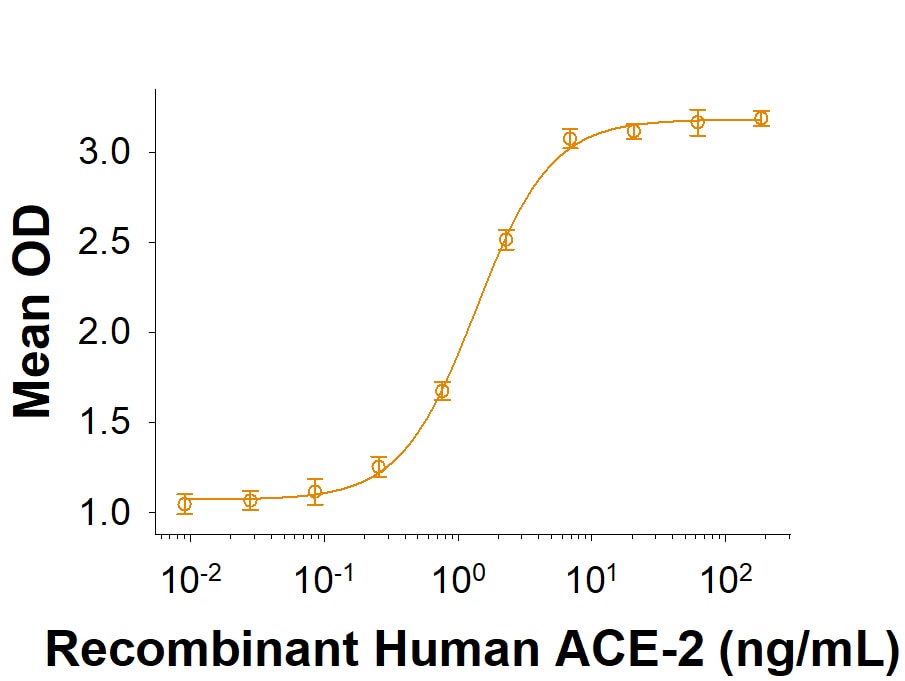
Recombinant SARS-CoV-2 Spike RBD mFc Chimera Protein Binding Activity.
Recombinant SARS-CoV-2 Spike RBD mFc Chimera (Catalog # 10657-CV) binds Recombinant Human ACE-2 His-tag (933-ZN) in a functional ELISA.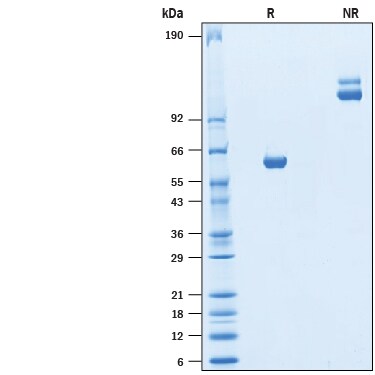
Recombinant SARS-CoV-2 Spike RBD mFc Chimera Protein SDS-PAGE.
2 μg/lane of Recombinant SARS-CoV-2 Spike RBD mFc Chimera Protein, CF (Catalog # 10657-CV) was resolved with SDS-PAGE under reducing (R) and non-reducing (NR) conditions and visualized by Coomassie® Blue staining, showing bands at 55-65 kDa and 110-130 kDa, respectively.Formulation, Preparation, and Storage
10657-CV
| Formulation | Lyophilized from a 0.2 μm filtered solution in PBS with Trehalose. |
| Reconstitution | Reconstitute at 500 μg/mL in PBS. |
| Shipping | The product is shipped at ambient temperature. Upon receipt, store it immediately at the temperature recommended below. |
| Stability & Storage | Use a manual defrost freezer and avoid repeated freeze-thaw cycles.
|
Calculators
Background: Spike RBD
References
- Wu, F. et al. (2020) Nature 579:265.
- Tortorici, M.A. and D. Veesler (2019). Adv. Virus Res. 105:93.
- Bosch, B.J. et al. (2003). J. Virol. 77:8801.
- Belouzard, S. et al. (2009) Proc. Natl. Acad. Sci. 106:5871.
- Millet, J.K. and G. R. Whittaker (2015) Virus Res. 202:120.
- Li, W. et al. (2003) Nature 426:450.
- Wong, S.K. et al. (2004) J. Biol. Chem. 279:3197.
- Jiang, S. et al. (2020) Trends. Immunol. https://doi.org/10.1016/j.it.2020.03.007.
- Ortega, J.T. et al. (2020) EXCLI J. 19:410.
- Wrapp, D. et al. (2020) Science 367:1260.
- Tai, W. et al. (2020) Cell. Mol. Immunol. https://doi.org/10.1016/j.it.2020.03.007.1
- Okba, N. M. A. et al. (2020). Emerg. Infect. Dis. https://doi.org/10.3201/eid2607.200841.
Long Name
Spike Receptor Binding Domain
Gene Symbol
S
UniProt
Additional Spike RBD Products
Product Documents for Recombinant SARS-CoV-2 Spike RBD mFc Chimera Protein, CF
Certificate of Analysis
To download a Certificate of Analysis, please enter a lot or batch number in the search box below.
Note: Certificate of Analysis not available for kit components.
Product Specific Notices for Recombinant SARS-CoV-2 Spike RBD mFc Chimera Protein, CF
For research use only
Related Research Areas
Citations for Recombinant SARS-CoV-2 Spike RBD mFc Chimera Protein, CF
 Powered by Bioz
Customer Reviews for Recombinant SARS-CoV-2 Spike RBD mFc Chimera Protein, CF
There are currently no reviews for this product. Be the first to review Recombinant SARS-CoV-2 Spike RBD mFc Chimera Protein, CF and earn rewards!
Have you used Recombinant SARS-CoV-2 Spike RBD mFc Chimera Protein, CF?
Submit a review and receive an Amazon gift card!
$25/€18/£15/$25CAN/¥2500 for a review with an image
$10/€7/£6/$10CAN/¥1110 for a review without an image
Submit a review
Loading...